Parking Puzzle Games: Plan Routes, Fuel and Car Order
On this page
Parking puzzle games can ask you to solve very different problems. You might remove cars from a crowded lot, decide which vehicle moves first, draw routes into colored bays, or count every square of fuel. Another game may put you behind the wheel and ask for careful steering. Choosing by the picture of a car alone can therefore lead you to the wrong challenge.
This collection groups six Zigzigo games by the decision each one asks you to make. The selection uses their catalog descriptions and control guides. It is a comparison of mechanics, rather than a popularity ranking or a claim that one game is universally hardest. Read the current opening instructions when you launch a game, because interfaces and available controls can change.
Parking puzzle games: choose the problem you want to solve
| Game | Main task | Choose it for |
|---|---|---|
| Parking Solution | Remove cars from a packed lot | Finding an available exit |
| Car Parking Order | Send cars to marked spaces | Sequencing moves |
| Parking Journey Car Puzzle | Draw routes to matching bays | Planning with a countdown |
| Car Escape Parking | Slide cars forward or backward | Clearing a blocked route |
| Picky Parking | Spend fuel and satisfy grid rules | Combining several constraints |
| Park the Cars | Steer into a parking space | Vehicle positioning |
Removing traffic: Parking Solution and Car Escape Parking
Parking Solution asks you to empty a crowded lot by swiping cars toward the road. Begin with a vehicle that has room to leave, then examine what its departure frees. The useful question is not simply which car can move, but which departure creates another available departure. Its catalog also lists a speedrun mode; leave that for a time when you want faster decisions rather than treating speed as the purpose of every attempt.
Car Escape Parking instead describes sliding cars forward and backward to create a safe escape path. A car may need to move temporarily rather than leave immediately. Before dragging, identify the blocked route and the vehicle occupying it. Then check whether moving that blocker creates a new obstruction elsewhere. This is the more relevant choice when you enjoy rearranging a jam instead of repeatedly selecting the next clear exit.
Arriving in order: Car Parking Order
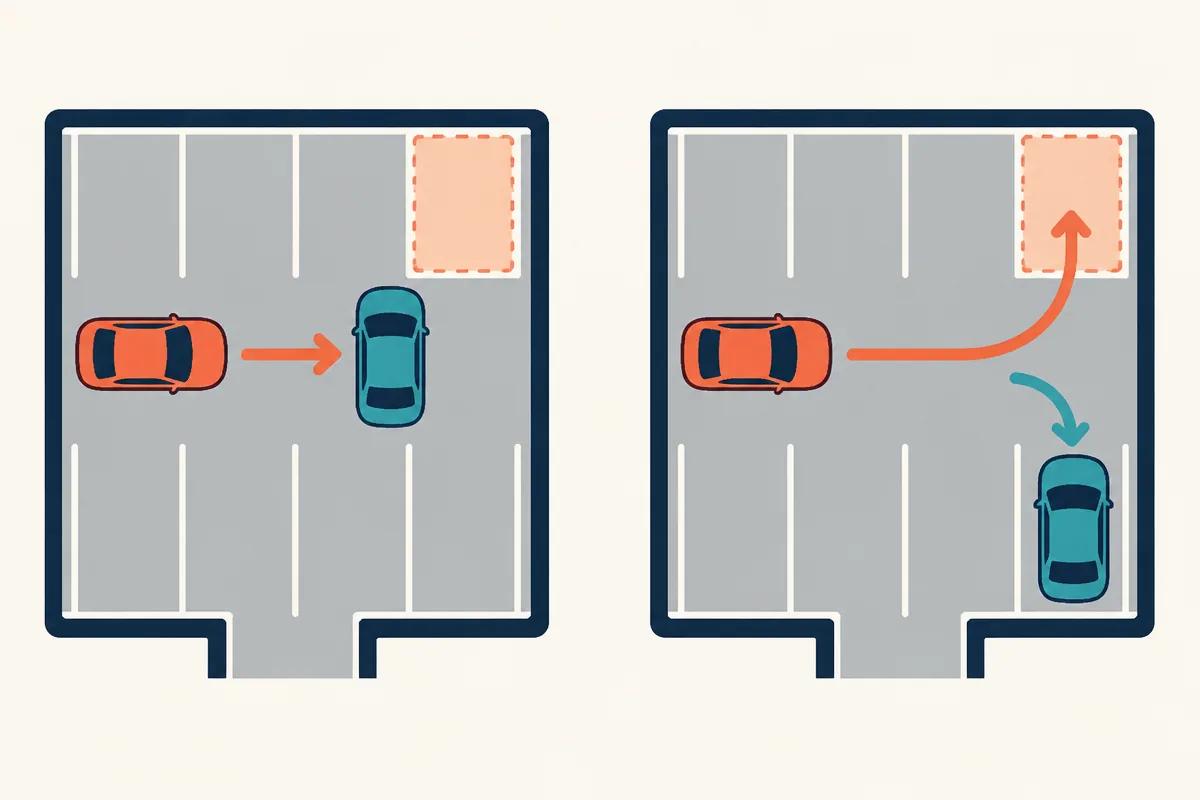
Conceptual move-order diagram, not a solution to a level in any listed game.
In Car Parking Order, every car needs its marked spot. That changes the meaning of progress: a parked vehicle can still be a problem if its final position blocks somebody else's route. Trace the path for each destination before committing to a sequence. If one car must pass through an area another will occupy, consider the passing car first.
The catalog advises checking vehicle characteristics and roadblocks, so do not assume every car behaves identically. Its exact mouse and touch mappings are labeled as suggested in the guide; check the displayed interface before relying on a particular gesture. Choose this game for the order-of-operations problem, especially when you prefer reaching destinations to clearing the entire board.
Drawing routes: Parking Journey Car Puzzle
Parking Journey Car Puzzle gives you route drawing and color-matched parking bays. Select or hold a car, draw its route, and use spare space to reposition blockers. The guide explicitly includes a countdown, making this a different choice from a puzzle you select specifically to avoid time pressure.
A practical opening is to match every car to its destination, then reserve a temporary space before filling it. An apparently tidy early arrival may remove the only room available to shift another car. The guide lists Undo and assistance options, but the underlying planning problem remains useful without treating those options as a guaranteed solution. Prefer this pick when drawing a path is part of the appeal, alongside deciding the order.
Counting fuel: Picky Parking
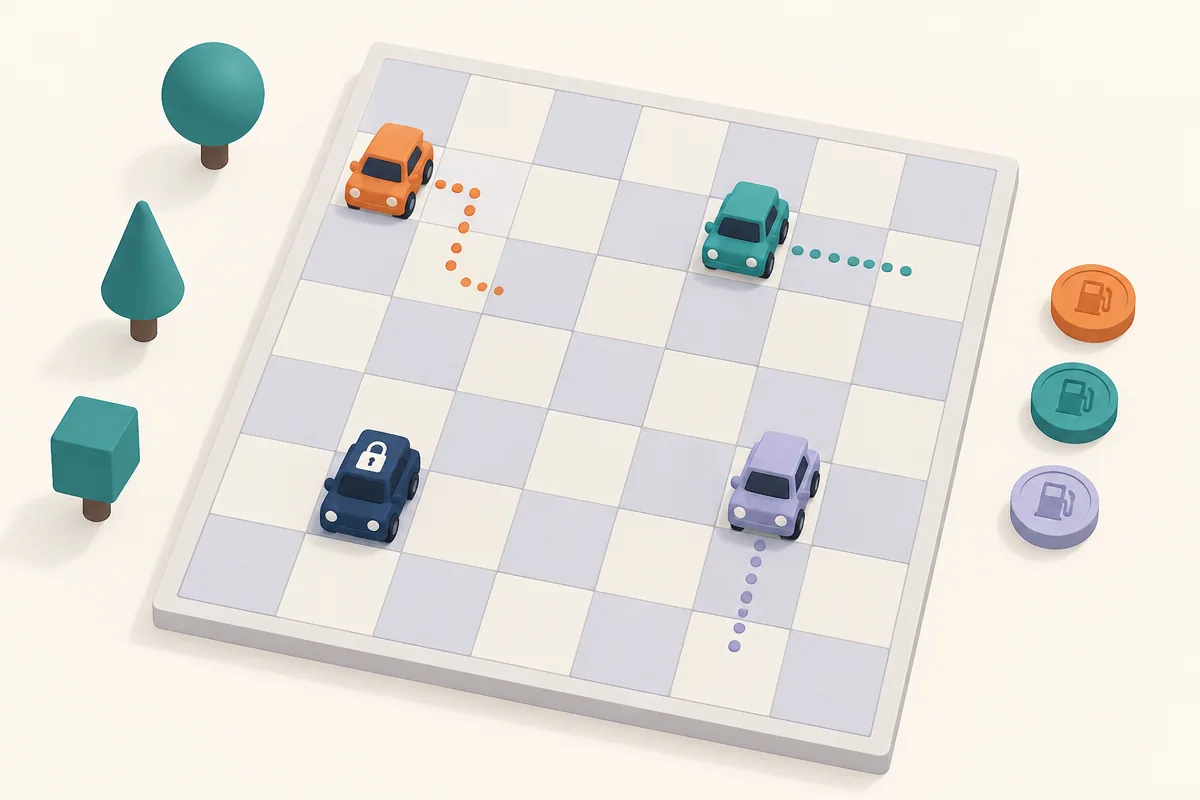
Conceptual illustration of fuel, spacing and fixed-car constraints; not a Picky Parking screenshot or solved level.
Picky Parking has the most explicit rule combination in this selection. Each square traveled spends one fuel. A completed puzzle uses all the cars' fuel, places exactly one car in each row and column, and keeps cars apart, including diagonally. Locked cars cannot move. Merely reaching an empty-looking space is therefore insufficient.
Check the final arrangement first: which rows and columns already contain an immovable car, and which nearby squares would violate the separation rule? Next compare a candidate destination with the available fuel. A move can be legal by distance yet leave an impossible final arrangement. The guide documents dragging or selecting a car and destination, plus desktop shortcuts including Z for undo and R for reset. Returning a car to its start also rewinds later moves, so inspect the result carefully.
Steering rather than sliding: Park the Cars
Park the Cars belongs in this comparison because it helps define the boundary of a parking puzzle. Its catalog describes driving through tight gaps and obstacles, using arrow keys to steer on desktop. Your plan must account for the approach and final alignment, then you have to carry out that approach with the vehicle.
Choose it when you want execution as well as route selection. If your main interest is moving pieces around a static lot, start with one of the earlier entries instead. For the driving version, inspect the narrowest gap before moving and approach the parking space slowly enough to make corrections. The catalog does not establish that these games reproduce real driving, so treat the control challenge as a game mechanic.
A planning routine that respects each game's rules
First state the win condition: empty the lot, reach assigned bays, or satisfy the entire grid. Second locate the bottleneck and ask what must happen before it opens. Third protect any temporary space that another move will need. Finally check special constraints such as fuel, diagonal separation, vehicle direction, and the countdown. This routine gives you a reason for each move while still allowing the six games to demand different solutions.
Related tags
Frequently asked questions
Which parking game focuses on move order?
Car Parking Order is directly about sending cars to their marked spaces without one blocking another. Parking Solution also rewards sequencing, but its objective is to empty the lot.
Which game includes a timer?
Parking Journey Car Puzzle explicitly includes a countdown in its guide. Parking Solution lists a separate speedrun mode. The catalog does not provide a complete timer audit of every other entry.
How is Picky Parking different from an ordinary traffic jam puzzle?
You must use all available fuel, finish with one car per row and column, and keep cars apart even diagonally. Locked cars add fixed constraints to that final arrangement.
Do all these games use arrow keys?
No. Park the Cars lists desktop arrow-key steering. Other entries describe swiping, dragging, route drawing or selecting cars. Picky Parking also documents keyboard shortcuts. Check the individual game guide.
Why can parking a car early be a mistake?
Its destination may occupy a route or temporary space another car still needs. Before completing that move, check whether any remaining vehicle must cross the same area.
Are these games real driving lessons?
This comparison covers their puzzle and control mechanics. It does not assess real vehicle handling, road rules or driver training. Sliding cars on a grid is particularly different from steering a vehicle.
Try a parking puzzle built around move order
Play Car Parking OrderMore puzzle guides
 Puzzle
Shelf Sorting Games: Free Items Without Blocking More
Compare three shelf sorters by item access, triple formation and timers. Check what a placement exposes before covering another needed product.
 Puzzle
Cube Rotation Puzzles: Track Faces as the View Changes
Compare a colour-faced rolling cube, a die with a hidden bottom face and arrows viewed from new angles. Distinguish object orientation from camera rotation.
 Puzzle
Jigsaw Puzzle Games: Compare Pieces, Shards and Stickers
Compare jigsaw pieces, picture shards and numbered stickers. Choose whether you want visual fitting, fragment assembly or keyed placement.
 Puzzle
Word Game Hints: Choose the Right Clue When You Stall
Choose word-game help after identifying the missing information. Compare one-letter hints, fragment guidance and whole-category reveals across three games.