Jigsaw Puzzle Games: Compare Pieces, Shards and Stickers
On this page
Picture assembly in jigsaw puzzle games can ask you to match an edge, rebuild a shard cluster or follow a numbered outline. These tasks share the pleasure of a finished image, but they provide different evidence about where a piece belongs. Choose the kind of uncertainty you want to solve.
Jigsaw puzzle games: identify the evidence that places each piece
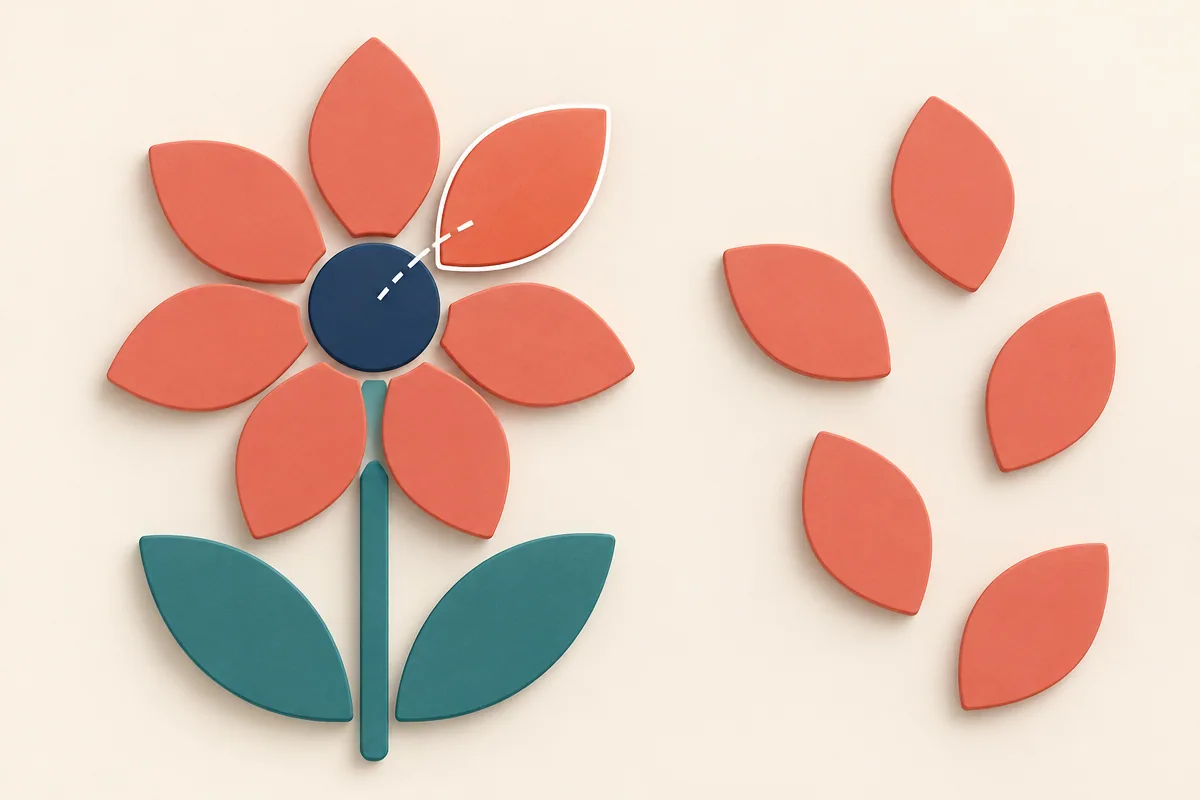
Illustration: Among same-colour petals, one outer contour and its link to the centre settle the placement.
Puzzlebot offers pictures at several difficulty levels. Assemble every piece and use zoom to inspect fine details. Its hint shows where some pieces belong, while speed is part of the challenge. A higher difficulty changes the assembly problem, not merely the decorative picture.
Poly Art reconstructs images from clusters of shards. Drag fragments into position and work through the picture's segments. Distinctive colour boundaries and the continuation of a shape can matter more than a familiar jigsaw tab.
Sticker Art Book Puzzle supplies numbered areas and stickers that match both number and outline. It gives an explicit key, so the job is accurate placement rather than guessing a whole image from loose fragments alone.
Use a feature that survives scale changes
When zoomed in, a tiny texture may appear informative but occur in several places. Look for a boundary between colours, the corner of an object or a uniquely shaped edge. Then zoom out to test whether the placement agrees with the larger picture.
In an invented flower image, several petals may share the same shade. Their relation to the central disc and outer outline distinguishes them. In a sticker puzzle, the number and exact contour provide additional checks; a similar shade is insufficient.
Choose help for the actual uncertainty
If the image is hard to read, zoom can help without supplying a solution. If a particular Puzzlebot piece remains impossible to place, its partial hint may provide a reference. For stickers, inspect the number and shape before assuming the puzzle needs a broad reveal.
Keep the known region intact while examining a neighbouring segment. A piece that seems to fit locally should still continue the image coherently. Do not confuse the absence of obvious gaps with a verified complete picture.
Choose Puzzlebot for piece-by-piece assembly with a time element, Poly Art for reconstructing fragmented artwork, and Sticker Art Book for keyed outlines. The best first anchor is the one whose visual evidence is distinctive enough to explain, rather than whichever piece is closest to the centre.
Related tags
Frequently asked questions
Does every assembly game use jigsaw tabs?
No. Poly Art uses image shards, while Sticker Art Book follows numbered outlines and matching shapes.
What should a sticker match?
Both its assigned number and the outline of the destination area.
Does zoom reveal the solution?
It improves inspection, but you still need evidence that the piece belongs at that position.
What does Puzzlebot’s hint show?
Its guide describes revealing destinations for some pieces rather than assembling the entire picture.
Why compare a close-up with the full image?
A local texture may fit several areas; the wider object boundary can confirm or contradict it.
Which pick explicitly values speed?
Puzzlebot includes finishing quickly as part of its challenge.
Try the mechanic that interests you
Play PuzzlebotMore puzzle guides
 Puzzle
Shelf Sorting Games: Free Items Without Blocking More
Compare three shelf sorters by item access, triple formation and timers. Check what a placement exposes before covering another needed product.
 Puzzle
Cube Rotation Puzzles: Track Faces as the View Changes
Compare a colour-faced rolling cube, a die with a hidden bottom face and arrows viewed from new angles. Distinguish object orientation from camera rotation.
 Puzzle
Word Game Hints: Choose the Right Clue When You Stall
Choose word-game help after identifying the missing information. Compare one-letter hints, fragment guidance and whole-category reveals across three games.
 Puzzle
Block Placement Games: Leave Room for Awkward Shapes
Compare TenTrix, Blocks Puzzle and DD Blocky. Preserve connected empty regions and inspect both rows and columns before placing the next shape.