Block Placement Games: Leave Room for Awkward Shapes
On this page
Ten empty cells do not help equally if they are scattered into isolated holes. A large piece needs a connected region in the correct shape. Block placement games therefore reward seeing the negative space as carefully as the blocks already on the board.
Compare three line-clearing games by how you inspect pieces and future fit. The goal is to create useful empty regions while completing lines, rather than filling the nearest gap every time.
Block placement games: count the shape, not just the cells
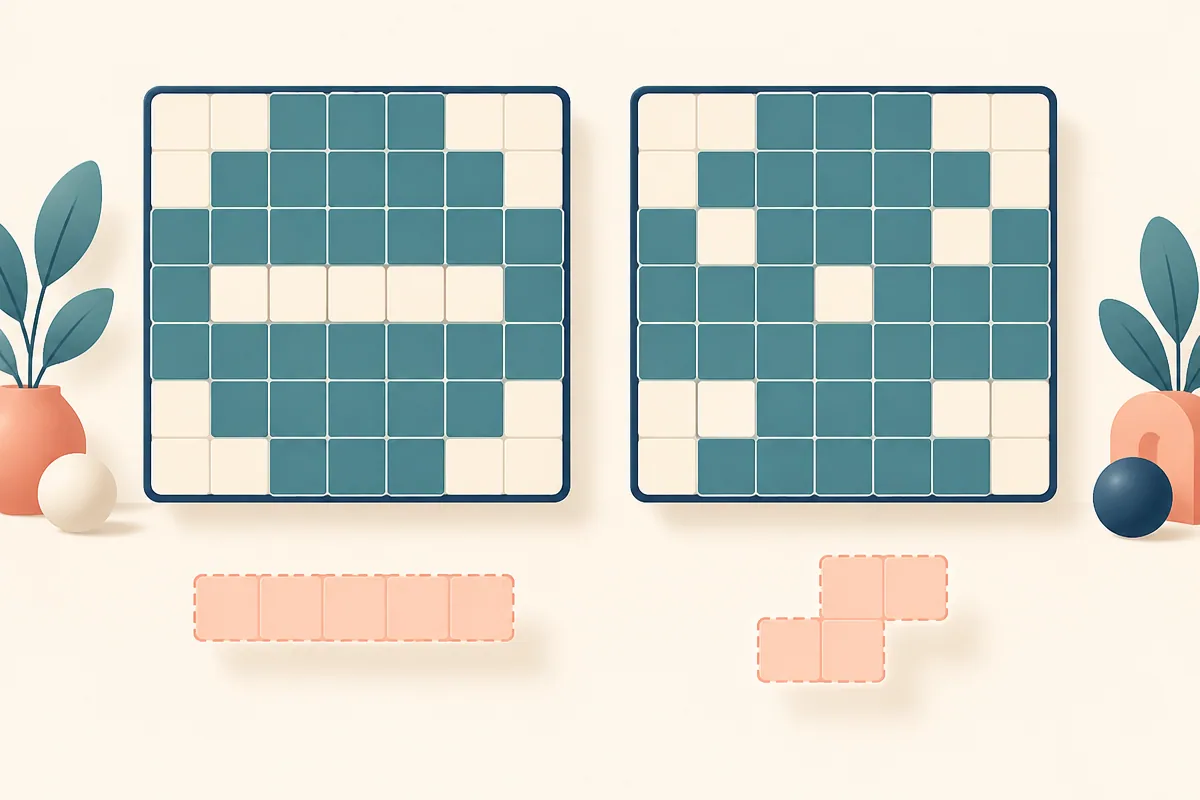
Illustration: Equal amounts of empty space, but only the unbroken strip can take the long ghosted piece.
TenTrix provides a tray of three shapes on a ten-by-ten grid. The pieces cannot be rotated. Each must fit exactly in the offered orientation, and complete rows or columns clear. Check all visible shapes before using a space that only one of them can occupy.
Blocks Puzzle drags shaped pieces onto a board to complete lines and earn points. Every placement changes the contours of the remaining gaps. A small line clear can be useful if it opens a broad area instead of merely producing another narrow pocket.
DD Blocky likewise clears rows and columns. Its run ends when the remaining space cannot accommodate the blocks. A shape can affect both a row and a column, so inspect the crossing line before deciding a placement is unproductive.
Protect a destination for the awkward piece
If the tray includes a wide shape, identify its possible homes before placing a flexible small square. The square may fit almost anywhere; the wide piece cannot. This does not establish a fixed rule to play the largest piece first. It means preserving the option that would otherwise disappear.
In an invented board, several single-cell gaps total six empty spaces but cannot accept a long bar. A connected strip of four cells might be more valuable even though it contains fewer total spaces. Evaluate geometry instead of adding emptiness numerically.
Look for clears that change the board meaningfully
Before committing, inspect which rows and columns will be completed and what region those clears expose. Sometimes a placement prepares both directions and leaves more options. Sometimes it nearly finishes a line but creates a hole with no plausible way to fill it.
Do not assume rotation exists because a piece resembles a familiar falling-block shape. TenTrix explicitly forbids it; use its actual orientation. For the other games, inspect the controls rather than inventing an ability not described by the guide.
Choose TenTrix for planning around fixed tray orientations, Blocks Puzzle for straightforward shaped placement, and DD Blocky for managing increasingly constrained remaining space. Your next move should leave somewhere for another real shape, not merely make the board look densely organized.
Related tags
Frequently asked questions
Can TenTrix shapes rotate?
No. Its guide explicitly says pieces must be placed in their offered orientation.
Why can many empty cells still be unusable?
They may be isolated or shaped incorrectly for the remaining pieces.
Should the smallest piece fill any available hole?
First check whether that hole is part of the only destination for a less flexible shape.
What ends DD Blocky?
The run ends when the remaining spaces cannot accommodate the blocks.
Why inspect a crossing column?
A placement can prepare or clear more than one direction, changing its value beyond the nearest row.
Does this imply always placing large shapes first?
No. Preserve scarce fitting options and evaluate the actual tray and board rather than follow a fixed size order.
Try the mechanic that interests you
Play TenTrixMore puzzle guides
 Puzzle
Shelf Sorting Games: Free Items Without Blocking More
Compare three shelf sorters by item access, triple formation and timers. Check what a placement exposes before covering another needed product.
 Puzzle
Cube Rotation Puzzles: Track Faces as the View Changes
Compare a colour-faced rolling cube, a die with a hidden bottom face and arrows viewed from new angles. Distinguish object orientation from camera rotation.
 Puzzle
Jigsaw Puzzle Games: Compare Pieces, Shards and Stickers
Compare jigsaw pieces, picture shards and numbered stickers. Choose whether you want visual fitting, fragment assembly or keyed placement.
 Puzzle
Word Game Hints: Choose the Right Clue When You Stall
Choose word-game help after identifying the missing information. Compare one-letter hints, fragment guidance and whole-category reveals across three games.