Cube Rotation Puzzles: Track Faces as the View Changes
On this page
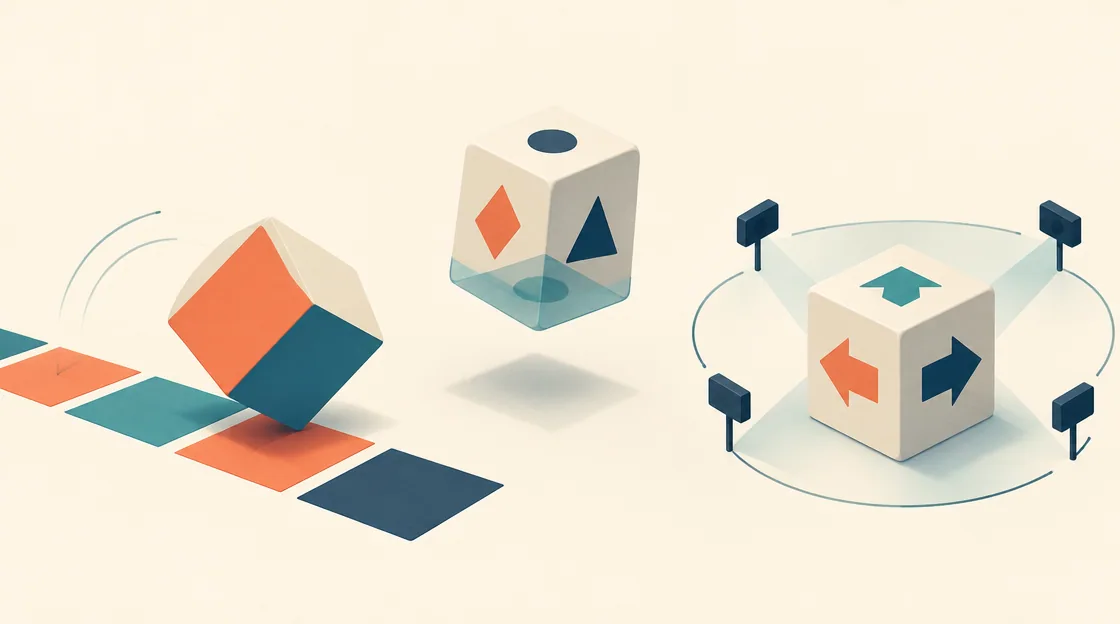
A cube can turn because you moved it across the board or because you rotated the camera around it. In cube rotation puzzles, those actions change different information. Confusing them makes a coloured face or arrow seem to behave unpredictably.
Changing the view is different from rolling the object
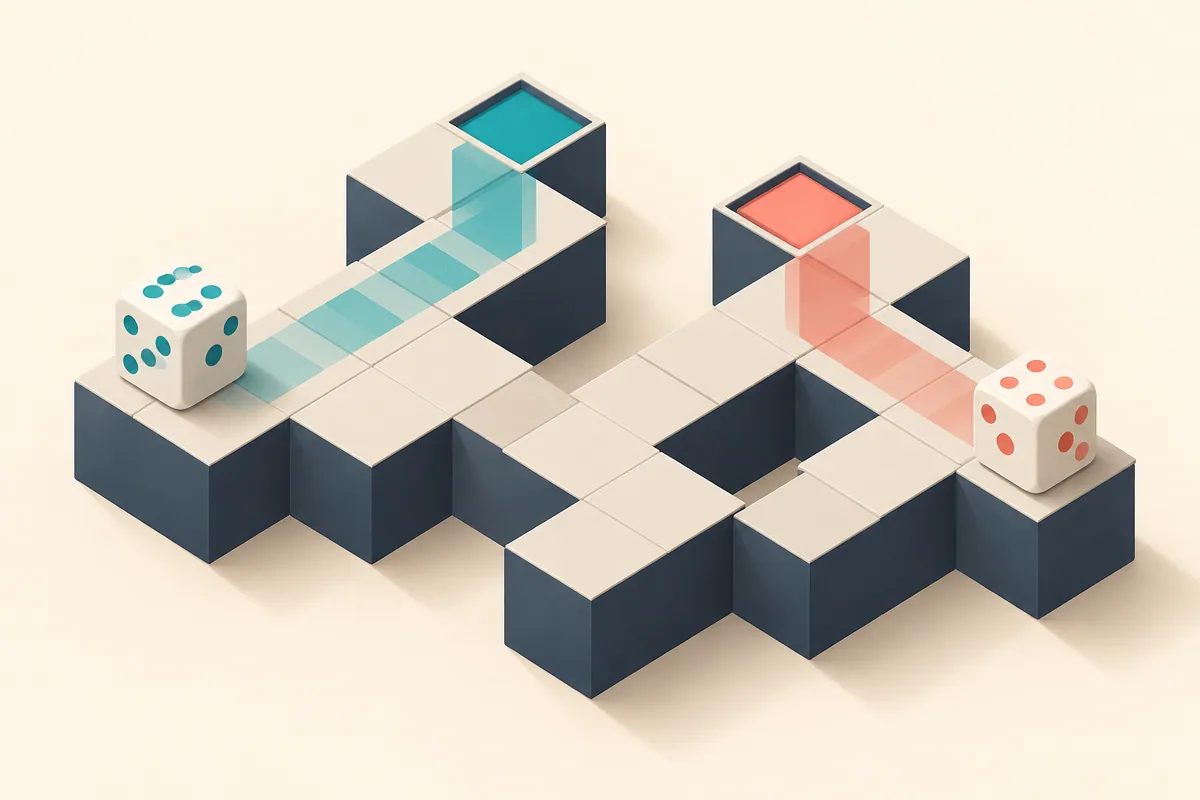
Illustration: Two roll trails end on matching squares, yet a different coloured face lands underneath each time.
Bloxorz: Color Block Roll rolls a cube one cell at a time. The face landing underneath must match the tile colour. Each roll changes which face points down, so the route controls both position and orientation.
Seven Down uses the die face touching the ground as its effective number. Opposite faces total seven, letting you infer the hidden bottom from the visible top. Its Puzzle, Action and Maze modes add different route and movement conditions.
Arrow Cube 3D rotates the viewpoint so you can inspect departure paths on six faces. The purpose of rotating is to reveal blockers and exits, rather than roll a face onto a board tile.
Cube rotation puzzles: track the state that the next move changes
For Bloxorz, follow the coloured face through each proposed roll. A tile can be reachable in position but wrong in orientation. For Seven Down, read the visible top and determine the bottom, then consider how the next roll changes it. For Arrow Cube, trace the object's actual directions after the new view reveals another face.
An invented route might reach a target square in two ways. Both arrive at the same location, but the sequence of rolls can leave a different face underneath. A shorter path is not automatically legal if its final orientation fails the landing condition.
Use a deliberate checkpoint before special tiles
Bloxorz includes moving, rotating and teleporting platforms. Inspect the destination's surrounding colours before entering a teleport rather than considering arrival alone. Seven Down's Action mode can continue rolling while a key is held, so a brief press can matter near hazards. Those are implementation-specific movement rules worth checking before a long input.
If you lose track, rotate the camera to inspect what is visible, but do not assume looking from another angle has altered the die's physical state. Recover the object's orientation from the actual faces and rules.
Choose Bloxorz for matching the landing face, Seven Down for hidden-face route planning, or Arrow Cube for viewpoint-based inspection. State whether your next action changes the object, its position or only what you can see.
Related tags
Frequently asked questions
What must match a Bloxorz landing tile?
The cube face that ends up underneath must match its colour.
How can Seven Down’s bottom be inferred?
Subtract the visible top face from seven, using the die’s opposite-face relationship.
Does rotating Arrow Cube’s view roll it onto a target?
No. It reveals other faces and paths for removal planning.
Can two routes reach the same square differently?
Yes. Their roll sequences can leave different faces pointing down.
Why use brief Seven Down Action inputs?
Its guide says held keys keep rolling in Action, which can matter beside hazards.
What should I inspect before a teleport?
The destination and its surrounding landing requirements, not just the source tile.
Try the mechanic that interests you
Play Bloxorz: Color Block RollMore puzzle guides
 Puzzle
Shelf Sorting Games: Free Items Without Blocking More
Compare three shelf sorters by item access, triple formation and timers. Check what a placement exposes before covering another needed product.
 Puzzle
Jigsaw Puzzle Games: Compare Pieces, Shards and Stickers
Compare jigsaw pieces, picture shards and numbered stickers. Choose whether you want visual fitting, fragment assembly or keyed placement.
 Puzzle
Word Game Hints: Choose the Right Clue When You Stall
Choose word-game help after identifying the missing information. Compare one-letter hints, fragment guidance and whole-category reveals across three games.
 Puzzle
Block Placement Games: Leave Room for Awkward Shapes
Compare TenTrix, Blocks Puzzle and DD Blocky. Preserve connected empty regions and inspect both rows and columns before placing the next shape.