Crossword Games: Clues, Fragments and Letter Pools
On this page
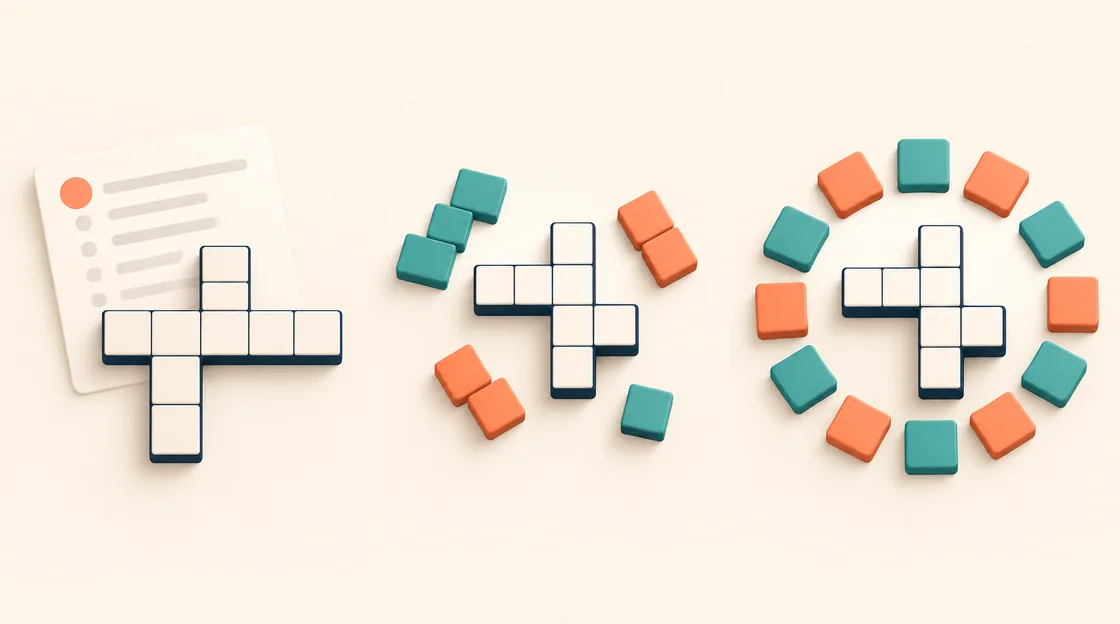
In crossword games, one layout can hide three very different tasks. You may answer a written clue, join fragments that already contain letters, or build an answer from a supplied pool. The same crossing shape does not mean you should approach every game by typing a definition-based answer.
Choose the kind of evidence you like working with. A traditional clue invites vocabulary and interpretation. A fragment puzzle adds spatial fit. A letter-pool game reduces the alphabet available for each candidate but still requires finding the right words.
The grid stays familiar while the evidence changes
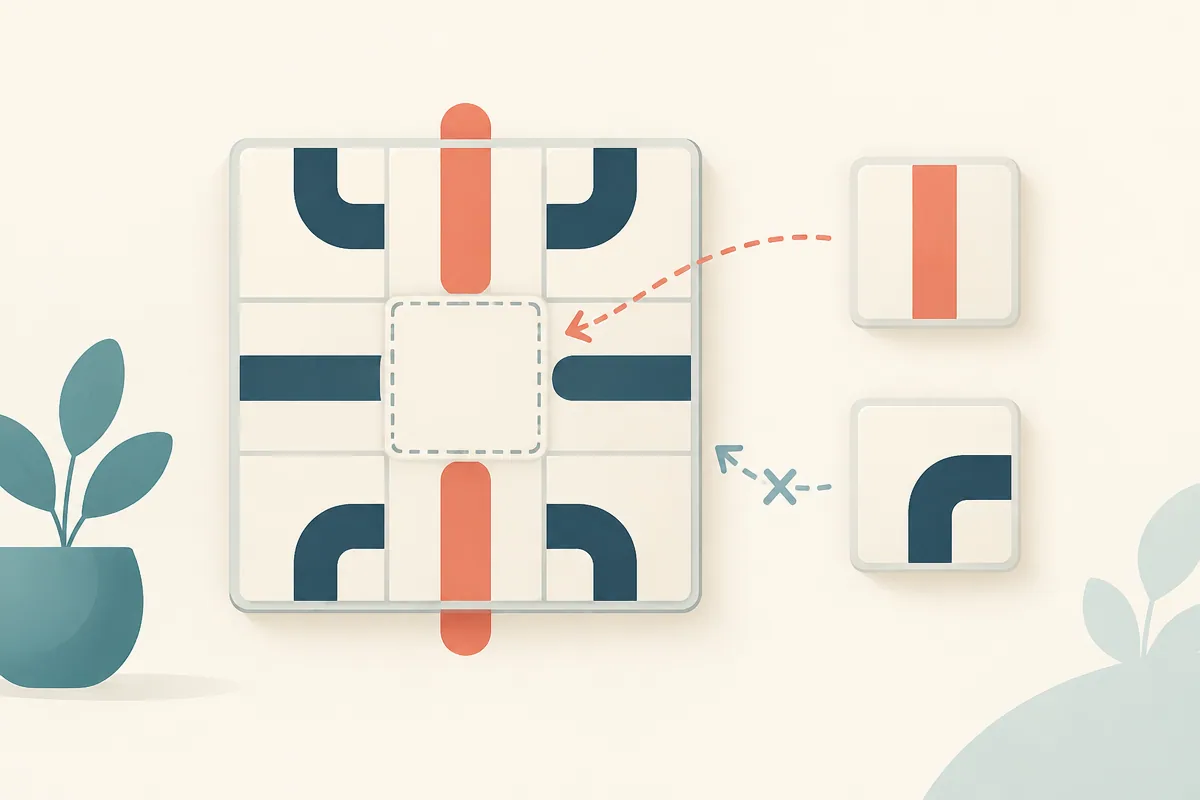
Illustration: Only one of two pale fragments lines up with the vertical crossing, so the other is ruled out.
Crosswords: Big Collection supplies a clue for each answer. Select cells and enter letters; completed answers contribute crossings to other words. When one clue is unfamiliar, another nearby clue can create a useful entry point.
CrossTile begins with a themed crossword broken into fragments. Dragging correct neighbours together makes them snap into a group that moves as one. The letters are already represented in the pieces, so the question is how they connect, not which key to type next.
Word Cross provides a set of letters and asks you to link them into answers that populate the crossword. Look at gap lengths and fixed crossing letters before building candidates. The pool narrows possible spelling, while the grid narrows where a word can belong.
Choose an anchor you can explain
In the clue collection, begin with an answer supported by a clear clue rather than a word that merely fits the number of cells. Once entered, use its crossing letter to test another answer. If that crossing creates a contradiction, reconsider the uncertain entry instead of inventing an increasingly strange second answer.
In CrossTile, a small secure connection can become the anchor. Inspect both the horizontal continuation and any vertical crossing. A fragment that finishes one plausible word might still prevent a crossing from forming. Build outward from a group with several supported connections, not simply the physically largest piece.
In Word Cross, compare candidate lengths first. If a five-cell gap includes a confirmed middle letter, use both constraints together. Listing unrelated words from the pool may uncover bonuses or accepted answers, but it does not necessarily solve the remaining opening.
Diagnose a stalled crossword
Ask whether you lack meaning, position or spelling. Meaning suggests trying another clue, considering another sense of a word or using a revealing hint. Position suggests inspecting fragment intersections. Spelling suggests checking the supplied letters and repeated-letter requirements.
For an invented example, a word fragment ending in a common suffix could fit several answers. A vertical crossing distinguishes them. Guessing the full word from the suffix alone is weaker than using the intersection. That principle applies across the three games even though the actual inputs differ.
Crossword games: pick the experience you want
Choose the traditional collection to interpret independent clues. Choose CrossTile to assemble visible evidence into a spatial whole. Choose Word Cross to discover words within a constrained letter set. Your strongest opening is the one supported by the evidence the particular game provides, and your next move should add another constraint instead of merely fill empty space.
Related tags
Frequently asked questions
Which game is closest to a traditional crossword?
Crosswords: Big Collection provides individual written clues and a grid where you enter answers letter by letter.
Do I type answers in CrossTile?
Its described mechanic is dragging existing letter fragments together. Correct connections snap into movable groups.
What does the Word Cross letter pool change?
It limits the letters available for constructing answers. Gap lengths and crossings provide additional constraints.
Why revisit a completed answer?
If it creates a conflict with a strongly supported crossing, the earlier answer may have been a plausible but incorrect interpretation.
Is the largest fragment always the best anchor?
Not necessarily. Prefer a group with clear word continuations and useful intersections, rather than size alone.
How can I choose a hint?
Identify whether the missing evidence concerns a word’s meaning, a letter position or the relationship between fragments.
Try the mechanic that interests you
Play Crosswords: Big CollectionMore puzzle guides
 Puzzle
Shelf Sorting Games: Free Items Without Blocking More
Compare three shelf sorters by item access, triple formation and timers. Check what a placement exposes before covering another needed product.
 Puzzle
Cube Rotation Puzzles: Track Faces as the View Changes
Compare a colour-faced rolling cube, a die with a hidden bottom face and arrows viewed from new angles. Distinguish object orientation from camera rotation.
 Puzzle
Jigsaw Puzzle Games: Compare Pieces, Shards and Stickers
Compare jigsaw pieces, picture shards and numbered stickers. Choose whether you want visual fitting, fragment assembly or keyed placement.
 Puzzle
Word Game Hints: Choose the Right Clue When You Stall
Choose word-game help after identifying the missing information. Compare one-letter hints, fragment guidance and whole-category reveals across three games.