Board Duel Games: Plan Lines, Captures and Hidden Shots
On this page
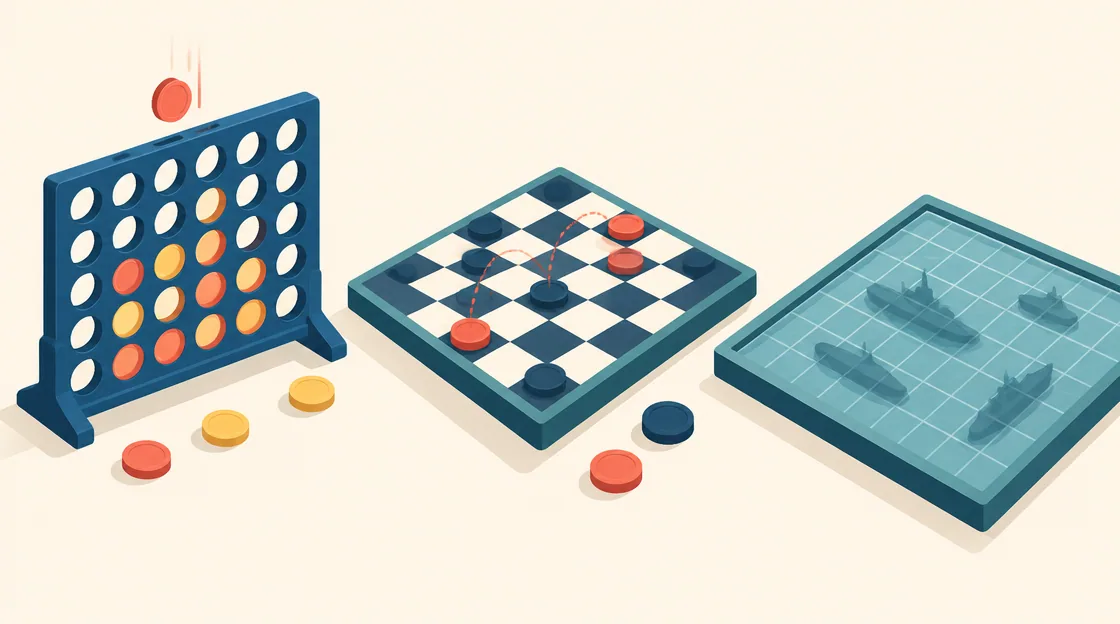
Turn-based board duel games give you time to think, but the information available can differ dramatically. A falling-disc board shows both players' pieces. Checkers shows possible captures and replies. Battleship conceals the target fleet, so an apparently empty square may be unknown rather than safe.
Choose the kind of prediction you enjoy: lines, exchanges or search. Each game asks you to take the opponent seriously, but not in the same way.
Board duel games: know which information the opponent can hide
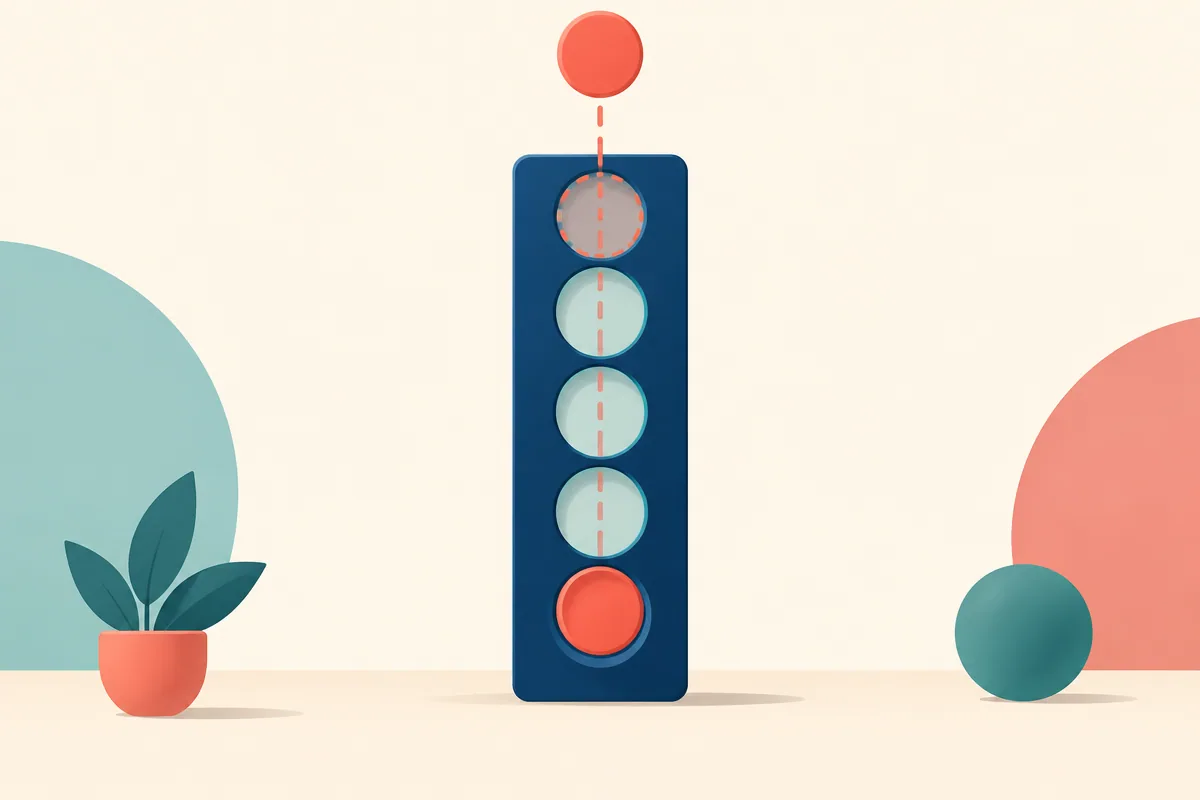
Illustration: Aimed at a higher square, the disc still drops to the lowest open cell in its column.
Connect 4 drops a disc to the lowest empty cell in a chosen column. Four in a horizontal, vertical or diagonal line wins. You choose a column, not an arbitrary square, so a threat above empty space may need supporting discs before it becomes playable.
Master Checkers Multiplayer moves diagonally and captures by jumping. The goal is to remove the opponent's pieces or leave no legal move. A capture can improve material while exposing the capturing piece to a reply.
TRZ Battleship alternates single shots at hidden enemy positions. Each shot either hits a ship or rules out a square. The match ends when one fleet is sunk, so information gathering is part of the race rather than a separate preliminary stage.
Evaluate your move and the reply
In Connect 4, inspect your own immediate line and the opponent's next drop. A visually promising diagonal is less urgent than a directly playable winning threat. In checkers, follow a proposed capture through the reply before assuming that taking a piece is a free gain.
In Battleship, distinguish a known miss from an untested square. Repeating an already resolved shot provides no new location information. After a hit, use the current board and revealed evidence to guide the next target rather than firing randomly around every direction without a reason.
A hypothetical two-front problem
Imagine a Connect 4 column that extends your line while permitting the opponent to complete a different line immediately. The local gain is not enough. Likewise, a checkers move can reach an attractive square while leaving the rest of your position vulnerable. A useful turn needs to account for the other side's strongest response.
The exact legal capture obligations and setup options belong to each game's current rules. Do not import a variant rule merely because the board is familiar.
Choose Connect 4 for gravity-supported alignment, checkers for visible captures and mobility, or Battleship for progressively revealing a hidden fleet. Ask what each turn improves: a threat, a defence, a useful exchange or the quality of your information.
Related tags
Frequently asked questions
Can Connect 4 place a disc in any empty cell?
No. It falls to the lowest available cell of the selected column.
What lines count in Connect 4?
Horizontal, vertical and diagonal groups of four of your discs.
Can checkers win without capturing the last piece?
Its guide also counts leaving the opponent with no legal move as a win.
What does a Battleship miss provide?
It rules out that target square and should inform future shots.
Why inspect an opponent’s reply?
A local improvement may allow an immediate loss or an unfavourable exchange.
Are all traditional variant rules assumed here?
No. Follow the selected title’s current legal moves and instructions.
Try the mechanic that interests you
Play Connect 4More puzzle guides
 Puzzle
Shelf Sorting Games: Free Items Without Blocking More
Compare three shelf sorters by item access, triple formation and timers. Check what a placement exposes before covering another needed product.
 Puzzle
Cube Rotation Puzzles: Track Faces as the View Changes
Compare a colour-faced rolling cube, a die with a hidden bottom face and arrows viewed from new angles. Distinguish object orientation from camera rotation.
 Puzzle
Jigsaw Puzzle Games: Compare Pieces, Shards and Stickers
Compare jigsaw pieces, picture shards and numbered stickers. Choose whether you want visual fitting, fragment assembly or keyed placement.
 Puzzle
Word Game Hints: Choose the Right Clue When You Stall
Choose word-game help after identifying the missing information. Compare one-letter hints, fragment guidance and whole-category reveals across three games.