Cryptogram Puzzles: Use Partial Words as Your Evidence
On this page
In cryptogram puzzles, a half-visible phrase can make a familiar answer leap to mind. That recognition is useful, but it can also make you stop checking. If you force the rest of a puzzle to match a quote or word you expect, an early mistaken assumption can spread through every remaining choice.
The stronger approach is to ask what the puzzle has actually confirmed. A revealed letter, a rejected keyboard choice and a crossing answer are different kinds of evidence. Comparing three formats helps you use each without assuming the games share the same substitution rules or penalties.
Three ways a partial answer becomes evidence
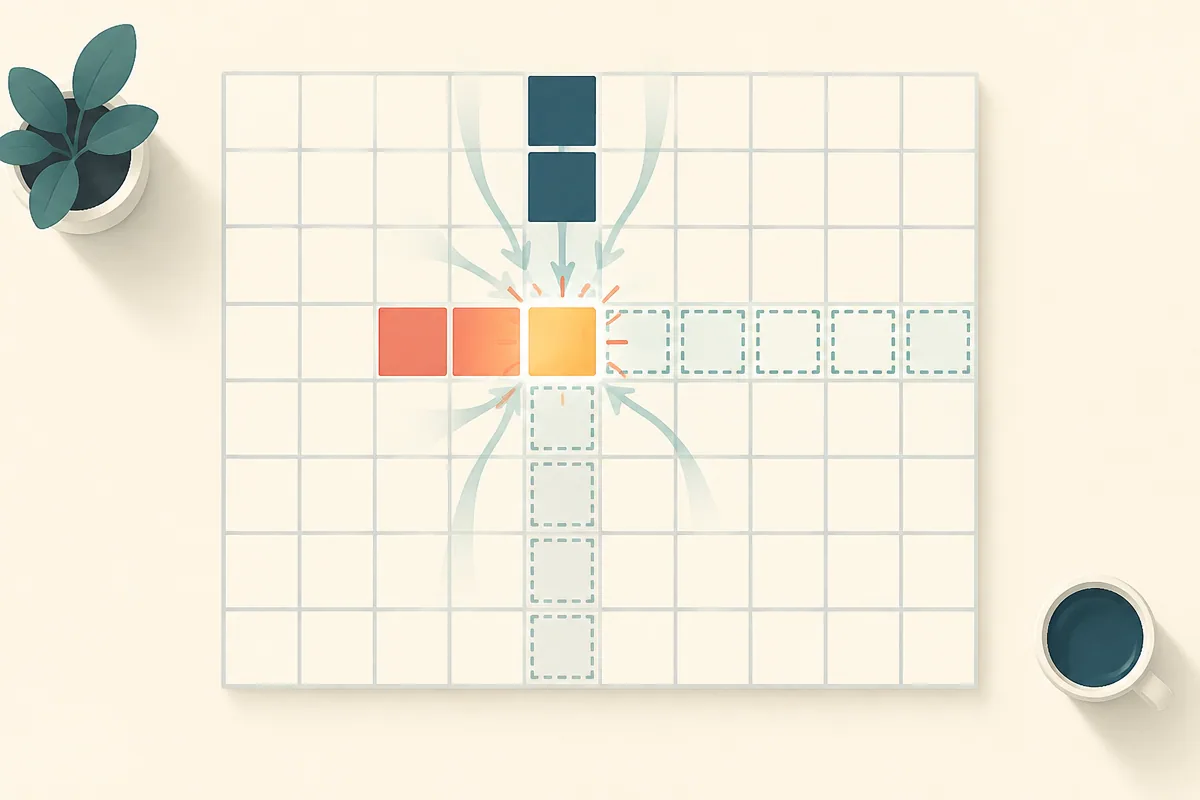
Illustration: Where two finished runs cross a longer blank one, the shared square narrows its candidates.
Cryptograms: Secret Text reveals a coded phrase gradually as you work out hidden letters. Themes include areas such as literature and film, and mistakes are tracked. Use the visible word structure and meaning together before committing a letter. A thematic guess that contradicts nearby completed text needs reconsideration.
Decode the Movie Quote uses on-screen keyboard feedback. Red marks a letter absent from the quote, yellow means that letter still has positions to fill, and dark means none remain. Selecting a yellow letter highlights its locations. Those states provide information that is more reliable than repeatedly guessing a famous line from memory.
Crosswords: Big Collection gives an independent clue for each answer. Solving a crossing word supplies a letter that can narrow a different clue. This creates a way out when the first answer does not come to mind: work on another clue rather than adding more guesses to the same one.
Keep confirmed letters separate from expectations
Imagine an invented phrase where you recognize a three-letter word and expect a familiar quotation. Write that expectation mentally as a candidate, then compare each known letter and word length with it. If one position disagrees, either your remembered quote is different or the candidate is wrong. Do not treat familiarity as confirmation.
In a crossword, a conflicting crossing can mean either answer needs review. Prefer the answer supported by a clear clue and several checked crossings over one filled from a vague association. In a phrase puzzle, reread the grammar around the uncertain space before cycling through visually similar letters.
Spend a hint on a useful uncertainty
A letter in a heavily constrained short word can reveal more than a letter in an isolated long blank. In Crosswords: Big Collection, the hint reveals one letter, so consider which unresolved answer connects to the largest useful part of the grid. In a phrase game, one strategically placed letter may distinguish two plausible readings.
Before using help in Decode the Movie Quote, exhaust the information already provided by keyboard states. Reusing an absent red letter adds no information. A yellow key may locate exactly the missing evidence you were about to spend a hint to obtain.
Cryptogram puzzles: pick the route to certainty you prefer
Choose Cryptograms: Secret Text for gradually uncovering a phrase, Decode the Movie Quote for recognition combined with keyboard feedback, or the crossword collection for independent clues that support each other. In each, the useful habit is to let confirmed information constrain the candidate, then revise the candidate when the evidence disagrees.
Related tags
Frequently asked questions
Does this comparison assume identical cipher rules?
No. Follow each game’s displayed rules; the shared method is checking partial text against confirmed evidence.
What does a red movie-quote key mean?
Its guide describes red as a letter that does not appear in the quote, so repeating it cannot fill a tile.
What information does a yellow key provide?
It marks a letter with positions still to fill. Selecting it highlights where that letter belongs.
Why switch to another crossword clue?
A solved crossing can supply a letter for the stalled answer, creating new evidence without forcing a guess.
Where is a letter hint most useful?
Consider a position that distinguishes plausible answers or supports several crossings, rather than choosing an isolated blank at random.
What if I recognize a quote but the letters disagree?
Treat recognition as provisional. Check every visible letter and word length instead of forcing the puzzle into the remembered wording.
Try the mechanic that interests you
Play Cryptograms: Secret TextMore puzzle guides
 Puzzle
Shelf Sorting Games: Free Items Without Blocking More
Compare three shelf sorters by item access, triple formation and timers. Check what a placement exposes before covering another needed product.
 Puzzle
Cube Rotation Puzzles: Track Faces as the View Changes
Compare a colour-faced rolling cube, a die with a hidden bottom face and arrows viewed from new angles. Distinguish object orientation from camera rotation.
 Puzzle
Jigsaw Puzzle Games: Compare Pieces, Shards and Stickers
Compare jigsaw pieces, picture shards and numbered stickers. Choose whether you want visual fitting, fragment assembly or keyed placement.
 Puzzle
Word Game Hints: Choose the Right Clue When You Stall
Choose word-game help after identifying the missing information. Compare one-letter hints, fragment guidance and whole-category reveals across three games.