Word Games with Themes: Narrow the Search Sensibly

On this page
A theme narrows the vocabulary of a word puzzle, but word games with themes do not always tell you the exact job. Sometimes you must discover which words the clue suggests. Sometimes all the words are visible and you must assign them to groups. Sometimes a supplied list already names every required answer.
Before thinking of more related vocabulary, identify which of those structures you are playing. Otherwise you may brainstorm words when you should inspect the path, or search letter tiles when the actual task is to classify a complete word.
Word games with themes: a clue, a destination or a list
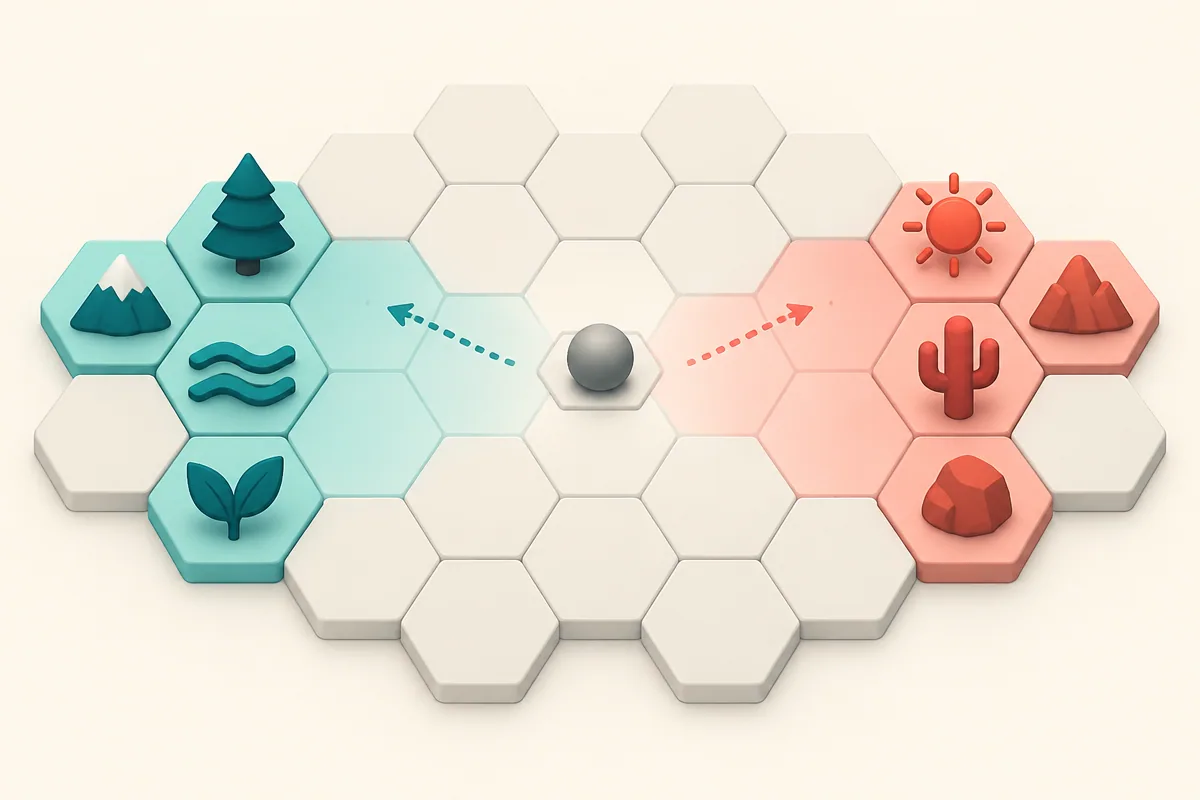
Illustration: With the obvious members placed on a hex board, one undecided token has fewer homes left.
Word Finder supplies a clue that points toward a set of related words. Trace them through the letter tiles; completed words alter the board shape. The theme suggests candidate answers, while the current arrangement determines whether you can select them now.
Hexa Word puts whole words on a hex-shaped board and shows themed groups above it. Select a group and assign the words that belong there. It is not a letter-search puzzle despite its title and geometry. The main uncertainty is overlapping meaning, because one visible word may appear to suit two groups.
Cooking Letters - Word Search provides a list and lets you connect letters horizontally, vertically, diagonally or in zigzag paths. The kitchen presentation gives context, but the displayed target words and path rules are the direct evidence for completing the level.
Avoid making the theme narrower than the puzzle
If the clue says nature, do not assume it means only animals. Plants, places and processes could also be relevant. The actual letters and accepted answers determine which interpretation belongs to the current puzzle. A broad theme should start a search, not become an invented restriction.
In Hexa Word, compare the ambiguous word with every displayed group. The obvious members help define how broad each category is. Assigning those first leaves fewer plausible homes for uncertain terms. Wrong choices bounce back according to its guide, allowing feedback without a countdown, but random selection still teaches less than testing a specific relationship.
Change the right part of your search
Imagine a hypothetical list that contains a familiar five-letter word you cannot locate. In Cooking Letters, try a turning route instead of inventing an alternative target. If Word Finder accepts one answer and reshapes the tiles, inspect the changed board before retrying another. If Hexa Word rejects a term from one group, reconsider its meaning in relation to the remaining categories.
Those are different responses to different kinds of feedback. A shuffle may refresh the appearance of a board, while a theme clue changes what answer you are seeking. Treat them as separate sources of help.
Choose the amount of vocabulary uncertainty
Word Finder suits interpreting a clue and locating related words. Hexa Word suits classifying words already in view. Cooking Letters suits searching for known targets using flexible paths. Pick the format in which the uncertainty itself appeals to you, then use the theme alongside the actual completion rule.
Related tags
Frequently asked questions
Does Hexa Word ask me to trace individual letters?
No. Its guide describes assigning whole word tiles to themed groups. The hexagonal layout does not make it a spelling-path game.
What does the clue do in Word Finder?
It suggests the related set of required words. You still need to locate valid paths through the current tiles.
Can Cooking Letters words turn corners?
Yes. Its guide permits zigzag connections in addition to horizontal, vertical and diagonal paths.
Should a broad theme be read narrowly?
Avoid inventing restrictions. Use visible words, letters and acceptance feedback to learn the intended scope.
What should I do with an ambiguous Hexa Word tile?
Place clear members first and compare the remaining word against all possible groups before choosing.
Why recheck after solving Word Finder?
Every completed word shifts the remaining tiles, so a candidate route may change even though the clue remains.
Try the mechanic that interests you
Play Hexa WordMore puzzle guides
 Puzzle
Shelf Sorting Games: Free Items Without Blocking More
Compare three shelf sorters by item access, triple formation and timers. Check what a placement exposes before covering another needed product.
 Puzzle
Cube Rotation Puzzles: Track Faces as the View Changes
Compare a colour-faced rolling cube, a die with a hidden bottom face and arrows viewed from new angles. Distinguish object orientation from camera rotation.
 Puzzle
Jigsaw Puzzle Games: Compare Pieces, Shards and Stickers
Compare jigsaw pieces, picture shards and numbered stickers. Choose whether you want visual fitting, fragment assembly or keyed placement.
 Puzzle
Word Game Hints: Choose the Right Clue When You Stall
Choose word-game help after identifying the missing information. Compare one-letter hints, fragment guidance and whole-category reveals across three games.