Similar Symbols in Games: Notice the Deciding Detail
On this page
Remembering a king is incomplete when the answer grid contains several suits. Remembering red is incomplete when several red shapes appear. With similar symbols in games, the useful unit of recall is the whole identity required by the selection, not the first feature that catches your attention.
Three sequence games demonstrate this problem without changing the basic job of watching, retaining and selecting. The key improvement is precision in what you encode.
Similar symbols in games: remember the feature that tells them apart
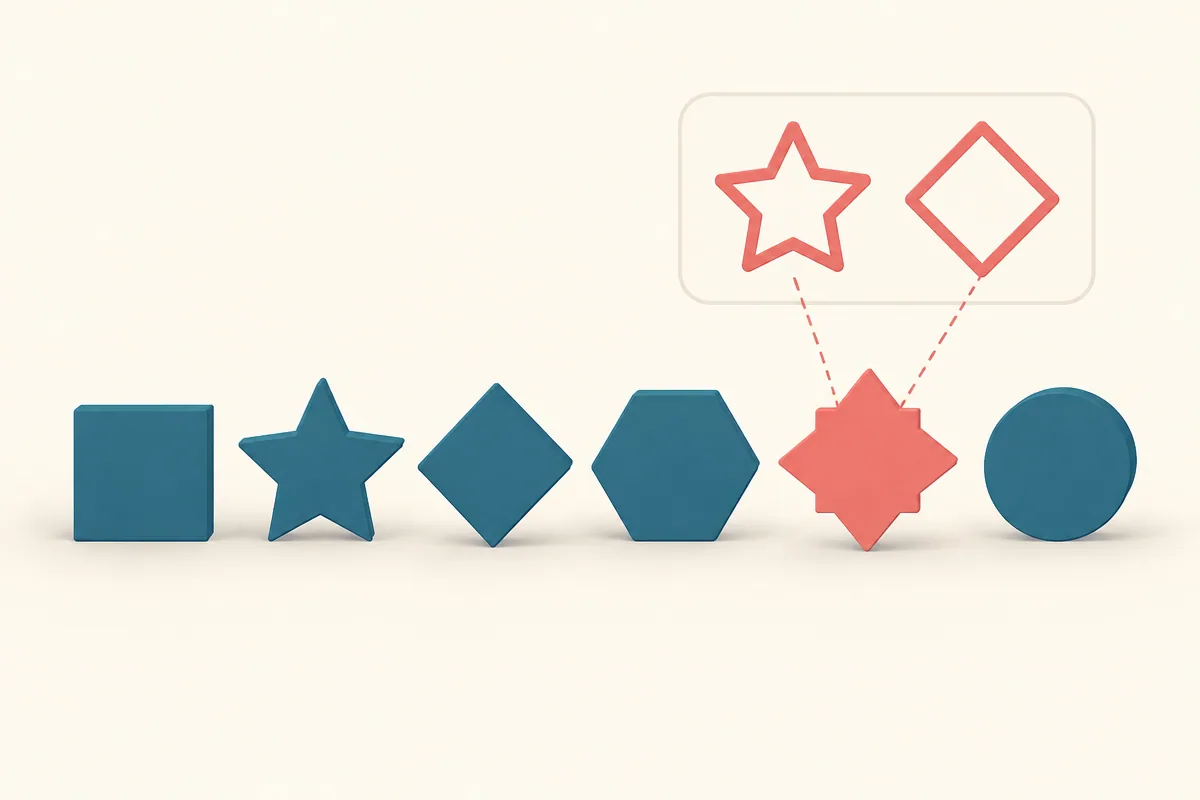
Illustration: In a row of same-colour shapes, an inset enlarges two outlines that colour alone cannot separate.
Memory Cards shows playing cards with their names, then asks for the same sequence from a rank-sorted grid. Retain both rank and suit. The sorted choices help you find the rank but cannot recover a suit you did not remember.
Kobadoo Shapes captions each preview with colour and form. Its answer board contains several shapes per colour, so red square and red parallelogram are different targets. Remembering the caption as a compound description uses the distinction the game itself supplies.
Kobadoo Emojis includes lookalikes such as different monkey gestures. The answer grid reshuffles, making the identity more important than a previously observed location. Use a short name that includes the distinguishing action rather than the generic animal alone.
Use complete but economical labels
A label should contain enough information to select uniquely without becoming an elaborate description that you cannot retain. Four of clubs, orange hexagon and ears-covered monkey each identify the relevant distinction more efficiently than a vague category.
For longer sequences, keep those complete labels in small ordered groups. Do not shorten them so far that suit, colour or gesture disappears. Also keep the original order separate from the order of the answer grid.
Diagnose which part was lost
After an error, ask whether you forgot the item, its distinguishing attribute or its sequence position. If you recall a red shape but not its form, improve the preview label. If you recall the complete shape but choose it too early, order is the issue. If you know the target but select a neighbour, slow the final comparison.
In an invented sequence of two red shapes, merely saying red-red records almost nothing useful. Saying red square then red star preserves the attribute that distinguishes the choices. This demonstrates a naming method rather than a real preview.
Choose among the three by the symbol set you enjoy. The shared practical rule is to remember exactly what would separate the right choice from its nearest distractor.
Related tags
Frequently asked questions
Why is rank alone insufficient in Memory Cards?
Several suits can share a rank, so the answer requires both parts of the card’s identity.
What should a shape label include?
The form and colour shown in the preview, such as orange hexagon.
Why avoid generic emoji names?
A grid can contain lookalikes with different gestures or details.
Does a sorted grid preserve the preview order?
No. It helps locate choices; the required answer order comes from the preview.
How do I distinguish a recall error from a misclick?
Ask whether you knew the complete target before selecting. If you did, improve the final visual check.
Must labels be long?
No. They should be short but include the feature that uniquely distinguishes the alternatives.
Try the mechanic that interests you
Play Memory CardsMore puzzle guides
 Puzzle
Shelf Sorting Games: Free Items Without Blocking More
Compare three shelf sorters by item access, triple formation and timers. Check what a placement exposes before covering another needed product.
 Puzzle
Cube Rotation Puzzles: Track Faces as the View Changes
Compare a colour-faced rolling cube, a die with a hidden bottom face and arrows viewed from new angles. Distinguish object orientation from camera rotation.
 Puzzle
Jigsaw Puzzle Games: Compare Pieces, Shards and Stickers
Compare jigsaw pieces, picture shards and numbered stickers. Choose whether you want visual fitting, fragment assembly or keyed placement.
 Puzzle
Word Game Hints: Choose the Right Clue When You Stall
Choose word-game help after identifying the missing information. Compare one-letter hints, fragment guidance and whole-category reveals across three games.