Push Puzzle Games: Preserve Access Behind Each Object
On this page
In push puzzle games, a target may be visible and a path may seem open, yet the action can still be impossible because you cannot reach the right side of the object. Spatial puzzles often require a route for the acting piece as well as the thing you want to move.
Push puzzle games: the route for the worker matters too
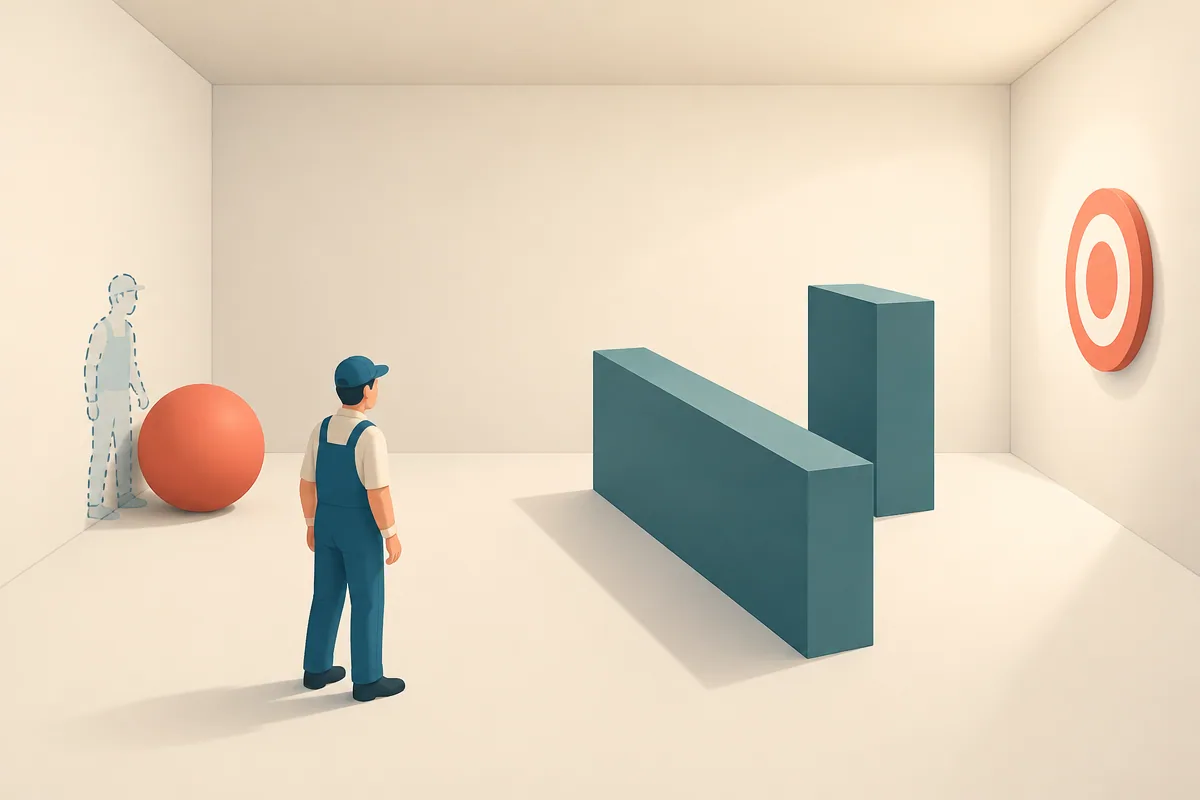
Illustration: The ball sits close to its target, yet the wall leaves no room to stand behind it.
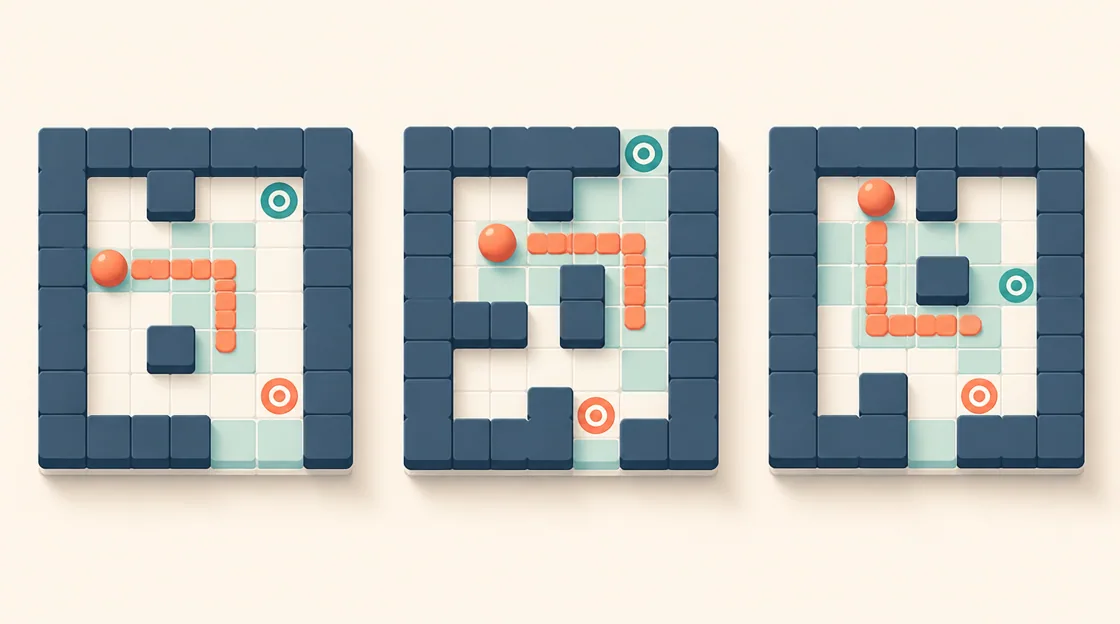
Sokoballs pushes balls onto floor switches. The character needs access behind a ball to push it in the desired direction. A ball against an unsuitable wall can become a dead end even when its switch remains nearby. Its restart input is useful after identifying such a mistake.
Monster Go connects matching endpoints with paths that cannot cross or overlap. Here there is no pushing character, but every connection consumes working space for the other pairs. Filling the whole field is additionally required for the full three-star result.
Worms collects every dot before reaching the exit. Its body occupies the trail behind the head, so your own progress can remove a return corridor. A route open at the start may be closed when you reach it later.
Preserve the next action's approach
Before pushing a ball, identify the square from which the character must make the next push. Before drawing a path, identify the corridor another pair must use. Before moving the worm, identify where its body will lie when the head returns.
In an invented Sokoballs position, pushing a ball into a corner without a switch can remove all useful pushing directions. The object has moved, but the worker no longer has access to recover it. Do not assume a pulling action exists when only pushing is established.
Separate reaching from finishing
Monster Go can connect a pair while leaving insufficient room for the others or unfilled space that affects its stars. Worms can approach the exit before collecting the final dot. Sokoballs can place one ball while blocking access for another. Local arrival is not the whole objective.
Plan backward from the most constrained destination. Which approach must remain clear, and what would occupy it too early? Follow those dependencies until you find a sensible first move.
Choose Sokoballs for pushing access, Monster Go for shared-board path allocation or Worms for managing your own occupied trail. The transferable check is not simply whether an object can get there, but whether the whole sequence retains the space it needs.
Related tags
Frequently asked questions
Why can a Sokoballs ball become unrecoverable?
A wall or corner can prevent the character from reaching the side needed for the next push.
Does this assume balls can be pulled?
No. Plan using the pushing mechanic described by the guide.
Can Monster Go paths overlap?
No. Each pair needs its own noncrossing, nonoverlapping path.
What extra goal earns full Monster Go stars?
Its guide requires the lines to fill the entire field for the full three-star result.
Why can a Worms route close behind me?
The body occupies tiles behind the head and can block a return corridor.
Where should I start planning?
Inspect the most constrained destination and preserve the approach needed to finish it.
Try the mechanic that interests you
Play SokoballsMore puzzle guides
 Puzzle
Shelf Sorting Games: Free Items Without Blocking More
Compare three shelf sorters by item access, triple formation and timers. Check what a placement exposes before covering another needed product.
 Puzzle
Cube Rotation Puzzles: Track Faces as the View Changes
Compare a colour-faced rolling cube, a die with a hidden bottom face and arrows viewed from new angles. Distinguish object orientation from camera rotation.
 Puzzle
Jigsaw Puzzle Games: Compare Pieces, Shards and Stickers
Compare jigsaw pieces, picture shards and numbered stickers. Choose whether you want visual fitting, fragment assembly or keyed placement.
 Puzzle
Word Game Hints: Choose the Right Clue When You Stall
Choose word-game help after identifying the missing information. Compare one-letter hints, fragment guidance and whole-category reveals across three games.