Noncrossing Path Puzzles: Give Every Pair Enough Room
On this page
Lines in noncrossing path puzzles can represent routes, physical ropes or required graph connections. A crossing that invalidates one puzzle may not be the stated issue in another. Before drawing or dragging, identify what the line means and which relationship the rules prohibit.
Not every line puzzle forbids the same thing
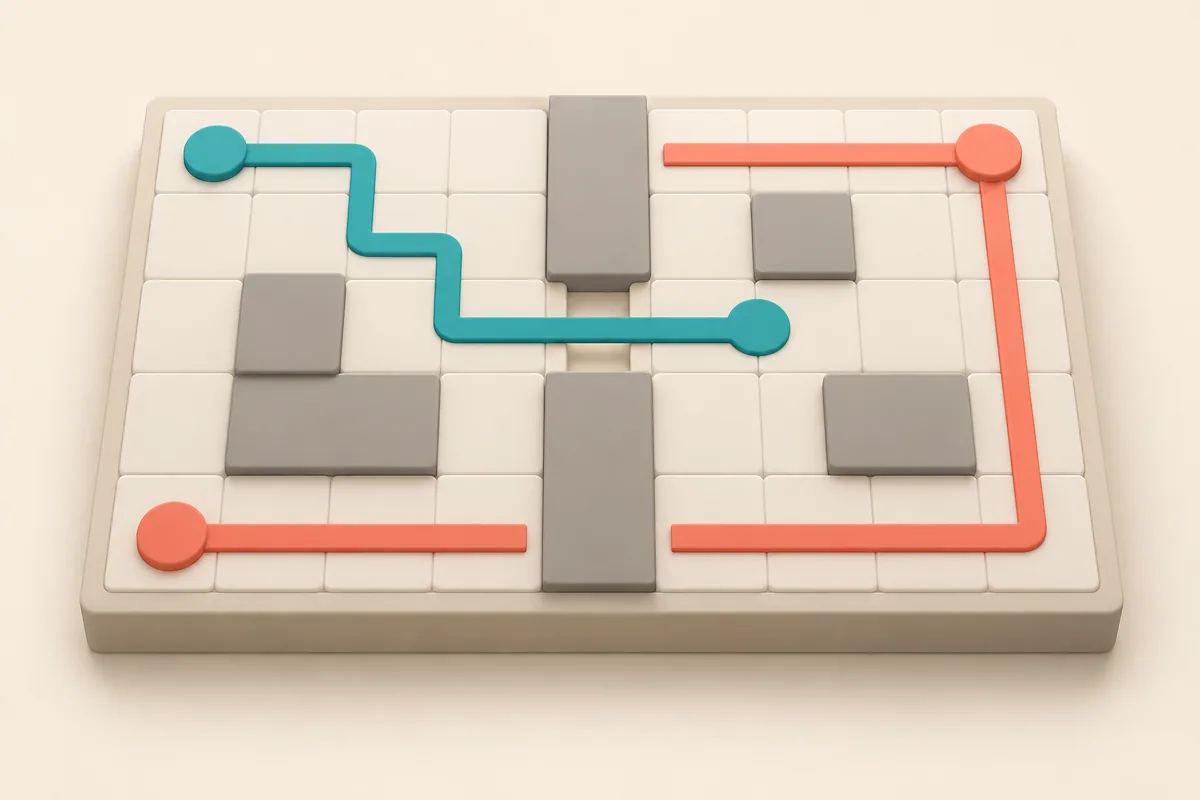
Illustration: One pair keeps the narrow central passage, so the other must swing around on a wide detour.
Monster Go links matching endpoints through a grid without crossing or overlapping paths. Full-field coverage earns the complete star result. The shortest connection for one pair can consume the corridor another pair needs.
Twisted Rope 3D repositions ropes to undo knots without creating new ones. The issue is their spatial entanglement, not merely drawing a flat grid path. Inspect the selected rope's relation to the others through the whole movement.
3D Dots requires an exact number of lines at each numbered point. Green indicates a satisfied count, while a wrong red line can be removed. Its described check is connection correctness and count; do not invent Monster Go's grid-coverage rule for it.
Noncrossing path puzzles: reserve room where choices are few
In Monster Go, endpoints near edges or narrow regions may have fewer plausible routes. Plan those restrictions before giving a flexible pair a direct line through the centre. In a rope tangle, choose a repositioning that releases a crossing while preserving room for another strand. In 3D Dots, inspect points with nearly satisfied counts and rotate to reveal hidden neighbours.
Imagine an invented board where two pairs need the same one-cell corridor. One route must take a detour or the arrangement must be reconsidered. Connecting the first pair quickly does not establish that the rest can be completed.
Reassess the whole network after a change
A new line consumes cells in Monster Go, changes a knot relationship in Twisted Rope and increases endpoint counts in 3D Dots. Check the affected constraints immediately. If the new state contradicts the rules, revise it before building more assumptions on top.
Do not assume a line that looks like a crossing in a projection physically intersects in three dimensions. Rotate the view where available to understand the spatial relationship rather than guessing from the front silhouette.
Choose Monster Go for nonoverlapping grid routes, Twisted Rope for spatial untangling or 3D Dots for exact connections that reveal a model. The useful line is justified by the actual puzzle's meaning, not by a rule imported from another line game.
Related tags
Frequently asked questions
Must Monster Go routes avoid overlap?
Yes. Its paired paths cannot cross or overlap.
Does 3D Dots require filling every grid cell?
That is not its described task. It satisfies point connection counts to reveal a model.
What makes a Twisted Rope move successful?
It loosens the tangle without creating another knot.
Why inspect constrained endpoints first?
They may have fewer available routes, while more flexible pairs can take a detour.
Can a front-view line crossing be misleading?
Yes. In three dimensions lines may be separated in depth; rotate to inspect the relationship.
What should follow a new connection?
Recheck the routes, knots or endpoint counts that it changes.
Try the mechanic that interests you
Play Monster GoMore puzzle guides
 Puzzle
Shelf Sorting Games: Free Items Without Blocking More
Compare three shelf sorters by item access, triple formation and timers. Check what a placement exposes before covering another needed product.
 Puzzle
Cube Rotation Puzzles: Track Faces as the View Changes
Compare a colour-faced rolling cube, a die with a hidden bottom face and arrows viewed from new angles. Distinguish object orientation from camera rotation.
 Puzzle
Jigsaw Puzzle Games: Compare Pieces, Shards and Stickers
Compare jigsaw pieces, picture shards and numbered stickers. Choose whether you want visual fitting, fragment assembly or keyed placement.
 Puzzle
Word Game Hints: Choose the Right Clue When You Stall
Choose word-game help after identifying the missing information. Compare one-letter hints, fragment guidance and whole-category reveals across three games.