
Layered Sorting Puzzles: Reveal What Lies Underneath
On this page
Layered sorting puzzles reward looking beyond the colour on top. Clearing that layer may reveal a useful partner, but it can also expose a different pattern in an awkward location. Your plan needs to describe both the current match and the state it leaves behind.
Three games make layers relevant in different ways: automatic hex stacking, stage-based sorting and a rotating sculpture with a limited tray. Do not assume their exact matching rules are identical just because all use colourful stacks.
A visible match can uncover a new problem
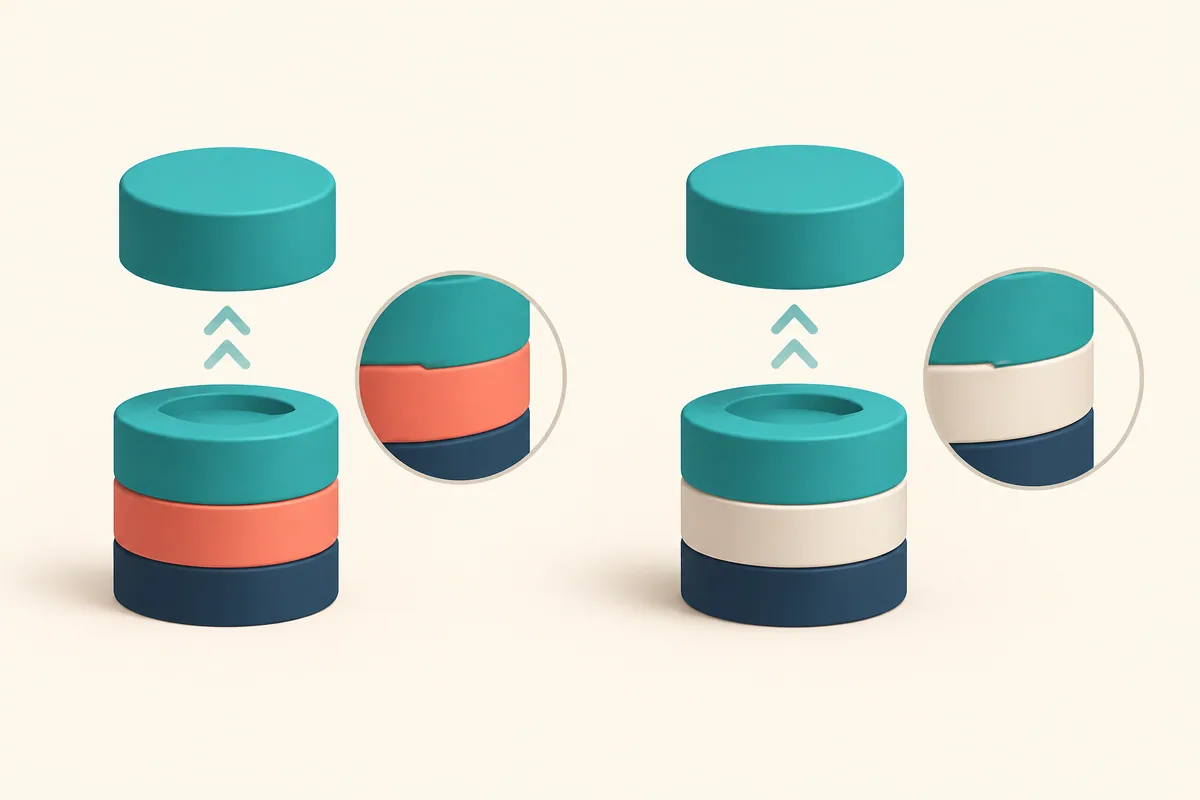
Illustration: The same top match uncovers a helpful colour in one stack pair and a clash in the other.
Hexa Sort places layered hexagon stacks on a compact board. Matching adjacent top colours stack together when their route is unobstructed. Removing a top colour exposes the next layer, which can create another match. A placement is therefore partly a decision about a currently hidden colour relationship.
Hexa Master 3D: Sort Puzzle asks you to organize and merge coloured hex stacks toward a stage goal. Completing stages supports a garden progression. Read the specific stage objective rather than treating every extra match as equivalent progress.
Cube Sort rotates a patterned sculpture and sends selected tiles to the currently open matching bucket. Nonmatching tiles occupy a limited tray, and filling it fails the level. Question-mark tiles reveal their pattern after a neighbouring tile is cleared, while permanent grey riveted pieces remain as obstacles.
Plan from the receiving space backward
In Hexa Sort, inspect the colours under the exposed top when visible. Ask whether clearing the first layer leaves another matching neighbour or merely occupies a scarce board position. In Hexa Master, connect the proposed change to the stated goal rather than the visual appeal of a tall stack.
For Cube Sort, identify tiles that satisfy the open bucket before lifting unrelated pieces. A removal that reveals a useful question-mark tile may justify using some tray capacity, but only if you have a credible follow-up. A concealed pattern cannot be treated as a promised match.
A hypothetical layer cascade
Imagine two hex stacks with matching blue tops and green layers underneath. A blue clear could expose green neighbours and continue productively. If one lower layer were red instead, the same opening would lead somewhere else. The example explains why layer inspection matters without claiming a fixed cascade rule for every sorter.
Layered sorting puzzles: reassess after the reveal
Once a layer changes, stop relying on the arrangement you had predicted if the new evidence differs. Check the actual active bucket, exposed colours and remaining spaces. A reveal is information; it is not a reason to complete a plan built on an assumption that has become false.
Choose Hexa Sort for local layered adjacency, Hexa Master for stage goals linked to garden progress, and Cube Sort for pattern targets with a tray constraint. Each rewards thinking about what the first satisfying match leaves unresolved.
Related tags
Frequently asked questions
What matters beneath a Hexa Sort top layer?
Its next colour may become available after the top clears and can change the usefulness of the placement.
Does every Hexa Master match finish a stage?
No. Work toward the current stage goal rather than assuming any visible combination completes it.
What happens to nonmatching Cube Sort tiles?
They wait in a limited tray, and filling that tray fails the level.
Are Cube Sort grey riveted tiles removable?
Its guide describes them as permanent obstacles to work around.
Can I know a question-mark pattern in advance?
Do not assume it. The guide says it is revealed after a neighbouring tile is cleared.
What should I do after an unexpected reveal?
Revise the plan using the actual exposed layer, active target and remaining receiving space.
Try the mechanic that interests you
Play Hexa SortMore puzzle guides
 Puzzle
Shelf Sorting Games: Free Items Without Blocking More
Compare three shelf sorters by item access, triple formation and timers. Check what a placement exposes before covering another needed product.
 Puzzle
Cube Rotation Puzzles: Track Faces as the View Changes
Compare a colour-faced rolling cube, a die with a hidden bottom face and arrows viewed from new angles. Distinguish object orientation from camera rotation.
 Puzzle
Jigsaw Puzzle Games: Compare Pieces, Shards and Stickers
Compare jigsaw pieces, picture shards and numbered stickers. Choose whether you want visual fitting, fragment assembly or keyed placement.
 Puzzle
Word Game Hints: Choose the Right Clue When You Stall
Choose word-game help after identifying the missing information. Compare one-letter hints, fragment guidance and whole-category reveals across three games.