
Eggy Car Tips: Keep the Egg Stable on Uneven Roads

On this page
Eggy Car gives you a small car, a loose egg and a rolling road. The objective is distance, but distance comes from keeping the egg aboard rather than from maintaining the highest speed. These Eggy Car tips start from one idea: a sudden change that helps the car can unsettle its cargo.
The useful habit is to read the hill and the egg together. Gas and brake move the vehicle, while the egg tells you how the recent acceleration is affecting the load. Treat every slope as an approach, a crest and a descent instead of one uninterrupted hold.
Eggy Car tips: learn what the two inputs actually change
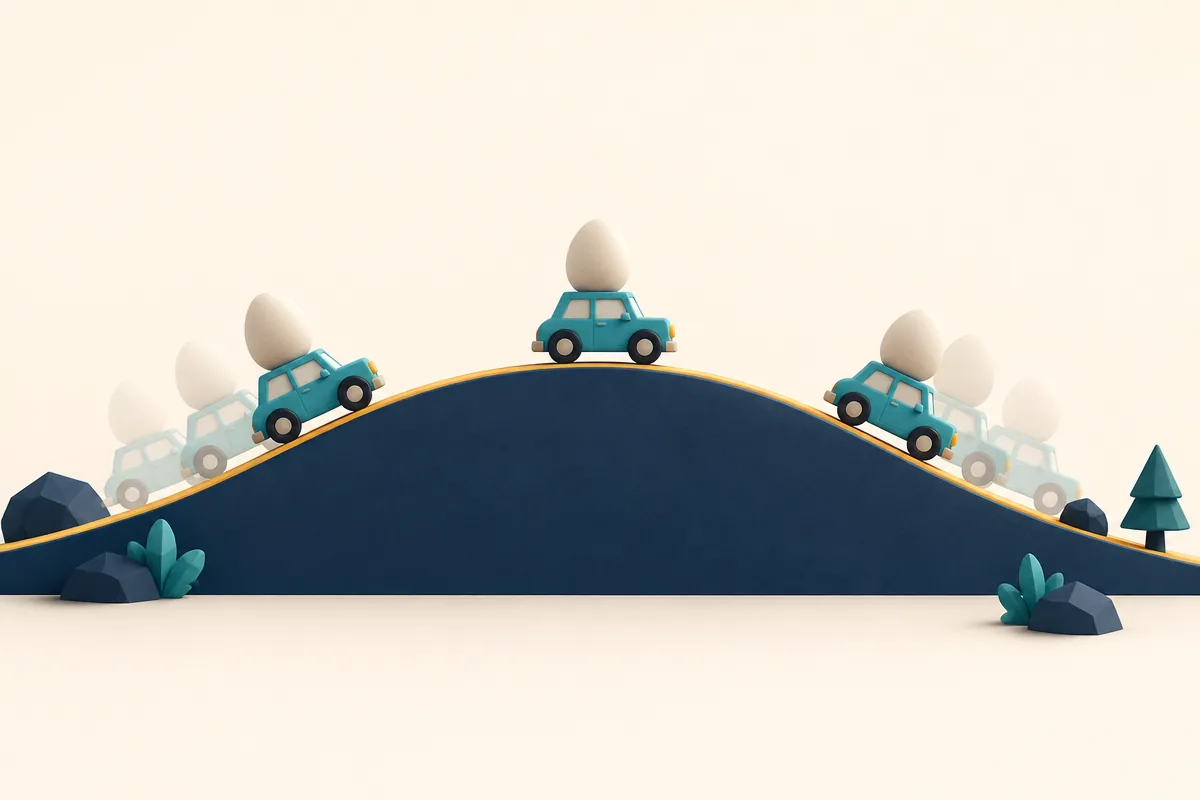
Illustration: Ghost positions trace how the support under the egg tilts from climb to crest to descent.
Eggy Car uses gas and brake, with arrow-key control recorded in the catalog. The run ends when the egg rolls off and cracks. There is no steering route to rescue a bad line; the central decisions concern forward motion and changes in speed.
Begin with small, deliberate adjustments so you can observe the egg's response. A large input change can be tempting when the car slows, but the immediate result on the vehicle is only half the feedback. Keep watching whether the egg is settled, beginning to roll or already near an edge. The guide does not establish an exact universally safe key duration, and different hill shapes make one fixed rhythm unreliable.
Approach a climb with a continuation in mind
A climb needs enough movement to reach the crest, but entering it as fast as possible may create a difficult transition at the top. Look at how steeply the road rises and whether it flattens or immediately drops afterward. The continuation decides how much recovery space you have.
If the car repeatedly stalls on one type of hill, compare a slightly different approach while watching the egg. If the climb is easy but the egg leaves at the top, more approach speed is unlikely to address the actual failure. Those observations identify different problems even though both occur on the same hill.
At the crest, avoid a panic correction
The top of a hill changes the support beneath the car. Accelerating into it, braking abruptly on it or immediately racing down the other side can all shift the loose egg. The important moment is the transition between slopes, where the motion you built on the climb meets the next section.
Imagine an illustrative run where the egg remains calm up the slope but begins rolling at the crest. The useful experiment is a gentler speed transition there, not a completely different approach to every part of the road. This example is a way to diagnose a mistake; it is not a guarantee that one tap sequence fits an actual level.
Manage the descent before the next hill arrives
A downhill stretch can build speed while the next climb is still ahead. Watch far enough along the road to see whether you need a smooth continuation or time to settle the egg. Repeated sharp braking can turn every descent into a new cargo movement problem.
Judge the whole sequence of hills. Reaching the bottom quickly is not useful if the egg is already leaving the car or the next crest becomes impossible to handle. A controlled run with fewer emergency adjustments is a better baseline than one longer attempt whose extra distance depended on an unexplained recovery.
Review the first movement that put the egg at risk
After the egg falls, trace back to when it first became unstable. Was that during the acceleration onto a climb, an abrupt change at the crest or a correction on the descent? The final fall can occur later than the decision that caused the trouble.
Keep one part of the next attempt consistent and change the suspected cause. That gives each retry a question to answer. The aim is a repeatable relationship between throttle, braking and the visible load.
Related tags
Frequently asked questions
What ends an Eggy Car run?
The guide describes the loose egg rolling off and cracking. The main score is distance travelled while keeping it aboard.
How many main controls are there?
Gas and brake are the central inputs, with arrow-key control recorded for computers. Follow the displayed mapping in the loaded game.
Why can braking at the crest be a problem?
An abrupt speed change can unsettle the loose egg just as the road changes slope. Observe the cargo response instead of correcting only the car speed.
Should I drive every hill as slowly as possible?
Not necessarily. A climb needs enough movement, while a descent and crest need control. Read the whole hill sequence rather than using one extreme for all terrain.
Which mistake should I review after the egg falls?
Find the first point where the egg became unstable, which may occur before the final fall. Identify whether the cause was on the approach, crest or descent.
Is there one guaranteed gas-and-brake pattern?
No universal pattern is established. Use the current road shape and the egg position to choose adjustments, changing one decision at a time.
Try the game that fits your next challenge
Play Eggy CarMore racing guides
 Racing
Traffic Timing Games: Junctions, Laps and Safe Gaps
Compare roundabout launch timing with stop-and-go traffic driving. Learn to inspect entry, occupied space and the exit before committing.
 Racing
Parking Puzzle Games: Plan Routes, Fuel and Car Order
Compare six parking games on Zigzigo by route drawing, traffic removal, fuel rules, move order and careful steering. Find the right planning challenge.
 Racing
Browser Racing Games: Stunts, Chases and Steady Driving
Compare six browser driving games on Zigzigo, from police chases and motorcycle stunts to bus routes and timed drag-racing shifts.
 Racing
Motorcycle Upgrade Games: Pick Progression That Fits
Compare motorcycle progression through circuit upgrades, traffic earnings and stunt-stage unlocks. Connect each purchase to a clear riding objective.