Memory Games Compared: Pairs, Sequences and Recall
On this page
Memory games compared side by side show that two titles can both test recall while asking you to remember completely different things. A face-down pair game asks where a picture was. A sequence game asks which item came next. A scene quiz asks what you noticed before the picture disappeared. Learning the wrong kind of routine can make an otherwise simple game feel surprisingly difficult.
This comparison uses the mechanics described in Zigzigo's game guides to separate those three tasks. It covers six games, explains what information you need to retain and gives a practical starting method for each.
Memory games compared: match each game to what you remember
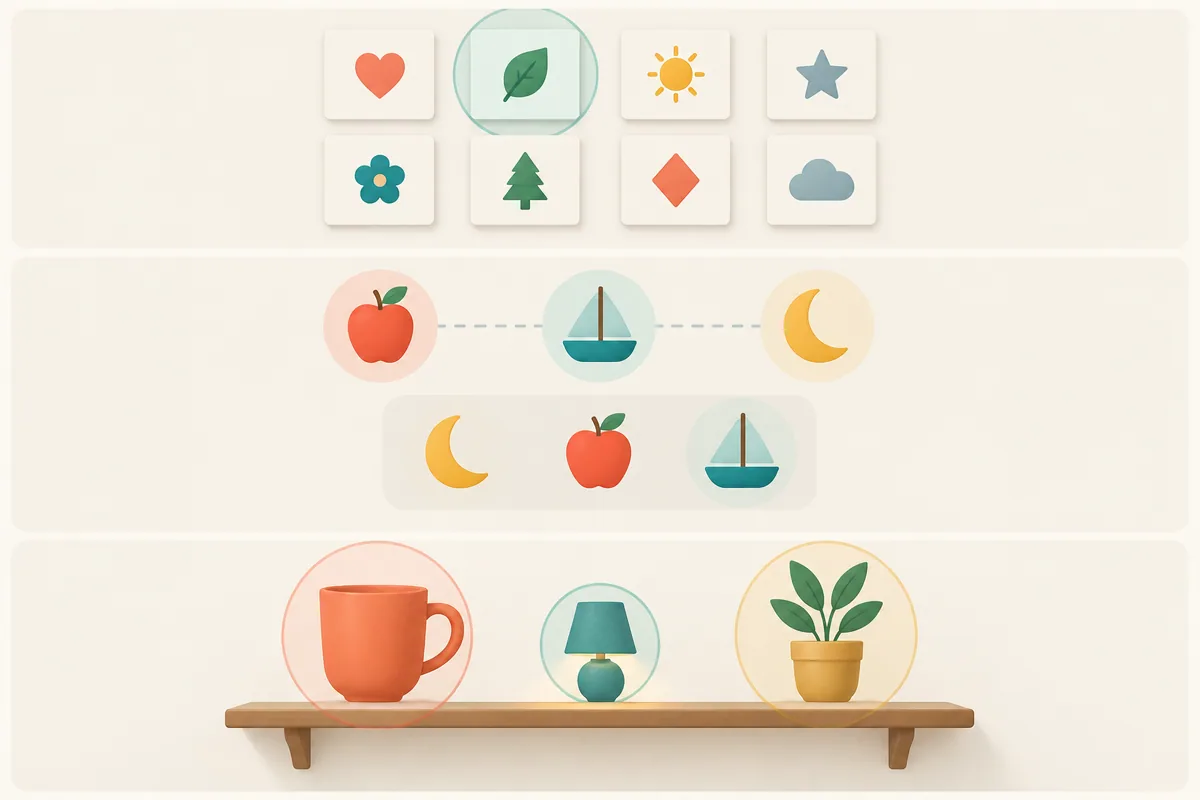
Three different things to retain: location, order and object details. These generic examples explain the tasks rather than provide game answers.
| Game | Remember | Important rule |
|---|---|---|
| Flag Memory Match | A flag and its position | Different cards turn back over |
| Memorybot | Card positions | Pairs must be found against the clock |
| Kobadoo Emojis | Emoji identities in order | The answer grid reshuffles |
| Memory Cards | Playing-card ranks and suits in order | The sorted grid is not the answer sequence |
| Kobadoo Numbers | Number values in order | Values appear in ascending order on the answer board |
| Awareness Game - The Robot Bar | Details from a brief scene | The observation video lasts ten seconds |
Pair matching: keep the identity and the location together
In Flag Memory Match, reveal two face-down cards to look for identical flags. Matching pairs remain visible; different flags turn back over. A country label appears in the top bar when a flag is revealed, which helps distinguish similar stripes and colour combinations.
The crucial unit of information is not just 'I saw that flag'. It is 'that flag was in this place'. Give locations a consistent description, such as top-left, middle-right or a row and column. When you uncover a new card, first ask whether its partner is already known. Repeatedly opening unknown cards can leave known pairs uncollected.
The catalogue's editorial pick describes no timer and a point penalty for a wrong pair. That gives this game a different rhythm from Memorybot, which explicitly asks you to find animated-card pairs against a clock. In Memorybot, repeated uncertain guesses also consume valuable seconds. Keep a steady scan order, but collect a known pair as soon as you recognize it.
Emoji sequences: preserve order before searching the grid
Kobadoo Emojis first presents emojis one at a time. After the preview, choose those same emojis from a larger selection grid in the original order. The answer grid reshuffles each round, so learning a symbol's old location will not tell you where it appears next.
Use short, distinctive names while watching. 'Monkey, fruit, vehicle' may be too vague if the choices contain several monkeys or vehicles. 'Ears-covered monkey, carrot, bus' carries the identifying detail. For a longer sequence, turn the labels into a small ordered event, while keeping the symbols themselves clear.
A wrong selection ends the run. The safe first step is to recall the next item's identity before scanning for it, then confirm the details before selecting. Looking around the answer grid without a remembered target can turn recognition of a familiar emoji into the false belief that it belongs next.
Playing-card sequences: rank alone is not enough
Memory Cards uses a similar preview-and-repeat structure, but its symbols are playing cards. Each preview card has a name beneath it. Afterward, the selection grid is sorted by rank, while your answer must follow the preview's order. This is a sequence game despite the title; it is not a face-down pair board.
Remember each rank with its suit: 'four of clubs' rather than 'four'. Suppose you recall a king followed by a low card but have lost both suits. Finding those ranks in the grid does not restore the missing information. Keep complete identities in short ordered groups and retrieve one group at a time.
The guide notes no countdown on the answer grid and a wrong choice ending the run. Use that distinction: attentive watching matters during the preview, while deliberate checking matters before a selection. Do not reorder your remembered cards to match the convenient rank order of the grid.
Number sequences: sorted choices help you search, not recall
Kobadoo Numbers shows a series of values from zero to ninety-nine, then asks you to select them in order. The answer board runs from smallest to largest. That organization makes a remembered value easier to locate, but it does not tell you which value came first.
Say each number as a whole value rather than splitting it into unrelated digits. Then preserve the original order. If the preview were eighty-eight followed by eighty-nine, the numerical closeness would be useful for locating them but could also encourage a neighbouring selection error.
Before selecting, check both the value and your position within the sequence. This separates two possible mistakes: forgetting the item and finding the wrong item despite remembering it. If you know which type happened, you can adjust either your preview routine or your selection accuracy.
Scene recall: observe relationships as well as objects
Awareness Game - The Robot Bar changes the task again. You watch a ten-second video of a robot bar, then answer questions about details such as objects, colours or sizes. The guide describes a target streak of ten correct answers and notes that speed matters during questions.
There is no face-down grid to revisit and no predefined sequence to rehearse. A useful approach is to sweep the scene once, then connect distinctive objects with their attributes and locations. 'A red object at the counter' is more informative than a loose list containing 'red' and 'counter' with no relationship between them.
You cannot know every future question from the start. Treat early attempts as a way to understand which details the game asks about. If an answer exposes something you missed, change what you watch for next time instead of simply trying to memorize the entire scene more intensely.
Use a routine that fits the task
- For pairs, record locations. Identify the picture and where it was, then return to known partners.
- For sequences, retain order. Recall the next complete item before finding it in the answer grid.
- For scenes, connect details. Remember what an object looked like and where it appeared together.
Choose Flag Memory Match if you want to revisit information on a stable board. Choose a Kobadoo variant or Memory Cards if the preview-and-repeat challenge appeals to you. Choose Memorybot when you also want timed pair finding, or Robot Bar when you prefer recalling a scene. Those distinctions are more useful than treating every memory game as interchangeable.
Related tags
Frequently asked questions
What is the main difference between pair matching and sequence memory?
Pair matching asks you to remember an item's location so you can uncover its partner. Sequence memory asks you to remember items in the original order, then find them among the answer choices. A familiar item can still be the wrong next answer.
Is Memory Cards a matching-pairs game?
The Memory Cards game in Zigzigo's catalogue is an ordered recall game. It previews playing cards, then asks you to choose them in the same order from a face-up grid. Remember both rank and suit.
Which of these games uses a countdown?
Memorybot explicitly requires finding pairs against the clock. Robot Bar gives a ten-second scene preview and also describes speed as relevant to its questions. Those timing rules differ from a pair board described without a timer, such as Flag Memory Match.
Can I remember positions in Kobadoo Emojis?
Positions are not a reliable way to retain the preview sequence because the selection grid reshuffles each round. Remember each emoji's identity and its order, then search the current grid for the next item.
Does Kobadoo Numbers ask me to calculate?
Its core task is to remember the displayed values and choose them in sequence. The answer board is sorted in ascending order, which helps you locate a value. Sorting the choices does not replace remembering the preview order.
How can I tell what went wrong after a missed answer?
Separate the mistakes. Did you forget the item's identity, reverse the order, lose its location or select a neighbouring choice? Use a more precise label for identity errors, rehearse order for sequence errors and a consistent position system for pair boards.
Try remembering a sequence of familiar symbols
Play Kobadoo EmojisMore puzzle guides
 Puzzle
Shelf Sorting Games: Free Items Without Blocking More
Compare three shelf sorters by item access, triple formation and timers. Check what a placement exposes before covering another needed product.
 Puzzle
Cube Rotation Puzzles: Track Faces as the View Changes
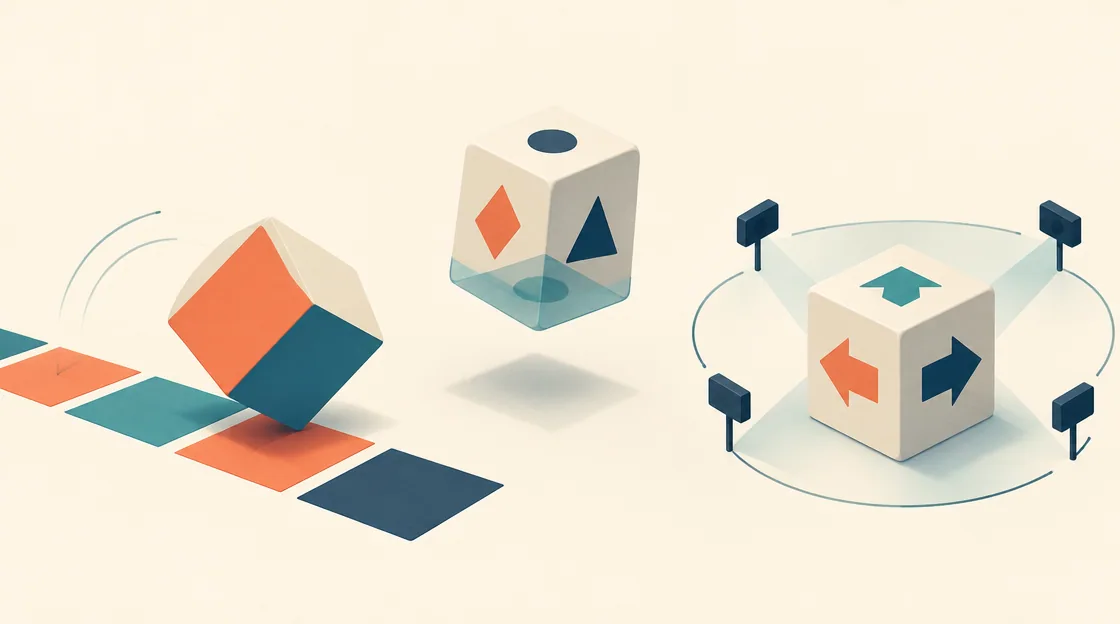
Compare a colour-faced rolling cube, a die with a hidden bottom face and arrows viewed from new angles. Distinguish object orientation from camera rotation.
 Puzzle
Jigsaw Puzzle Games: Compare Pieces, Shards and Stickers
Compare jigsaw pieces, picture shards and numbered stickers. Choose whether you want visual fitting, fragment assembly or keyed placement.
 Puzzle
Word Game Hints: Choose the Right Clue When You Stall
Choose word-game help after identifying the missing information. Compare one-letter hints, fragment guidance and whole-category reveals across three games.