Flight Runner Games: Glide, Climb and Follow the Light
On this page
In flight runner games, a flying character does not establish a single control style. A paper plane can use directional steering, a bird can rise through repeated taps, and a glider can depend on the remaining light as well as avoiding a crash. Those differences determine what you watch and why a pickup matters.
Paperly, Horizon: Flight Into the Light, Going Up and Shadobirds offer distinct flight routes. Compare the input, destination and ongoing pressure before choosing. Some are explicitly endless, while others lead toward nests or through separate levels. A sky background alone tells you little about the shape of the attempt.
| Game | Main control idea | Progress or pressure |
|---|---|---|
| Paperly | Directional steering and boost | Extend an endless flight |
| Horizon: Flight Into the Light | Steering and available jumps | Keep the light alive |
| Going Up | Click to fly upward | Move toward a nest |
| Shadobirds | Touch to jump through obstacles | Reach nests across 20 levels |
Paperly: guide a line through terrain
Paperly - Paper Plane Adventure uses a paper plane in an endless three-dimensional flight. Arrow keys steer up, down, left and right, while Shift boosts. Terrain, obstacles and collectible boosts give the route shape.
Look for a continuous passage rather than make a sharp correction toward every pickup. A boost is most useful to understand in relation to the route after it. Choose Paperly if you want to manage a flight line with directional control and extend distance, rather than repeatedly tap to gain height toward a particular nest.
Horizon: obstacles also interact with the light
Horizon: Flight Into the Light adds a setting sun to its glider route. Blue crystals raise the sun, building shadows make it set faster, and green crystals provide jumps. The flight ends when the light is gone or the glider crashes.
That creates two connected considerations: maintaining a clear route and preserving the resource that keeps the run active. A path beside a tower may involve more than collision avoidance because its shadow also matters. Read the upcoming space and crystal color before steering. Desktop arrows or A/D steer, with Space, Up or W for a jump.
Going Up: lift toward a destination
Going Up uses a touch or desktop left click to send the bird upward. Obstacles interrupt the climb, while coins unlock skins. The description gives the bird a nest destination, so its visual progression is different from simply flying farther along an endless landscape.
Use the opening lift to observe how the input moves the bird. Then target a gap that leaves room for the next lift, not merely a coin floating near it. A cosmetic unlock is a separate reason to collect; it does not turn every coin route into a requirement for safe ascent.
Shadobirds: the nest is the level goal
Shadobirds moves a shadowy bird through 20 obstacle-filled levels toward a nest. The documented touch action makes the bird jump. Its guide specifically warns that fresh obstacles can appear when a level looks nearly finished.
Keep reading the route until the destination is actually reached. A quieter-looking final stretch is not proof that the remaining inputs are unnecessary. Choose this game if a sequence of separate nest-reaching challenges appeals more than one continuous distance run. Use the current screen for any input mapping not explicitly shown in its touch-focused guide.
Distinguish destination pickups from survival pickups
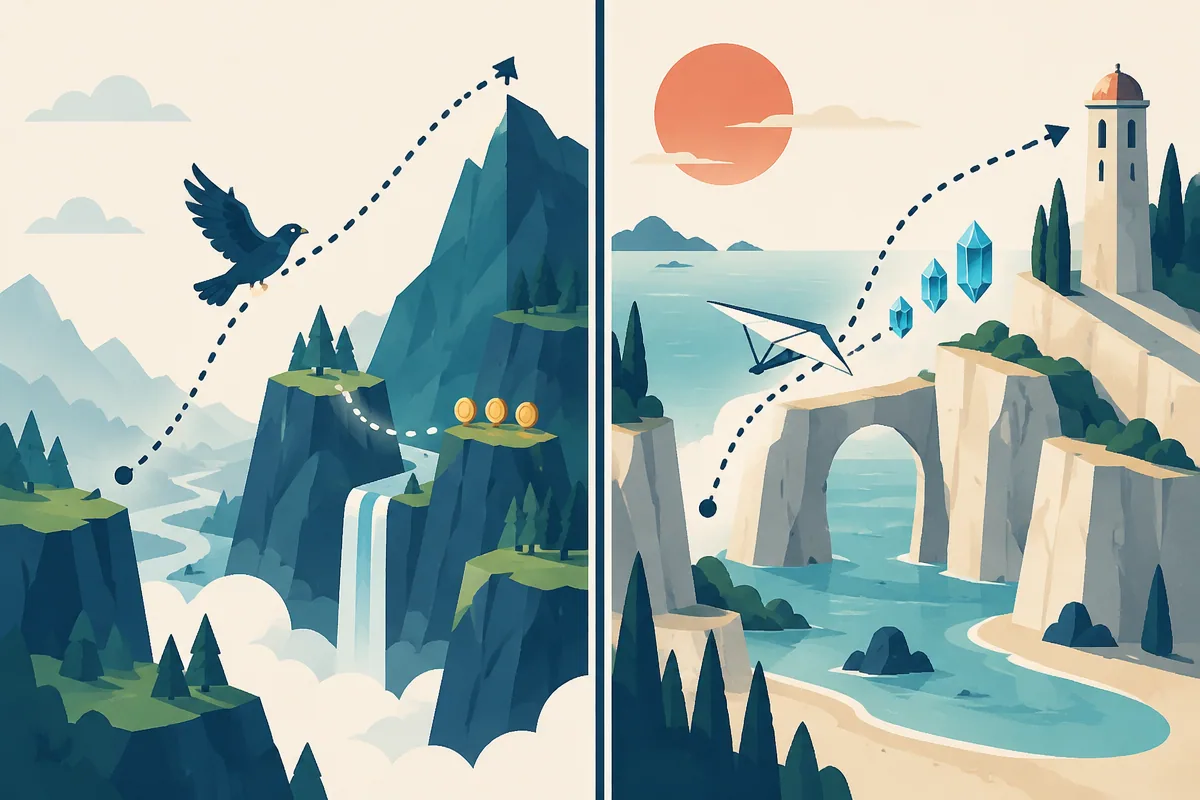
Conceptual pickup-role comparison; not a level solution or measured flight path.
A coin that contributes to a skin and a crystal that preserves the flight have different immediate significance. In Going Up, collection supports customization. In Horizon, blue crystals affect how long the light remains, while green ones supply jumps. Paperly's boosts affect the flight route in another way.
Before changing direction, identify the pickup's role and the passage after it. A survival-related object can deserve more attention without making the surrounding obstacles disappear. A cosmetic object can be worth collecting on a chosen detour without being mandatory. The role, not merely its brightness, should inform the route decision.
Flight runner games: choose the action you want to repeat
Select Paperly for directional gliding through terrain, Horizon for a flight shaped by light and crystals, Going Up for repeated upward lifts, or Shadobirds for obstacle levels with nests. The best match is the movement and stopping condition you prefer.
On the next attempt, watch one concrete factor: a sharp steering correction, a shadowed route, a poorly chosen lift gap or an obstacle overlooked near the nest. Different flight loops create different mistakes, so the useful correction should belong to the game you actually selected.
Related tags
Frequently asked questions
Which flight pick is explicitly endless?
Paperly describes an endless flight focused on extending distance, with directional steering and boosts.
What do Horizon’s blue and green crystals do?
Blue crystals raise the setting sun, while green crystals provide jumps. Building shadows make the sun set faster.
What ends a Horizon flight?
Its guide names losing all the light or crashing. Route clearance and preserving light therefore both matter.
How does Going Up document desktop input?
A left click sends the bird upward. Coins contribute to skins while the route leads toward a nest.
How many levels does Shadobirds describe?
It describes 20 obstacle-filled levels, each leading toward a nest. Continue reading obstacles until the destination is actually reached.
Should every flying game use the same input pattern?
No. Directional steering, repeated upward lifts and timed jumps are different control styles. Learn the selected game’s opening response.
Try a flight where crystals help preserve the light
Play Horizon: Flight Into the LightMore action guides
 Action
Side-Scrolling Shooters: Ground Fire or Aerial Routes
Compare side-scrolling shooters by ground movement, free flight, enemy approaches and mission structure in Alpha Guns, Crazy Plane Shooter and Super Pork.
 Action
Top-Down Shooter Games: Movement, Aim and Open Space
Compare top-down shooters by movement, aiming and the space you must protect in Geometry Gunner, The Room and In Space.
 Action
Melee Action Games: Compare Reach, Movement and Pace
Compare melee action games by movement, weapon interaction, aimed leaps and spinning attacks in four Zigzigo brawlers.
 Action
Shooter Mission Goals: Waves, Chapters and Rescue Runs
Compare shooter mission goals: chapters, capture tasks, encirclement and rescue exploration. Choose what you want each completed encounter to achieve.