Melee Action Games: Compare Reach, Movement and Pace
On this page
Melee action games can involve walking into close range, picking up a nearby object, launching an aimed leap or spinning through surrounding foes. The absence of a long-range gun does not make those control loops identical. Choose the way movement connects to the attack before deciding which warrior or weapon looks most dramatic.
Samurai Brawling, Ghost Walker, Stickman Archero Fight and Knight 360 illustrate four different connections. Compare the documented input and immediate space around the character. The aim is to find the interaction you want to repeat, not declare one weapon or character universally strongest.
| Game | Attack relationship | Movement attraction |
|---|---|---|
| Samurai Brawling | Separate attack and special moves | Move Arashin through 3D brawls |
| Ghost Walker | Aim a leap, then release | Slow-motion approach decisions |
| Stickman Archero Fight | Interact with items, then hit | Use objects around the village |
| Knight 360 | Spin attacks around the knight | Read nearby enemies and arrows |
Samurai Brawling: movement and attack remain separate
Samurai Brawling follows Arashin through battles against ninja, samurai and assassins. Arrow keys move and Space attacks, with special moves and ability improvements part of the progression. The movement route and attack command are distinct responsibilities.
Choose this if walking through a story-led brawl with separate attack decisions appeals to you. Watch where the character will stand after approaching an enemy, not only whether Space is being pressed. A special move adds an option, but its current effect should be learned before expecting it to solve every crowded encounter.
Ghost Walker: aim the approach itself
Ghost Walker uses held left-mouse dragging to aim an assassin's next leap and release to launch. Its slow-motion battles lead toward bandit leaders, with choices about engaging or avoiding their crews. That makes the approach a visible decision before the movement happens.
Inspect the landing or continuation after the leap as well as the target. An attractive line toward one opponent can lead into a poor next position. Choose Ghost Walker if planning a committed movement is more appealing than steering continuously through every close-range exchange.
Stickman Archero Fight: nearby objects matter
Stickman Archero Fight uses WASD movement, E to interact with items and left mouse to hit. Objects in the village can become weapons, while later crafting and leveling support progression. The environment is therefore part of selecting how to fight.
Before an exchange, notice whether a useful object is on a route you can actually reach. The interaction action is separate from attacking, so simply standing near an item is not the whole input sequence. Choose this if improvising with the surroundings interests you more than taking one fixed weapon through every encounter.
Knight 360: read the space around a spin
Knight 360 describes walking and spinning through levels against ghosts and skeletons, with arrows that can be knocked away. Its listed movement and attack mappings are suggestions, so the current opening should establish whether spinning is automatic or uses a displayed action.
The attraction is the surrounding space of a spin rather than a single aimed leap. Notice which enemies are near and where an incoming arrow crosses the route. Choose it if a sweeping attack around the character sounds appealing, while learning its actual activation before relying on the motion.
Compare reach with the position after contact
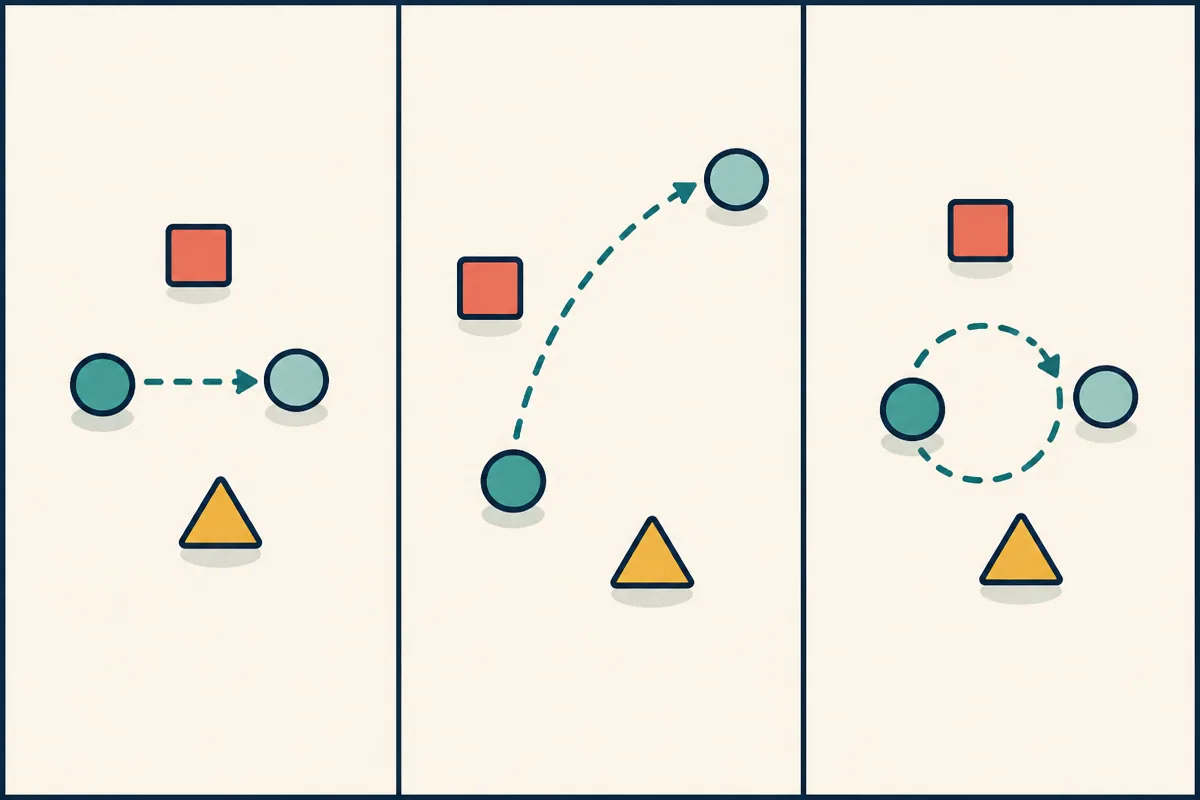
Hypothetical position-after-action diagram; not measured hit areas.
Imagine one opponent ahead and another farther to the side. A close strike may address the first but leave the side approach unchanged. An aimed leap may carry the character beyond the first target. A spin may involve the nearby space around the character rather than a straight line.
Those are hypothetical mechanical contrasts, not claims about the exact hit areas of the four games. The useful question is where the action leaves you. An attack can connect while still creating a difficult continuation. Read the aftermath as part of the approach instead of evaluating only the moment of contact.
Melee action games: choose the pace of decision you want
Start with Samurai Brawling for separate movement and attacks in a story-led brawl, Ghost Walker for a held-and-released leap, Stickman Archero Fight for item interaction, or Knight 360 for surrounding spin action. Their melee theme supports different control preferences.
On the next attempt, identify whether the problem was getting into useful range, activating the right action or leaving a poor next position. Those are more specific adjustments than simply choosing another weapon before understanding the movement loop.
Related tags
Frequently asked questions
What are Samurai Brawling’s documented desktop actions?
Arrow keys move Arashin and Space attacks. Its progression also describes special moves and improving abilities.
How does Ghost Walker launch the next leap?
Hold the left mouse button and drag to aim, then release to launch. Inspect the continuation as well as the target.
What does E do in Stickman Archero Fight?
It interacts with nearby items, including objects that can be used as weapons. Left mouse is the separate hit action.
Is Knight 360’s spin definitely mapped to one universal key?
No exact universal key is established here. Its listed mapping is suggestive, so use the current tutorial or displayed action.
Does connecting an attack guarantee a useful position?
No. The action may leave another approach exposed or put the character in a restrictive area. Read what follows contact.
Which pick emphasizes a committed aimed movement?
Ghost Walker explicitly describes aiming and releasing a leap, rather than only steering continuously while pressing an attack.
Try melee action built around aiming a leap
Play Ghost WalkerMore action guides
 Action
Side-Scrolling Shooters: Ground Fire or Aerial Routes
Compare side-scrolling shooters by ground movement, free flight, enemy approaches and mission structure in Alpha Guns, Crazy Plane Shooter and Super Pork.
 Action
Top-Down Shooter Games: Movement, Aim and Open Space
Compare top-down shooters by movement, aiming and the space you must protect in Geometry Gunner, The Room and In Space.
 Action
Flight Runner Games: Glide, Climb and Follow the Light
Compare flight runners by steering, upward taps, boosts and light management in Paperly, Horizon, Going Up and Shadobirds.
 Action
Shooter Mission Goals: Waves, Chapters and Rescue Runs
Compare shooter mission goals: chapters, capture tasks, encirclement and rescue exploration. Choose what you want each completed encounter to achieve.