Landing Routes: Plan the Jump Beyond the First Ledge
On this page
A jump is not finished when the character clears the gap. It ends on a landing surface, often with another decision already approaching. A narrow ledge, a key above the exit or a descent into water can make the space after takeoff more important than the empty gap itself. Thinking in landing routes helps separate those situations.
These four games provide contrasting examples: a key-and-return room, a slow-descent ability, an upward forest climb and a platform adventure with swimming. The comparison focuses on what to inspect before committing. It does not assume identical jump height, air control or collision rules between them.
| Game | Landing question | Distinctive mechanic |
|---|---|---|
| Epic Duck | How do I return after the key? | Ledges between key and exit |
| 2D Platformer Coin | Where will the slow descent end? | Hold Space to float downward |
| Jump and Fly | Which platform supports the next climb? | Upward ledges and held input |
| Ringo Starfish | Am I entering a platform or water section? | Swimming and checkpoints |
Epic Duck makes the return journey visible
Epic Duck places a key away from the locked door, so climbing to the pickup does not complete the room. Walk with the documented left-right controls and jump with W, but keep the lower platforms in view as possible parts of the return.
Before the ascent, identify a landing from which you can continue upward. After collecting the key, reassess the descent rather than blindly reverse the same input. A platform that was helpful while climbing may be awkward to approach from above. The aim is to connect the key and door through usable positions, not merely touch the highest point.
Slow descent changes when you need to decide
In 2D Platformer Coin, A/D move, W jumps and holding Space during a jump slows the descent. Collecting eight coins wins the round. That extra descent action gives you another variable beyond the initial takeoff.
Use it with a destination in mind. Slowing a fall is useful when it helps you reach or align with a landing; holding it automatically does not choose the correct platform. Look for a surface that leaves a route to the remaining coins. A prolonged descent toward the wrong side of a gap can still be the wrong route, even if it feels controlled.
An upward climb needs somewhere to continue
Jump and Fly sends a squirrel or bee between forest ledges, collecting coins and power-ups while climbing. Its documented gesture is tap and hold to jump. The useful target is not always the highest visible platform; it is a reachable landing that connects to the next part of the ascent.
Look at the platform above the one you are choosing. If the current landing leaves you poorly aligned for the following move, a more modest first step may be worth considering. Hidden routes add another reason to inspect the surrounding ledges instead of following only the most obvious vertical line.
Ringo Starfish changes the movement context
Ringo Starfish combines platforms, underwater sections, firepower, invincibility and checkpoints. A route can therefore change how the character moves, rather than simply change the size of the next gap. Recognize whether you are approaching a platform landing or entering a swimming section.
Checkpoints are useful landmarks for deciding how far a route experiment extends. The guide encourages using each one reached. Exact jump, swim and fire mappings should be confirmed in the opening tutorial because its listed controls are suggestions. Choose this adventure when changing movement contexts is part of the appeal, alongside collecting crystals and passing barriers.
Compare a landing that ends well with one that continues well
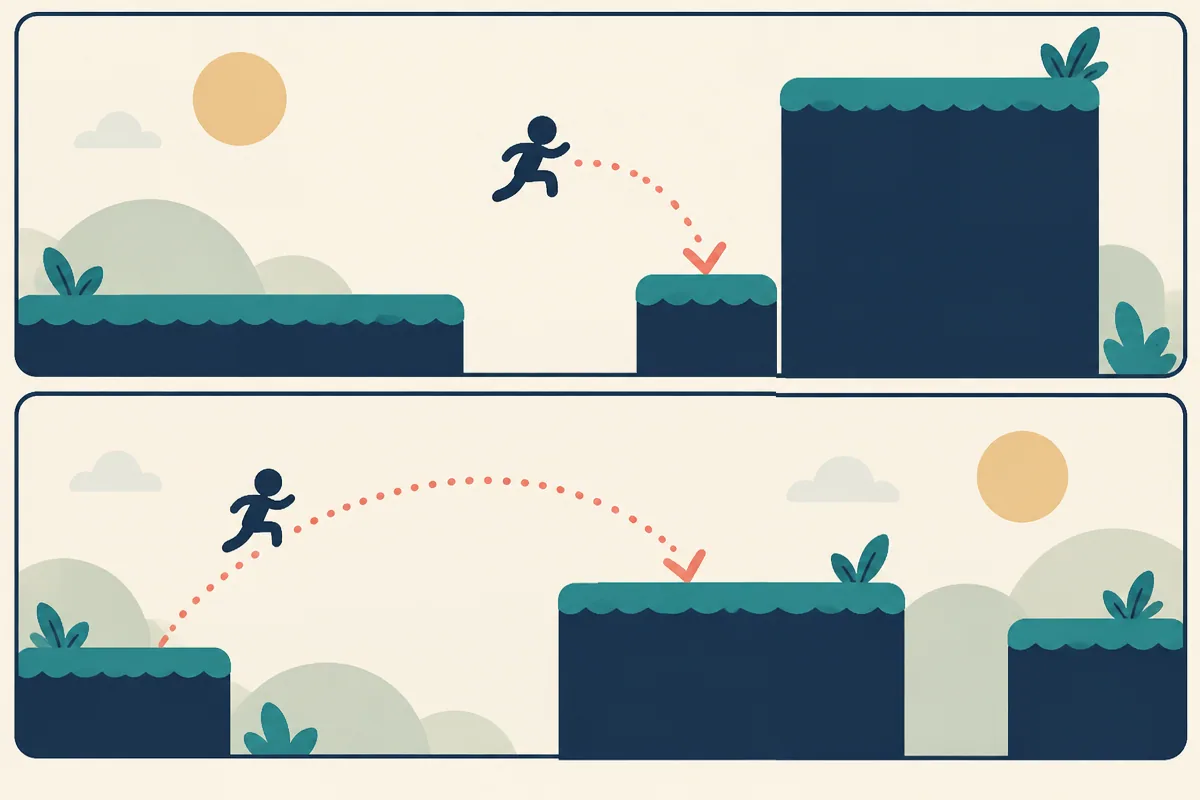
Hypothetical landing-route comparison; not a measured jump or level solution.
Imagine two available ledges. One is easy to reach but leaves a tall wall directly ahead. The other requires a more deliberate approach but has a broad surface and a clear next step. The first jump can succeed while still producing a difficult route. That is why evaluating a landing involves the space beyond the touchdown point.
In a game with slow descent, you might use the extra airtime to align with the broader surface. In a key-return room, you might choose the ledge that also supports the descent. These are hypothetical decisions, not tested shortcuts for a specific level. Their value is in asking what the landing enables next.
Landing routes: use a three-part check before committing
First identify the takeoff position. Second name the actual landing surface, rather than only the collectible floating near it. Third look for the next safe action after landing. If one of those three is unclear, inspect the route while the game allows you to do so.
After a miss, record which part failed. A bad takeoff, an incorrect landing target and an unplanned follow-up require different corrections. That distinction helps you choose between an adventure built around deliberate ledges, a climb with continuous upward decisions, and a movement system that lets you control descent.
Related tags
Frequently asked questions
Why is collecting Epic Duck’s key only part of the route?
The key opens the locked door elsewhere in the room. You still need a usable route back to the exit after reaching the pickup.
What does holding Space do in 2D Platformer Coin?
Its documented control slows descent during a jump. A/D move and W jumps; the level objective is to collect eight coins.
Should I always choose the highest platform in Jump and Fly?
Choose a reachable landing that supports the next move. The highest visible ledge is not automatically the best route through the surrounding platforms.
What makes Ringo Starfish different from a platform-only route?
It includes swimming sections as well as platforms, and checkpoints along the adventure. Confirm its current movement actions in the tutorial.
What should I inspect after a missed landing?
Separate the takeoff position, intended touchdown surface and action after landing. Identify which changed before altering every part of the attempt.
Does this guide establish exact jump distances?
No. The games use different mechanics. The examples explain route choices without claiming measured physics or a level-specific shortcut.
Try a platformer with a controlled slow descent
Play 2D Platformer CoinMore arcade guides
 Arcade
Side-Scrolling Shooters: Ground Fire or Aerial Routes
Compare side-scrolling shooters by ground movement, free flight, enemy approaches and mission structure in Alpha Guns, Crazy Plane Shooter and Super Pork.
 Arcade
Vertical Climbing Games: Platforms, Dashes and Stacks
Compare vertical climbing games by alternating jumps, stacking blocks, timed jelly leaps and checkpoint routes. Choose the upward challenge you want.
 Arcade
Top-Down Shooter Games: Movement, Aim and Open Space
Compare top-down shooters by movement, aiming and the space you must protect in Geometry Gunner, The Room and In Space.
 Arcade
Flight Runner Games: Glide, Climb and Follow the Light
Compare flight runners by steering, upward taps, boosts and light management in Paperly, Horizon, Going Up and Shadobirds.