Knife Timing Games: Throwing Targets or Flipping Routes
On this page
Knife timing games can be about aiming, waiting for a gap or controlling a moving object through a course. Those are different tasks despite the shared visual theme. In one game a successful throw creates the next obstacle; in another, the challenge is finishing the journey with a usable landing.
Choose by what happens after you press. Does a knife leave your position toward a target, or does the knife itself continue along a route? Understanding that answer prevents a rhythm learned in one game from causing avoidable mistakes in another.
Knife timing games: separate throwing from travelling
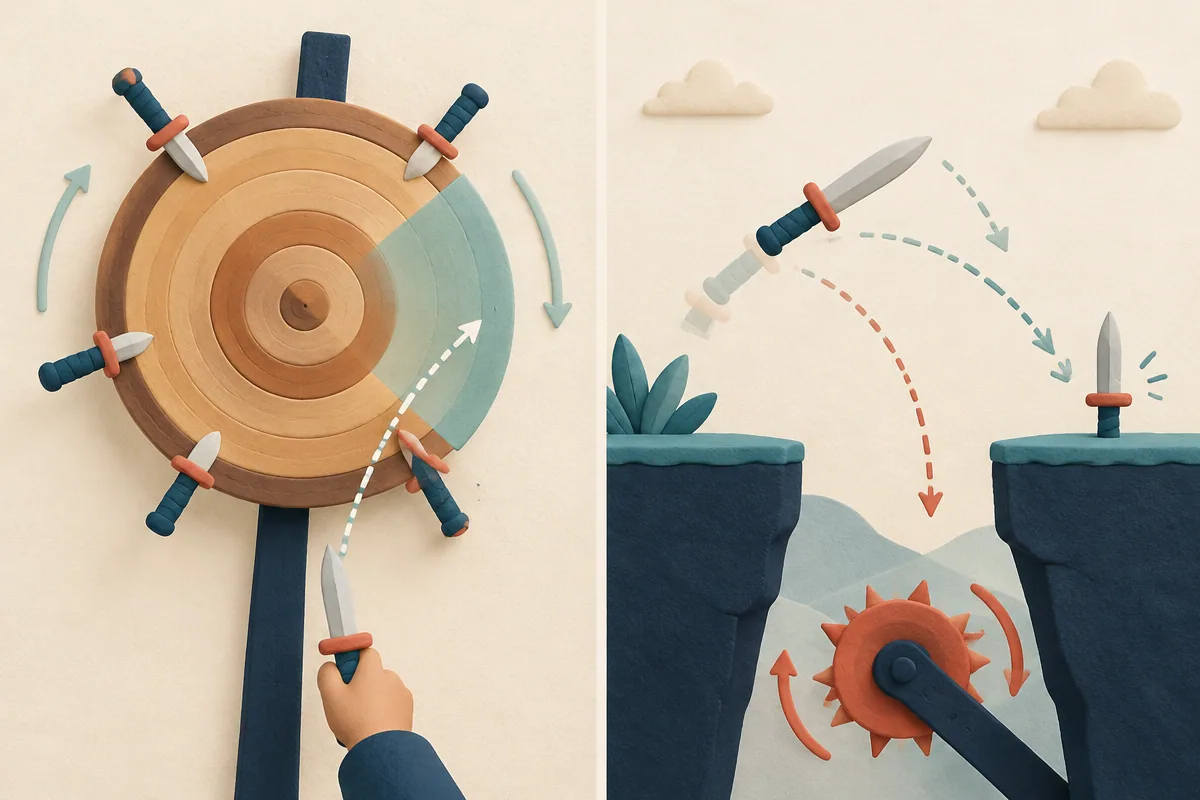
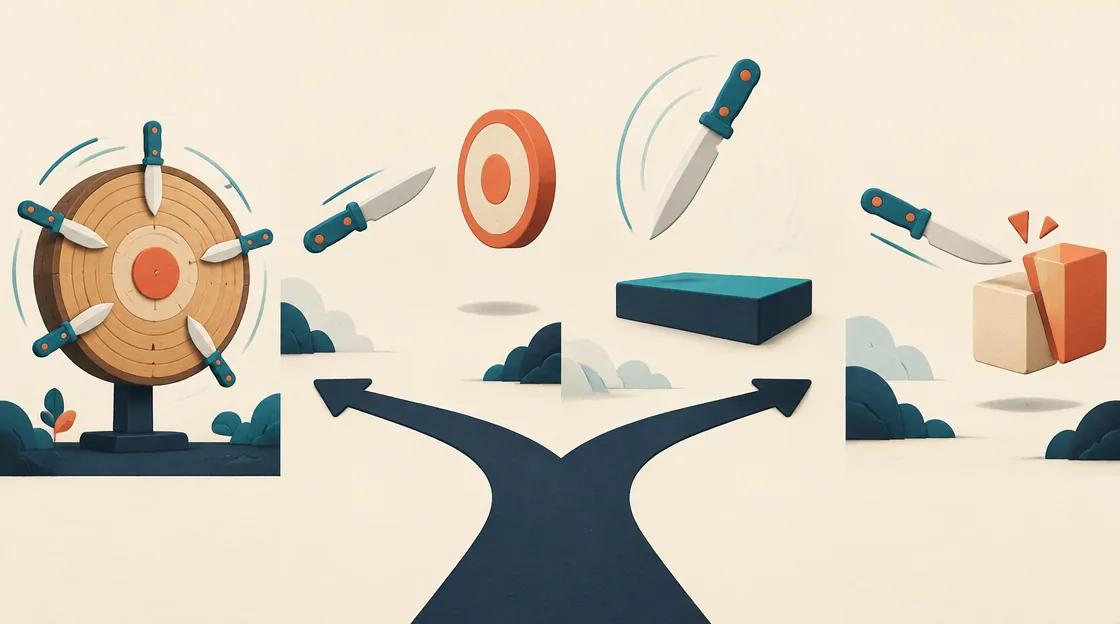
Illustrative timing problems: select a clear target gap or plan the next upright landing.
| Game | Decision to make | Watch for |
|---|---|---|
| Knives | Throw into a clear part of a spinning target | Previously embedded blades |
| Knifer | Aim at floating faces | A limited allowance for misses |
| Knife Slice 3D | Flip onto the next platform | Upright landings and moving traps |
| Cut It 3D | Keep a travelling knife airborne | Blade contact differs from a handle bounce |
Knives: every successful throw changes the next opening
In Knives, blades stick into a rotating surface. Hitting an already embedded blade ends the run. Progress therefore makes the target more crowded: an opening that was generous earlier may no longer exist after several successful throws.
Observe the next gap as it approaches the launch line. Reacting only when it is already moving away encourages a late throw. The useful habit is anticipation of a clear space, rather than repeating a fixed interval between presses.
After a clean hit, inspect the new spacing before committing again. Success is information about the changed target, not permission to repeat the same action indefinitely. Check the loaded throw control; the source notes do not establish a particular keyboard key.
Knifer: preserve accuracy instead of spraying attempts
Knifer asks you to aim at floating faces and click to throw. It tolerates only a limited number of misses, while consecutive hits help build the score. The key decision is whether the current alignment justifies spending an attempt.
Imagine you have missed several times and a target is poorly aligned. A hurried throw may feel like an opportunity to recover points, but it can spend the remaining allowance without a strong chance of a hit. Reset your aim and commit when the target is clearly lined up.
This is a different kind of patience from Knives. You are checking the aim of an individual shot, rather than navigating a target increasingly occupied by your previous blades. Keep those failure conditions separate when choosing what to practise.
Knife Slice 3D: judge the landing and the route together
Knife Slice 3D sends the knife flipping toward another platform with each click or tap. It needs to land upright. Spikes, saws and moving traps stand between platforms, while apples provide a reason to consider optional routes.
Inspect the destination before launching. A flip can pass a nearby hazard yet still fail at the landing. Decide where the knife should finish, then account for the trap between the current position and that destination.
Collect apples when they fit a viable route. Reaching an item does not help if the next platform cannot be approached safely. Treat each flip as a fresh decision rather than clicking to a rhythm that ignores the changing gap.
Cut It 3D: blade orientation matters while airborne
Cut It 3D moves the knife forward along an obstacle course. Your input flips it, and the blade must meet objects to cut them. The knife must remain airborne; falling ends the attempt. A handle strike can bounce it back into another flip, so that contact is not automatically the same failure as dropping.
Watch the orientation after a bounce before pressing again. A useful recovery depends on the knife's current position and rotation, not on the timing of the previous clean cut. The objective includes slicing obstacles into equal halves, making contact position relevant as well as survival.
Choose target throwing if you enjoy waiting for a precise opportunity. Choose a flipping route if you prefer making several connected movement decisions.
Related tags
Frequently asked questions
Which game becomes more crowded after each hit?
Knives leaves successfully thrown blades embedded in a rotating target. Each one becomes an obstacle that future throws must avoid.
What makes Knifer different from Knives?
Knifer focuses on aiming at floating faces with a limited miss allowance. Knives focuses on finding space among blades already stuck in a rotating target.
Do both flipping games require upright platform landings?
Knife Slice 3D explicitly requires upright landings on platforms. Cut It 3D instead emphasizes remaining airborne and presenting the blade correctly to obstacles.
Does a handle strike always end Cut It 3D?
The documented handle contact can bounce the knife and flip it again. Falling is a separate failure, so watch the resulting motion before attempting recovery.
Should I chase every apple in Knife Slice 3D?
Consider the next landing and any moving hazard first. An optional apple is a poor trade when collecting it leaves no workable continuation.
Is a fixed tapping rhythm useful for every level?
Changing gaps, embedded blades and moving traps can invalidate a fixed rhythm. Observe the current opening or destination before repeating the previous timing.
Try the mechanic that interests you
Play KnivesMore arcade guides
 Arcade
Side-Scrolling Shooters: Ground Fire or Aerial Routes
Compare side-scrolling shooters by ground movement, free flight, enemy approaches and mission structure in Alpha Guns, Crazy Plane Shooter and Super Pork.
 Arcade
Vertical Climbing Games: Platforms, Dashes and Stacks
Compare vertical climbing games by alternating jumps, stacking blocks, timed jelly leaps and checkpoint routes. Choose the upward challenge you want.
 Arcade
Top-Down Shooter Games: Movement, Aim and Open Space
Compare top-down shooters by movement, aiming and the space you must protect in Geometry Gunner, The Room and In Space.
 Arcade
Flight Runner Games: Glide, Climb and Follow the Light
Compare flight runners by steering, upward taps, boosts and light management in Paperly, Horizon, Going Up and Shadobirds.