Platform Combat: Stomps, Swords and Ranged Attacks

On this page
Platform combat changes how you read the space around an enemy. A stomp asks for a landing above it. A sword asks you to enter reach without losing a safe position. A projectile lets you attack across space, but still leaves movement and hazards to manage. These are different reasons to choose an action game, even when all four use a side-view world.
Compare Super Onion Boy 2, Super Slashman, Super Steve World and Alpha Guns by their combat actions. The aim here is to choose the mechanic you enjoy, rather than prescribe one universal tactic. Each combines movement with fighting, but the relationship between your position and the attack is different.
| Game | Combat attraction | Decision to expect |
|---|---|---|
| Super Onion Boy 2 | Powers and transformations | Use the ability currently available |
| Super Slashman | Cyber-sword attacks | Enter and leave close range |
| Super Steve World | Stomps and available fireballs | Choose landing or ranged interaction |
| Alpha Guns | Side-scrolling gun action | Move and shoot through a mission |
A stomp makes the enemy part of the landing
Super Steve World explicitly includes jumping onto enemies' heads. That means the landing itself can be the attack. You are choosing a touchdown point with consequences, rather than pressing a separate attack button from any position.
Its available fireballs offer another interaction, but only when the relevant power is present. The arrow-key layout uses Z to jump and X to shoot; the WASD layout uses K or Space to jump and J to shoot. Choose it if you want to alternate between movement-based attacks and a separate ranged option while still respecting the level timer.
A sword makes nearby space the immediate issue
Super Slashman documents arrow-key movement and Z for its cyber-sword slash. Robots attack the city across five levels, while coins and green energy balls sit along the route. The dedicated slash makes close-range combat a distinct action alongside moving through platforms.
Choose this if judging when an enemy is within reach sounds more appealing than aiming a shot across the screen. Start by noticing the space between the hero, the opponent and the nearest edge. A successful slash still needs somewhere for the hero to stand afterward. The game description does not establish that every opponent can be approached in the same way.
Powers make the current state matter
Super Onion Boy 2 adds powers and transformations to a rescue adventure with bosses. Treasure chests provide magic potions, and X or J uses a power when one is available. Movement and jumping remain separate documented actions.
This is the better fit if changing abilities are part of the attraction. Before a difficult encounter, notice what the character can actually use now. A remembered power from an earlier stretch is not automatically available in the present one. Compare how the ability changes your options, rather than assume every obstacle requires using it immediately.
A shooter makes repeated attack part of the journey
Alpha Guns follows Max through side-scrolling missions with guns and later arsenal upgrades. Movement and shooting must coexist while enemy forces approach. Its documented on-screen joystick and shoot controls provide a different action rhythm from deciding when to perform one sword slash.
Choose it if sustained shooting through a stage is what you want to repeat. Between missions, an upgrade can change the available equipment; replaying an earlier mission then gives the new setup a familiar setting. Confirm the current control interface before beginning, particularly if you are using an input method different from the displayed buttons.
Compare the same enemy position across mechanics
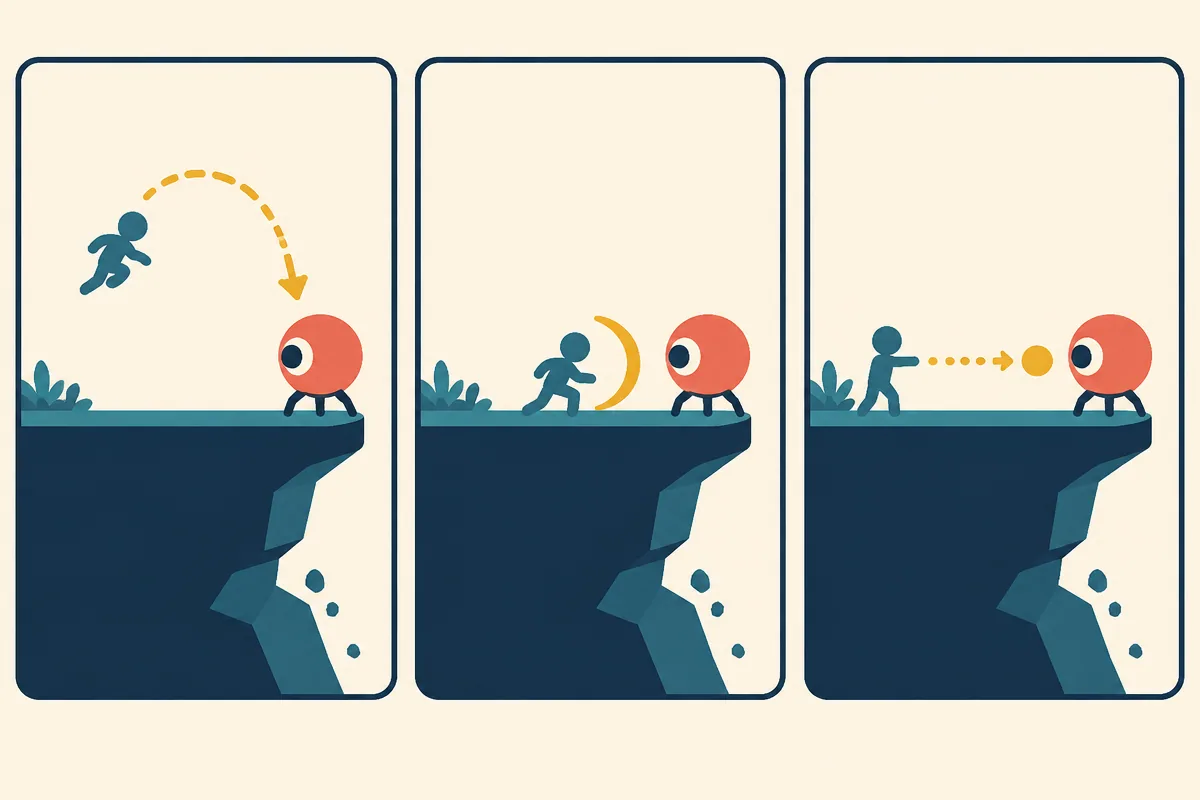
Hypothetical combat-position diagram; not a specific enemy solution.
Imagine an opponent beside a short platform edge. In a stomp-oriented situation, you need an approach from above and a useful landing afterward. With a sword, you need a position close enough to strike without stepping off the edge. With a projectile, separation may be useful, although the route still contains movement hazards.
That imagined comparison explains why “more attacks” is not the only meaningful difference. The attack changes which part of the screen deserves attention. A player who enjoys aerial approach decisions may prefer stomps; someone who enjoys managing close reach may prefer a sword. The example does not assign an actual enemy weakness to any listed game.
Platform combat: choose the action first, then learn its conditions
For a dedicated melee button, start with Super Slashman. For a mix of stomps and available fireballs, compare Super Steve World. For evolving powers and boss encounters, look at Super Onion Boy 2. For mission-based shooting, Alpha Guns is the more relevant structure.
After choosing, learn one attack in a safe section before combining every action at once. Check what enables a power, where its attack reaches, and what movement remains necessary. Those questions help you understand the selected mechanic without turning four different games into the same generic combat checklist.
Related tags
Frequently asked questions
Which pick has a dedicated sword button?
Super Slashman documents Z for slashing with a cyber sword and arrow keys for movement. Its combat therefore includes a separate close-range action.
Can Super Steve World use both stomps and projectiles?
Yes. Its description includes enemy stomps and fireballs, with the latter available when the relevant power is present. The two keyboard layouts use different keys.
How are powers used in Super Onion Boy 2?
X or J activates a power when one is available. Its guide also describes magic potions from treasure chests and a separate movement and jump layout.
Which game is most directly built around guns through missions?
Alpha Guns follows Max through side-scrolling shooting missions and arsenal upgrades. That is its main combat format, unlike a sword or stomp-centered interaction.
Does having a projectile remove the need to plan movement?
No. Platforms, enemies and hazards still define where the character can stand and continue. Ranged interaction changes the attack, not the entire route.
Is one combat style always easier?
The mechanics ask for different judgments about landing, reach and equipment. This comparison does not establish a universal difficulty ranking.
Try a platform adventure with a dedicated sword action
Play Super SlashmanMore arcade guides
 Arcade
Side-Scrolling Shooters: Ground Fire or Aerial Routes
Compare side-scrolling shooters by ground movement, free flight, enemy approaches and mission structure in Alpha Guns, Crazy Plane Shooter and Super Pork.
 Arcade
Vertical Climbing Games: Platforms, Dashes and Stacks
Compare vertical climbing games by alternating jumps, stacking blocks, timed jelly leaps and checkpoint routes. Choose the upward challenge you want.
 Arcade
Top-Down Shooter Games: Movement, Aim and Open Space
Compare top-down shooters by movement, aiming and the space you must protect in Geometry Gunner, The Room and In Space.
 Arcade
Flight Runner Games: Glide, Climb and Follow the Light
Compare flight runners by steering, upward taps, boosts and light management in Paperly, Horizon, Going Up and Shadobirds.