Mahjong Puzzle Games: Compare Pairs, Triples and Access
On this page
Mahjong puzzle games in the browser share tiles, but they do not all use the same matching count or accessibility rule. Two identical pictures can be a complete pair in one game and only part of a required triple in another. Before selecting, read what constitutes a legal set.
Mahjong puzzle games: check the matching count and the access rule

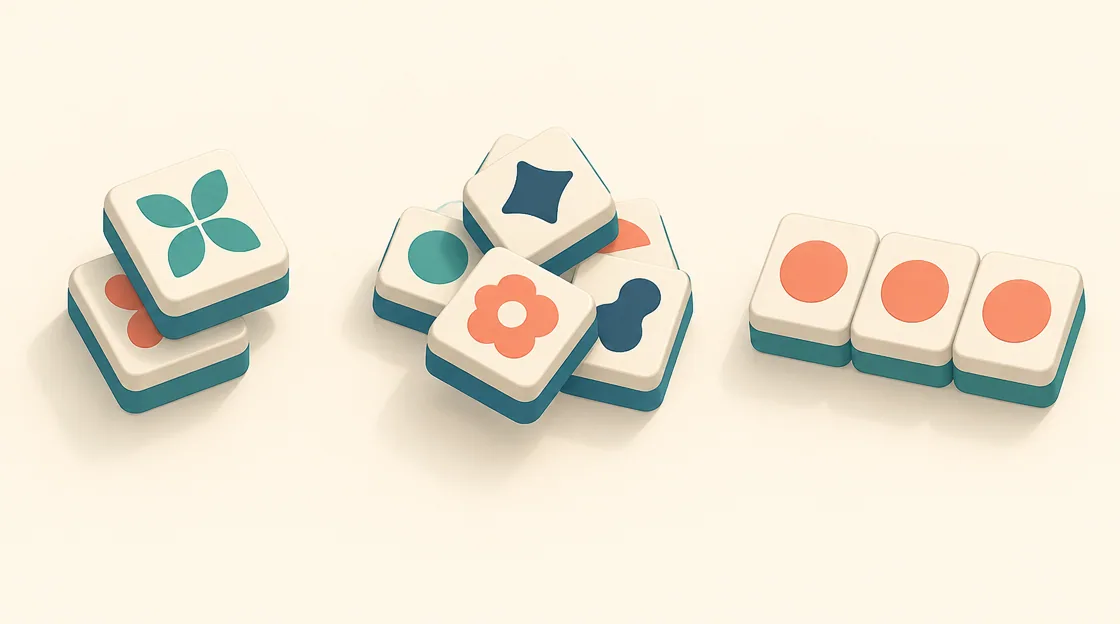
Illustration: Only the tile with an open side can be picked; the covered one must wait.
Mahjong Solitaire Zodiac removes identical pairs of open tiles. A tile is open when nothing rests on it and at least its left or right side is free. Recognizing two identical symbols is insufficient if one remains covered or blocked on both sides.
Candy Mahjong 3D finds identical candy pairs in a rotating pile. Drag to inspect another side and zoom for small details. Its guide emphasizes partly hidden tiles, so a matching partner may be around the back rather than absent from the board.
Mahjong Match instead clears three tiles of the same colour. Its guide specifically makes colour, rather than the depicted symbol, the relationship to read. Importing Zodiac's pair rule would leave you selecting an incomplete set.
Compare what the removal makes available
In Zodiac, consider whether a pair uncovers another tile or releases a blocked side. Two equal open pairs can lead to different access. In Candy Mahjong, rotate before taking the first plausible pair so you understand which layers it exposes. In Mahjong Match, locate enough members for the required triple rather than collecting isolated colours without a continuation.
An invented layered board might offer two identical pairs, one on a tall covering stack and another on an isolated edge. Removing the covering pair could reveal more choices. That is an illustration of access planning, not a claim that the same pair is always optimal.
Inspect rather than infer a shared implementation
Only apply Zodiac's explicit open-side condition where the current game states it. A three-dimensional presentation does not automatically confirm that it duplicates every traditional solitaire rule. Likewise, the word mahjong does not establish multiplayer play, a score table or a particular timer.
Choose Zodiac for layered open-pair planning, Candy Mahjong for inspecting a rotatable pair pile, or Mahjong Match for colour triples. On a stalled board, check the required count, the property that matches and whether every intended tile is selectable. Those three checks explain many apparent mismatches before you need help.
Related tags
Frequently asked questions
How many tiles form a Mahjong Match set?
Three of the same colour, according to its guide.
When is a Zodiac tile open?
Nothing rests on it and at least one of its left or right sides is free.
What is the Candy Mahjong matching rule?
Select two identical candy tiles to remove the pair.
Why rotate a 3D pile?
It can reveal partners and layers hidden behind the current view.
Should I apply the same open-side rule everywhere?
Only where it is established by the selected game’s instructions. Shared themes do not establish identical mechanics.
What can make one available pair more useful?
It may uncover tiles or open access needed for later matches.
Try the mechanic that interests you
Play Mahjong Solitaire ZodiacMore puzzle guides
 Puzzle
Shelf Sorting Games: Free Items Without Blocking More
Compare three shelf sorters by item access, triple formation and timers. Check what a placement exposes before covering another needed product.
 Puzzle
Cube Rotation Puzzles: Track Faces as the View Changes
Compare a colour-faced rolling cube, a die with a hidden bottom face and arrows viewed from new angles. Distinguish object orientation from camera rotation.
 Puzzle
Jigsaw Puzzle Games: Compare Pieces, Shards and Stickers
Compare jigsaw pieces, picture shards and numbered stickers. Choose whether you want visual fitting, fragment assembly or keyed placement.
 Puzzle
Word Game Hints: Choose the Right Clue When You Stall
Choose word-game help after identifying the missing information. Compare one-letter hints, fragment guidance and whole-category reveals across three games.