Untangling Puzzle Games: Move One Obstruction at a Time

On this page
In untangling puzzle games, a tangled-looking screen can hide several different movement systems. A rope can be repositioned, a snake may slide until blocked, or a long body may need steering into a matching hole. A move that solves one kind of obstruction can be meaningless in another.
Start by naming what prevents progress. Is it an unwanted crossing, an unavoidable stopping point or a route occupied by another body? The useful first move should change that specific condition.
Untangling puzzle games: name the obstruction before moving it
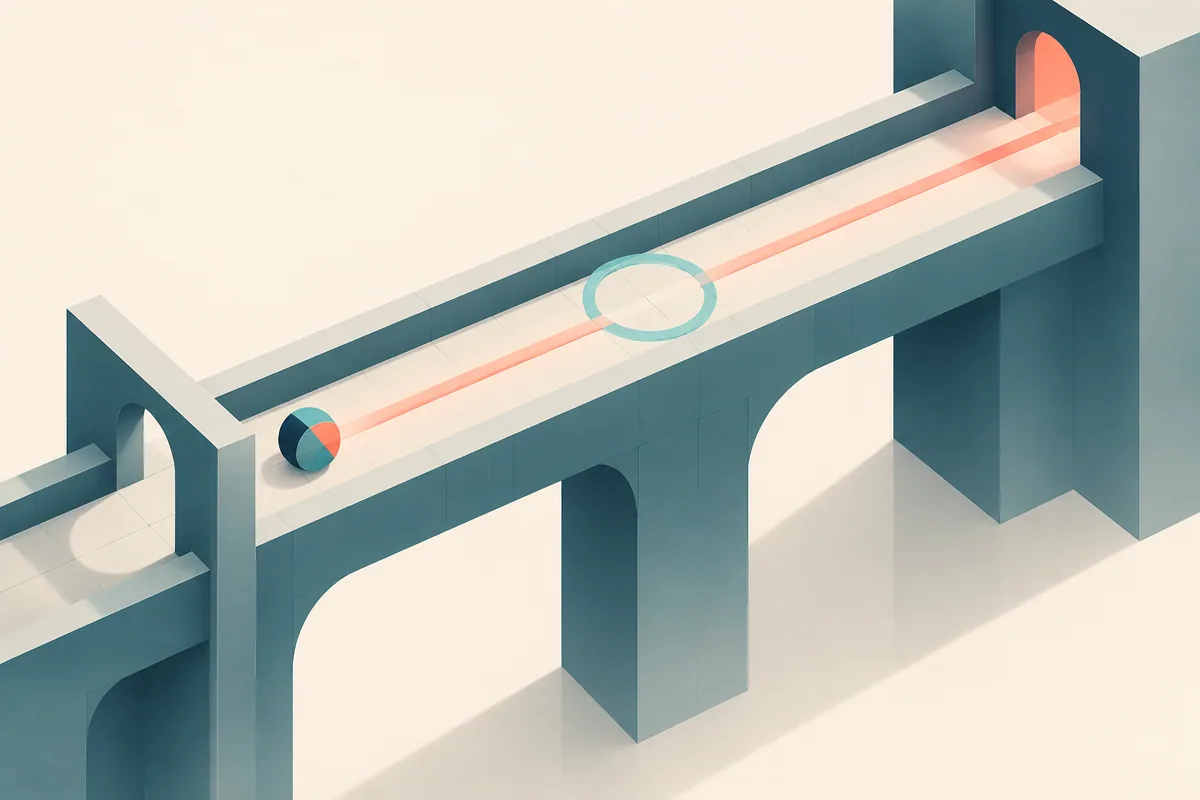
Illustration: The segmented token's trail runs straight past a ringed opening and stops only at the wall.
Twisted Rope 3D asks you to reposition ropes until knots are undone without creating new ones. Inspect how a proposed movement affects the other ropes, not only the selected strand. Pulling one section away can tighten or introduce another crossing.
Snake Tangle uses forced straight motion: once launched in a direction, the snake continues until an obstacle or maze edge stops it. The endpoint matters more than the first few cells of a slide. Some later levels add moving barriers, time limits or swipe limits.
Snake Out drags coloured snakes toward their matching holes before a timer expires. Different lengths occupy different amounts of grid, so route choice and move order both matter. A small body can still block the critical corridor of a longer one.
Predict the resting state, not just the motion
For ropes, inspect where the selected strand will sit relative to every crossing it passes. For Snake Tangle, trace the entire straight slide to its stopping point. For Snake Out, consider the space the full body occupies on its route rather than only the head’s destination.
Imagine an invented narrow corridor. Sliding a snake toward its entrance might overshoot the useful stopping point in Snake Tangle, while dragging a different snake out first might open the corridor in Snake Out. The board geometry may resemble each other while the legal control and consequence differ.
Work backward from the difficult exit
Identify the final corridor or hole approach and ask what needs to be absent before the object can use it. Follow that dependency until you find a legal initial action. This can be more efficient than repeatedly moving whichever piece looks most crowded.
Do not assume a tangled title means unlimited time or unrestricted dragging. Snake Out explicitly has a countdown, and Snake Tangle can add move or timing restrictions later. Inspect those conditions before experimenting with a long sequence.
Choose Twisted Rope for crossing relationships, Snake Tangle for endpoint planning, and Snake Out for shared-grid routing. The most useful movement is one whose final position you can explain and whose effect on the other pieces you have considered.
Related tags
Frequently asked questions
Does Snake Tangle stop after one cell?
No. It continues straight until an obstacle or the edge stops it.
Does Snake Out have a timer?
Yes. Every snake must reach its matching hole before the countdown expires.
What makes a rope move risky?
Repositioning one strand can create a new knot with another, so inspect the whole arrangement.
Why consider snake length?
A longer body occupies more route space and may block a corridor even after its head has moved.
Can I transfer the same drag habit between all three?
No. Their legal movements differ: rope repositioning, forced slides and guided dragging.
Where should a backward plan begin?
At the difficult final approach, tracing which blockers must move before it can be used.
Try the mechanic that interests you
Play Twisted Rope 3DMore puzzle guides
 Puzzle
Shelf Sorting Games: Free Items Without Blocking More
Compare three shelf sorters by item access, triple formation and timers. Check what a placement exposes before covering another needed product.
 Puzzle
Cube Rotation Puzzles: Track Faces as the View Changes
Compare a colour-faced rolling cube, a die with a hidden bottom face and arrows viewed from new angles. Distinguish object orientation from camera rotation.
 Puzzle
Jigsaw Puzzle Games: Compare Pieces, Shards and Stickers
Compare jigsaw pieces, picture shards and numbered stickers. Choose whether you want visual fitting, fragment assembly or keyed placement.
 Puzzle
Word Game Hints: Choose the Right Clue When You Stall
Choose word-game help after identifying the missing information. Compare one-letter hints, fragment guidance and whole-category reveals across three games.