Swinging Games: Compare Hook Arcs and Release Timing
On this page
Swinging games make letting go an active decision. Attaching keeps the character on an arc; releasing turns that motion into the route toward a new hook or landing. A late release and an early release can miss in different directions, so watching only the anchor point gives you an incomplete picture.
Hook, Bounce Ball Hook and Hook King Runner offer related but distinct versions of this movement. Compare what the documented press does, how release is described and what the level asks you to reach. The shared hook theme does not establish identical rope behavior, automatic targeting or a universal release angle.
| Game | Documented interaction | Route goal |
|---|---|---|
| Hook | Aim, hold to attach, release onward | Carry momentum through levels |
| Bounce Ball Hook | Click, or touch and hold | Bounce and hook while collecting stars |
| Hook King Runner | Hold to swing, release to fly | Pass traps and reach the finish |
Hook: the next anchor matters before release
Hook asks you to point toward a hook, hold the mouse button to attach and release to fly onward. Its more than 100 levels make the swing-to-swing transition the main activity. The next anchor is relevant while the current arc is still developing.
Watch the direction of travel, not merely how close the figure is to the hook. A position beside the anchor can occur while moving toward or away from the next route. Choose this game if carrying momentum between attachments is the mechanic you want to explore, with level progression providing a defined stopping point.
Bounce Ball Hook combines two movement ideas
Bounce Ball Hook describes a ball that bounces and hooks through levels, collecting stars without falling. Its documented desktop action is left mouse click, while the touch guide uses hold input. That wording is enough to distinguish the broad interaction, but not to assume every device uses an identical release sequence.
Learn the opening response before chasing a star off the direct line. Does the current action place the ball on a useful continuation? A collectible is only one point in the route; the ball still needs somewhere to go afterward. Choose it if you want the bounce-and-hook combination rather than a stick figure swinging alone.
Hook King Runner makes release part of the obstacle route
Hook King Runner explicitly describes holding to launch the hook and swing, then releasing to fly past traps and enemies. Coins sit along a route toward the finish. Its ragdoll presentation makes the visible body move with the swing, but the useful question remains where the route continues after release.
Look beyond the first obstruction. A release that clears a trap may still leave the character approaching an enemy or an unusable landing. Choose a line that connects several pieces of the route instead of aiming only for the nearest opening. Exact attachment behavior should come from the current level's feedback.
Separate attachment, arc and departure
Treat a swing as three linked decisions. First choose a useful attachment if the game gives you that choice. Next watch the arc develop and the direction of motion change. Finally release toward a destination you have already identified. An error in the first part can make the final release look harder than it needs to be.
This does not mean waiting for the same visual angle in every game. Rope length, available anchors and the surrounding route can differ. The practical habit is to name the destination before letting go, then judge whether the current arc can lead there.
Use an invented early-versus-late comparison
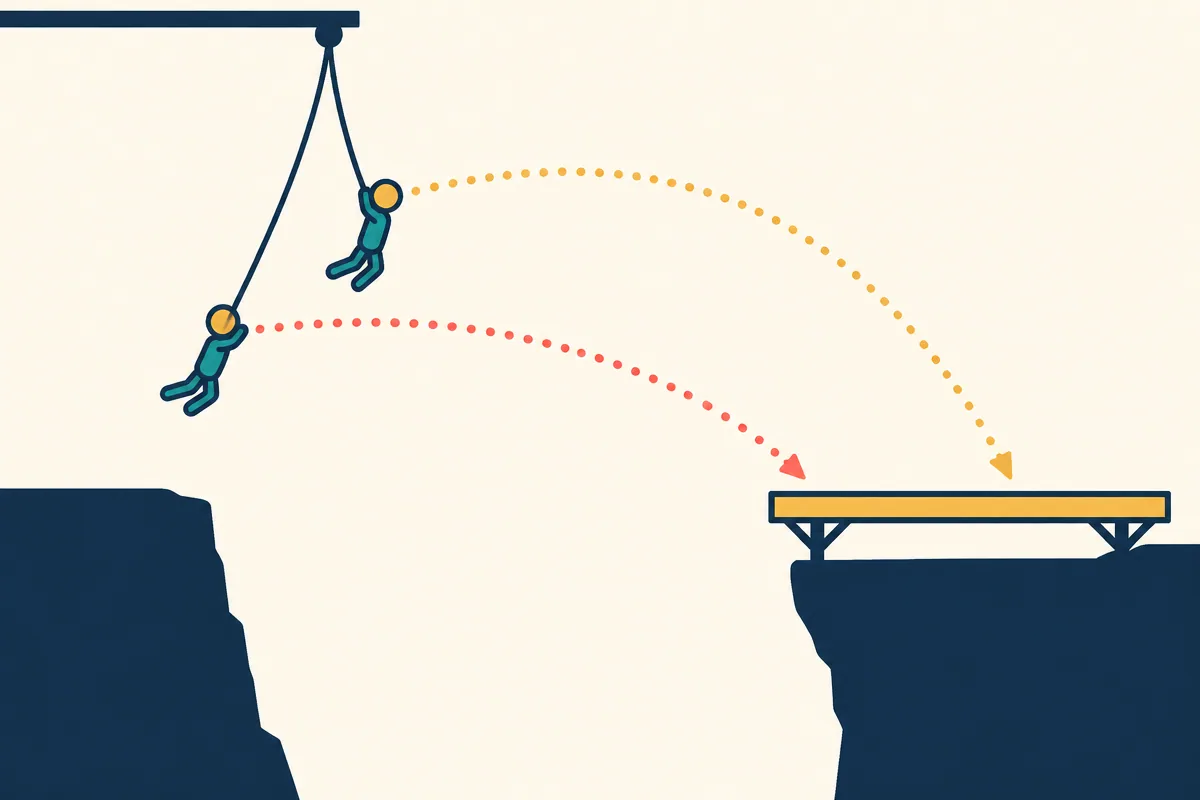
Hypothetical release-timing diagram; not measured game physics.
Imagine a hook above a gap with a broad platform to the right. An early release might send the traveler along a low path that does not reach the platform's height. A later release might carry the traveler higher but toward a different part of the scene. Which is useful depends on the current motion and geometry.
On a replay, change the release moment while keeping the chosen anchor and approach similar. That makes the result easier to compare. The example is conceptual, not measured physics for one of these games, and it does not establish a single best angle or a guaranteed landing.
Swinging games: choose the swing structure you want
Pick Hook for repeated anchor transitions, Bounce Ball Hook for a ball's bounce-and-hook route with stars, or Hook King Runner for held swings and releases through traps toward a finish. Each puts the next landing in a different context.
After a miss, ask whether the attachment was useful, whether the release matched the direction of travel and whether you had a destination beyond the obstacle. Those questions lead to more specific corrections than repeatedly holding longer without watching what the swing is doing.
Related tags
Frequently asked questions
What does holding the mouse do in Hook?
The guide describes pointing toward a hook and holding to attach. Releasing sends the figure onward toward the next part of the route.
Is Bounce Ball Hook only a swinging game?
Its description combines bouncing and hooking, with stars to collect while avoiding a fall. Learn how the opening input affects both actions.
What is the release action in Hook King Runner?
Hold to swing, then release to fly past obstacles toward the finish. The route also contains traps, enemies and coins.
Does the same release angle work in all three games?
No shared angle is established. The available anchors, route geometry and movement behavior can differ.
Why should I look past the first obstacle?
Clearing one hazard can still leave a poor next landing or another hazard. Choose a continuation rather than aim only at empty space beside the current trap.
How can I compare two release attempts?
Keep the anchor and approach similar, then change the release moment. This isolates timing more clearly than altering every part of the swing at once.
Try attaching to a hook and releasing into the next arc
Play HookMore arcade guides
 Arcade
Side-Scrolling Shooters: Ground Fire or Aerial Routes
Compare side-scrolling shooters by ground movement, free flight, enemy approaches and mission structure in Alpha Guns, Crazy Plane Shooter and Super Pork.
 Arcade
Vertical Climbing Games: Platforms, Dashes and Stacks
Compare vertical climbing games by alternating jumps, stacking blocks, timed jelly leaps and checkpoint routes. Choose the upward challenge you want.
 Arcade
Top-Down Shooter Games: Movement, Aim and Open Space
Compare top-down shooters by movement, aiming and the space you must protect in Geometry Gunner, The Room and In Space.
 Arcade
Flight Runner Games: Glide, Climb and Follow the Light
Compare flight runners by steering, upward taps, boosts and light management in Paperly, Horizon, Going Up and Shadobirds.