
Strategy Games on Zigzigo: Defense, Resources and Timing
On this page
Strategy games cover several different kinds of decisions. One game asks where to place a tower before the next wave. Another asks which production step needs an upgrade. A third keeps you moving between tasks while resources run low. To find a useful starting point on Zigzigo, compare the decisions you want to make rather than assuming every strategy game plays like a battlefield simulator.
These six picks come from the catalog's strategy category and were selected for their contrasting mechanics. The descriptions below use the listed objectives and guides, without claiming a popularity order or hands-on performance results. Garden Master is included deliberately as a timing-and-prioritization example: its plant-care arcade loop differs from the army and building games beside it.
Pick the decision you want to manage in strategy games
| Game | Core decision | Useful distinction |
|---|---|---|
| Defend the Castle | Where to build and upgrade | Grid defense between waves |
| Tower Crush | How to arm and target a tower | Combat decisions by floor |
| Stickman Simulator Final Battle | Which troops to deploy and where | Army setup before fighting |
| Babel Tower | Which production stage needs attention | Linked resource processes |
| My Sugar Factory | Where to reinvest earnings | Factory and research growth |
| Garden Master | Which plant or refill needs attention | Movement and task timing |
Defend the Castle: plan coverage before the next wave
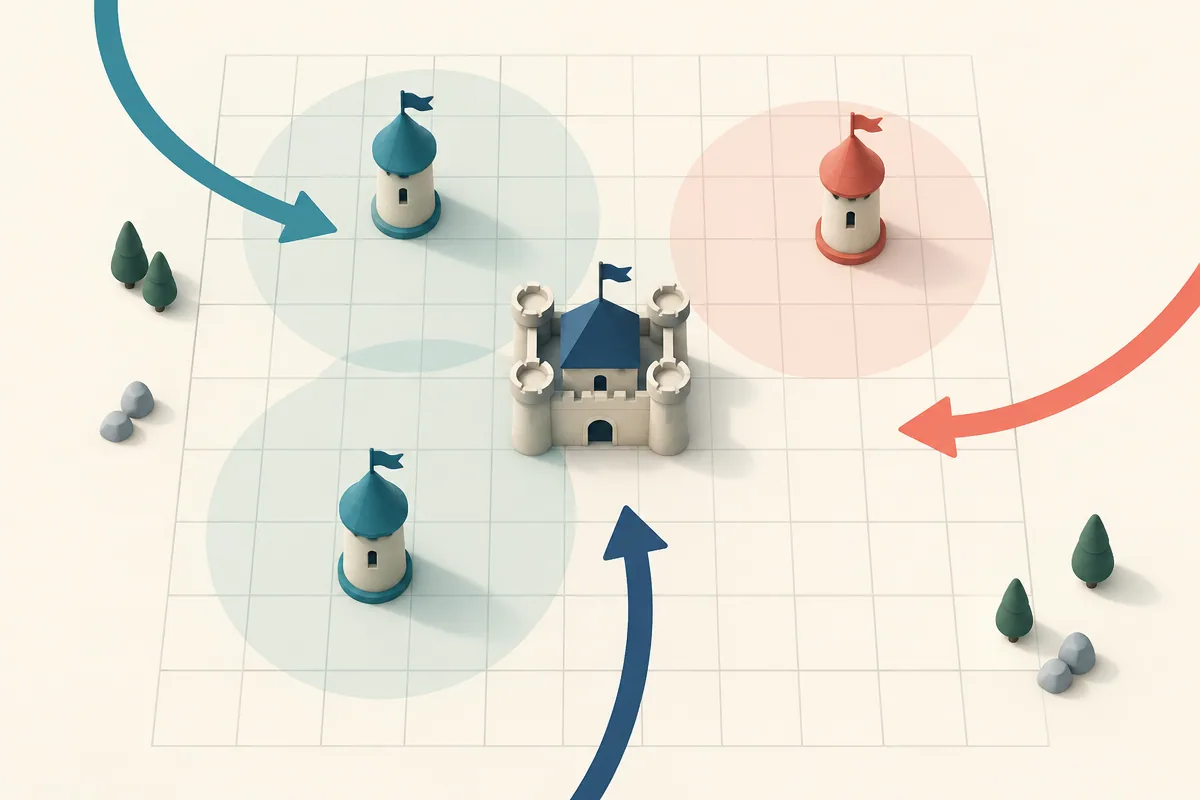
Conceptual diagram of coverage from different approaches; not a Defend the Castle layout or solution.
Defend the Castle uses a building grid, gold and wood, with walls, archer towers and cannon towers. Enemies approach the castle from several sides. This makes placement a coverage problem: a strong defense on one approach does not automatically protect another. Observe the routes during a wave, then spend the next build phase on the weakness you actually saw.
The guide documents selecting a build card and a grid square, Space to start a wave, and U to upgrade a selected tower. Its build-phase undo refunds that phase's placements. That gives you a way to reconsider a layout before sending the next attack. Choose this game if you enjoy separating preparation from the consequences of that preparation.
Tower Crush: manage floors and choose targets
Tower Crush builds combat around towers with up to six floors, each carrying a weapon. Instead of surrounding a fixed castle, you arm your own stacked structure and attack an opposing tower. On desktop, the guide describes selecting a section, or dragging across several, then clicking an enemy floor to target it.
Your selection question is whether you want decisions during the exchange as well as upgrades between battles. Observe which floor you are selecting and which enemy floor it targets before changing several things at once. The catalog mentions weapon upgrades and special powers, but it does not establish one universally strongest loadout. Treat different weapons as options to compare against the opponent rather than a promised winning formula.
Stickman Simulator Final Battle: test an army arrangement
Stickman Simulator Final Battle emphasizes choosing troops and placing them before the fight. Its guide describes clicking a unit icon, selecting an empty deployment square, and starting the battle once the army is ready. This is a different appeal from aiming individual attacks: the arrangement is the decision you take into the encounter.
Watch which units fall first and whether another group reaches the fight too late to contribute. On a later attempt, change a formation choice or troop mix for a specific reason. Changing everything together makes it harder to understand what improved the result. Choose this entry when comparing setups interests you more than managing an economic chain.
Babel Tower: look for the production bottleneck
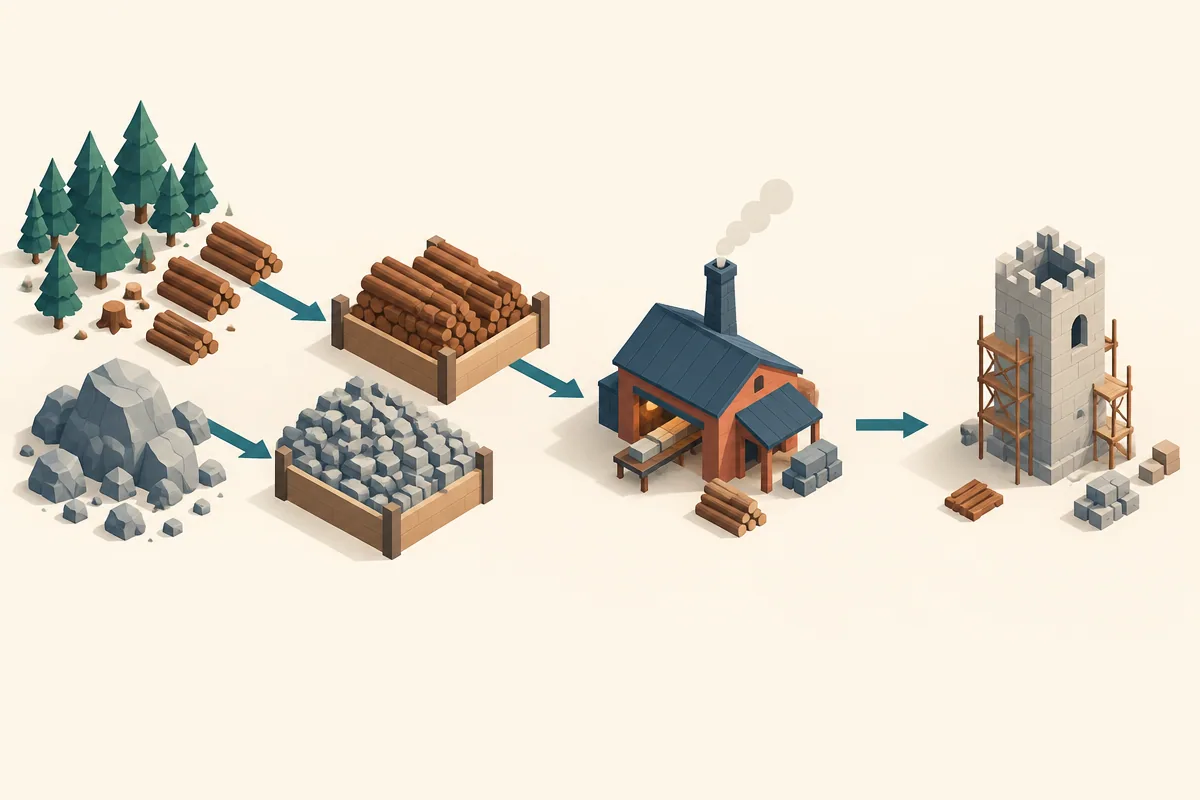
Conceptual production-bottleneck illustration; not a Babel Tower screenshot or upgrade recommendation.
Babel Tower connects wood, water, stone, processing and construction. Its guide describes starting the forest and quarry, supplying water for regrowth, moving resources through storage, and speeding processing actions. The important distinction is the relationship between steps: a productive source may still leave a later stage waiting.
Before an upgrade, follow one material from its source to its use. Is the shortage caused by collection, transport or processing? Prioritize the step that is holding up the next stage rather than repeatedly boosting a source because its button is familiar. Choose Babel Tower when you want incremental progress with a visible chain of dependencies. The guide does not quantify an optimal upgrade sequence or promise a particular completion time.
My Sugar Factory: compare expansion with research
My Sugar Factory starts with tapping and develops into purchasing factories, funding research and improving sugarcane. It is the more focused choice for reinvesting earnings into a growing business. The catalog describes an idle component, but does not specify exact away-time limits, earning rates or browser-storage behavior.
When deciding what to buy, distinguish adding production capacity from improving what you already operate. Read the current purchase description and cost before spending, then inspect the effect. Avoid assuming that the most expensive visible option always gives the best immediate return. Choose it for an economic progression loop rather than defensive positioning or precise movement.
Garden Master: strategy through task priorities
Garden Master asks a gnome to water five pots, refill a can at a barrel, and respond to gophers. Its desktop guide lists arrow-key movement between shelves and Space for watering. The strategy comes from choosing the next job while the plants and water supply need attention.
A useful route accounts for the return trip to the barrel, instead of visiting plants until the can runs empty far away. The gopher warning also competes with watering priorities. Choose this entry if you want planning expressed through movement and timely action. If your preference is arranging a defense and then watching a wave, Defend the Castle offers a more relevant structure.
Use one observation to guide the next decision
For defense games, name the route or target that caused the problem. For builders, name the production stage that is waiting. For task games, name the job you neglected and why. Then change one controllable part of your approach. This keeps an unsuccessful attempt informative without pretending that a general tip can replace the rules and upgrade choices of each game.
Related tags
Frequently asked questions
Which pick is a tower-defense game?
Defend the Castle places defenses on a grid around a castle and sends enemies in waves. Tower Crush also uses towers, but its central structure is a floor-by-floor battle against another tower.
Which strategy game focuses on resources rather than fighting?
Babel Tower links collection, transport and processing to construction. My Sugar Factory focuses on factories, research and sugarcane improvements. Both are more relevant than the combat picks if production decisions interest you.
Is Garden Master the same kind of strategy game as an army simulator?
No. It is listed in the strategy category, but its catalog describes plant care, movement, refilling water and responding to gophers. Its decisions concern task priorities rather than troop deployment.
What should I change after a failed army setup?
Observe which units fell first or failed to contribute, then change a specific formation choice or troop mix. This comparison is a general method; it does not establish a winning formation for every battle.
Does My Sugar Factory guarantee earnings when the browser is closed?
The catalog describes idle earnings but does not document browser closure, saved progress or away-time limits. Check the current game information before relying on unattended earnings or stored progress.
Are exact controls available for every pick?
The catalog gives detailed desktop mappings for several picks, while some builder guides primarily describe tapping actions. Use the individual guide and the current game interface to confirm available inputs.
Start with a grid defense challenge
Play Defend the CastleMore strategy guides
 Strategy
Creator Career Games: Projects, Posts and Upgrade Plans
Compare simulated creator careers through game releases, profile activity and video publication. Choose the work loop and feedback you want to learn.
 Strategy
Land Clearing Games: Tools, Routes and Growing Work Areas
Compare garden cleanup, crop-machine work and logging deliveries. Choose tools, carrying upgrades and routes that complete the whole work loop.
 Strategy
Farm Management Games: Crops, Animals and Task Priorities
Choose farm games by crafting, crop-machine missions or egg production and protection. Compare the next task before expanding the homestead.
 Strategy
 Resource Choices: Spend, Save or Reinforce Now
Decide when strategy resources should fund growth, supply or immediate defense. Compare three games using a practical now, next and later check.