Sliding Block Games: Think About the Space Afterward
On this page
In sliding block games, a move changes more than one piece’s location. It creates a gap, can trigger a fall or changes the route available to another tile. If you look only at the piece you want to place, the next board state can be an unpleasant surprise.
Three games make those consequences different. One uses horizontal slides and gravity, another rebuilds a picture against a clock, and a third reorders numbers through a single gap.
The space after the slide is part of the move
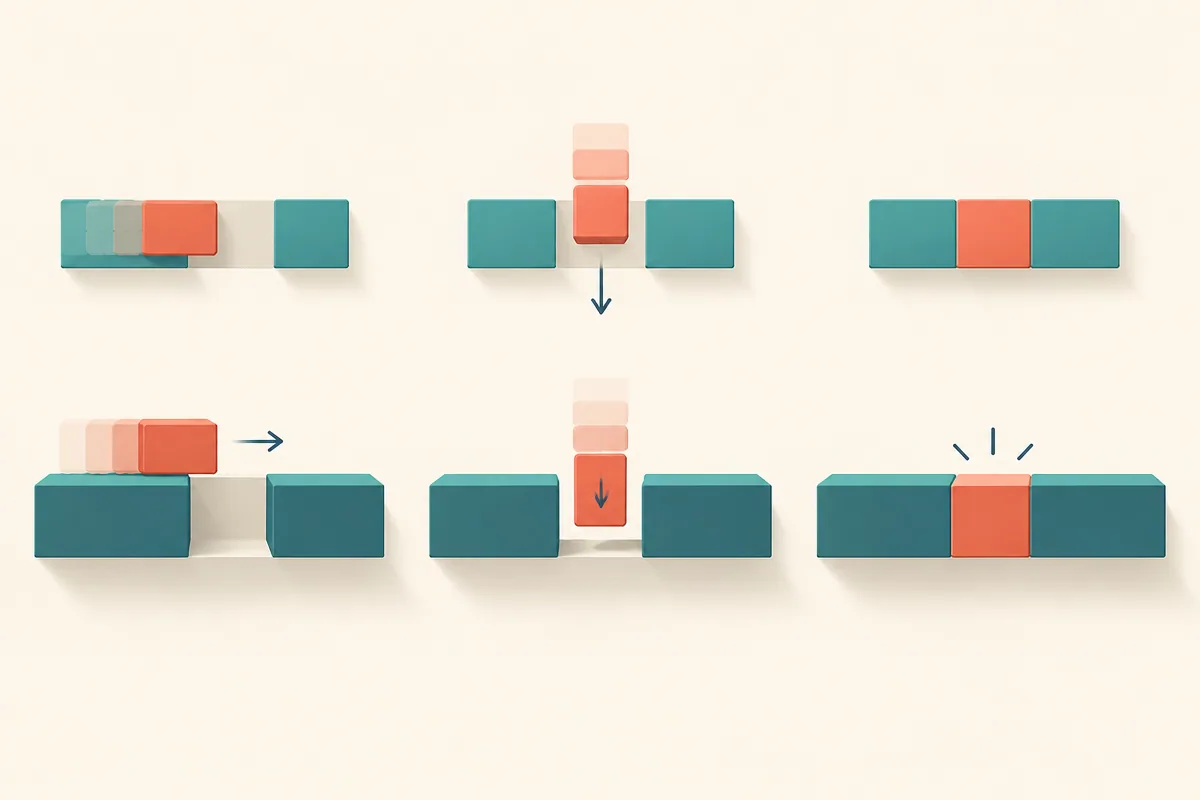
Illustration: Sliding sideways, the brick drops into the gap and completes a row, the outcome that matters most.
Brick Slide moves coloured bricks only sideways. When space opens underneath, they fall automatically. A full row clears, but a slide that fails to complete a row adds another row from below. Evaluate the eventual resting positions and stack height, not just the immediate lateral movement.
Slide Blocks 3D asks you to restore a scrambled picture before a countdown expires. Its Hint indicates a piece’s destination, Undo reverses the last move and Magnet places a piece. The reference image helps identify destination, but you still need a usable sequence of slides.
Classic Number Puzzle uses numbered tiles and one empty space. Only a neighbouring tile can enter the gap. Each move opens a new gap elsewhere, so solving a section means controlling where that empty space ends up.
Sliding block games: predict the full resting state
For Brick Slide, follow gravity after the sideways movement. Which pieces drop, which gaps fill, and does a row actually complete? A move that looks promising halfway through may still raise the stack if it produces no clear.
For a picture puzzle, use shared edges and recognisable image features to determine whether a tile is genuinely in place. For the numbered puzzle, inspect how moving toward one destination affects access for the other unsolved tiles.
A hypothetical move with the wrong aftermath
Imagine a brick that can slide over a hole. If it falls into the hole and completes a row, the board changes in your favour. If it merely fills a cavity without finishing the row, the added bottom row may consume precious height. The rule makes two visually similar movements carry different costs.
In a one-gap puzzle, a tile can reach its destination while leaving the gap trapped away from the next working area. The local success is real, but the surrounding sequence still needs planning.
Choose the feedback you prefer
Brick Slide suits planning cascades with a height penalty for unproductive moves. Slide Blocks 3D suits image reconstruction with an explicit timer and several kinds of help. Classic Number Puzzle suits orderly rearrangement through a constrained gap. Across all three, finish the mental move before finishing the physical drag.
Related tags
Frequently asked questions
Can Brick Slide bricks move upward?
Its guide describes sideways movement only; bricks drop automatically when space opens below.
What does an unproductive Brick Slide move cost?
A slide that completes no row sends another row upward from the bottom.
Is Slide Blocks 3D untimed?
No. Its guide explicitly includes a countdown for rebuilding the picture.
How does Magnet differ from Undo?
Magnet places a piece into its destination; Undo reverses the previous move.
Why track the gap in Classic Number Puzzle?
It determines the next legal tile movement and can end up away from the section you want to solve.
What should I predict before releasing a drag?
The final resting state, including falls, clears and the location of the newly opened space.
Try the mechanic that interests you
Play Brick SlideMore puzzle guides
 Puzzle
Shelf Sorting Games: Free Items Without Blocking More
Compare three shelf sorters by item access, triple formation and timers. Check what a placement exposes before covering another needed product.
 Puzzle
Cube Rotation Puzzles: Track Faces as the View Changes
Compare a colour-faced rolling cube, a die with a hidden bottom face and arrows viewed from new angles. Distinguish object orientation from camera rotation.
 Puzzle
Jigsaw Puzzle Games: Compare Pieces, Shards and Stickers
Compare jigsaw pieces, picture shards and numbered stickers. Choose whether you want visual fitting, fragment assembly or keyed placement.
 Puzzle
Word Game Hints: Choose the Right Clue When You Stall
Choose word-game help after identifying the missing information. Compare one-letter hints, fragment guidance and whole-category reveals across three games.