
Rolling Ball Games: Narrow Bridges or Tilting Boards
On this page
A narrow bridge can look similar in two rolling ball games while responding differently to your input. One game moves the ball directly, another uses drag speed, and a third asks you to tilt the surface underneath it. Trouble often starts when you correct for the wrong relationship between the control and the ball.
This comparison starts with that relationship. Learn what one small input changes, then inspect the obstacle ahead. Speed is useful only when it leaves enough room to handle the next bend, landing or target hole.
Identify what your input actually moves
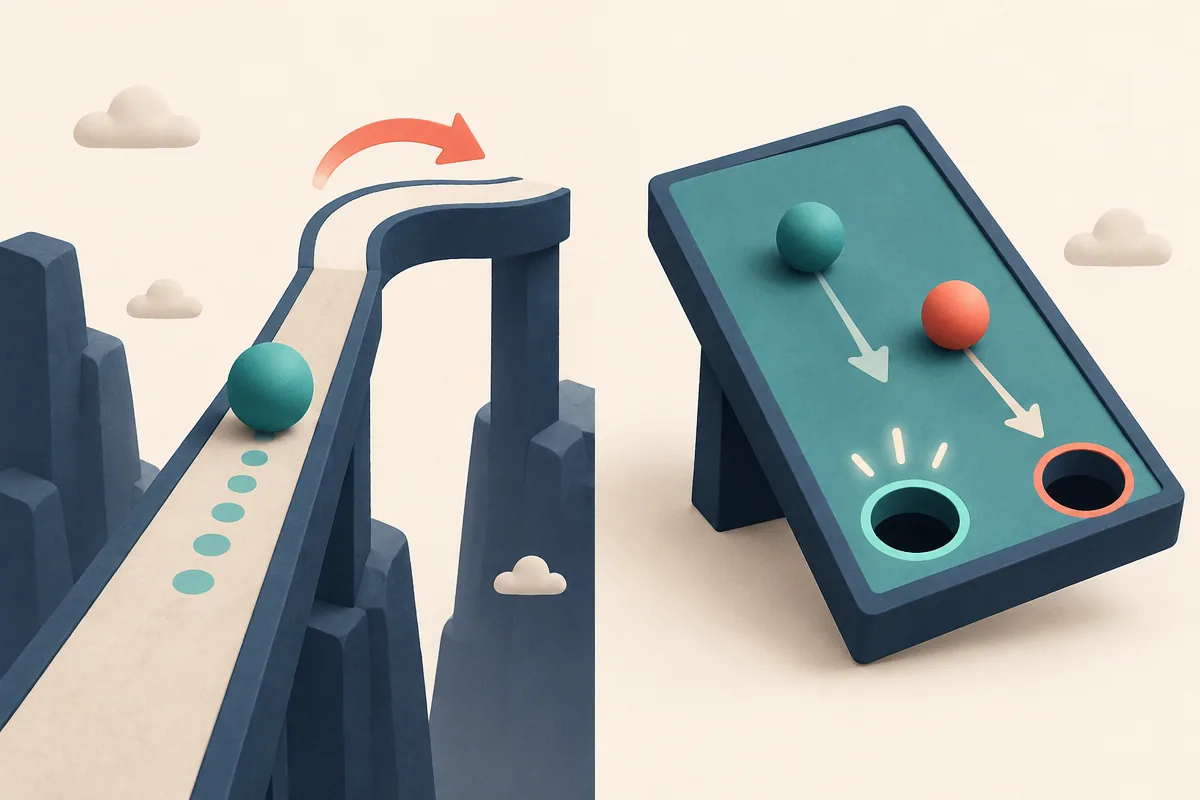
Illustrations separate changing a ball’s heading from changing the surface beneath it.
| Game | Decision to make | Watch for |
|---|---|---|
| Extreme Balancer | Guide a ball across narrow structures | Moving platforms and a full level restart after a fall |
| Rolling Balancer Ball | Set direction and speed with gestures | Over-correction beside open water |
| Ball: Path Through Obstacles | Move forward, turn and jump | A heading must be lined up before accelerating |
| BAROHO | Tilt the platform carrying the balls | Target holes, coins and multiple balls |
Narrow-route games reward a readable approach
Extreme Balancer sends a ball across wooden bridges, tracks and moving obstacles. A fall returns you to the beginning of the level. Before entering a moving section, observe where its usable surface will be when you reach it, rather than judging only its present position.
Consider the difference between waiting on a stable bridge and hesitating halfway across a rotating part. The first can give you information; the second may leave the ball on a surface that continues changing underneath it. Decide on a viable crossing window before committing.
The source provides suggested directional controls for Extreme Balancer, rather than a confirmed binding. Check the loaded game and use a small test movement on safe ground before approaching an edge.
Rolling Balancer Ball ties forward pace to your gesture
Rolling Balancer Ball uses sideways swipes to shift the ball and forward drags to roll ahead. Faster forward dragging means a faster roll. Its destination is a boat beyond narrow bridges, with traps along the way.
A useful correction starts before the narrowest point. Reduce the forward gesture, straighten the approach, then cross with smaller sideways movements. Trying to repair a large sideways error while still driving forward quickly leaves less bridge on which to recover.
Separate a steering problem from a speed problem. If the ball is correctly aligned but repeatedly passes a safe stopping area, changing only sideways input will not address the cause. The drag-to-speed relationship gives you another control to adjust.
Ball: Path Through Obstacles separates heading from motion
Ball: Path Through Obstacles behaves more like a small vehicle. W moves forward, S backward, and A or D turn. Space jumps. That means turning does not simply slide the ball to a new horizontal position.
Line up the heading before accelerating through a narrow section. For a sharp bend, ease off, turn toward the next path and then advance. Holding forward while making a late turn can carry the ball into a trap even when the new direction eventually looks correct.
Coins support both skins and improvements in this game. Treat collection as a route choice: inspect whether an item can be reached while keeping a manageable approach to the next obstacle. Check an improvement's displayed effect instead of assuming it solves every handling problem.
BAROHO changes the surface rather than the ball
In BAROHO, you tilt a manipulator platform to roll balls toward yellow-rimmed target holes with glowing arrows. Other openings are not interchangeable with the targets. Every ball is needed to win, so one successful ball does not make the remaining board expendable.
Think about the consequence of a tilt for all balls still on the platform. A movement that helps one may send another toward a bad edge or opening. With a gamepad, the two sticks control separate sides; keyboard and touchscreen controls offer other ways to move the platform.
Fans introduce an additional push. Start with smaller tilts while learning how that force changes the path. The goal is a stable, interpretable adjustment, not a large correction followed by another equally large correction in the opposite direction.
Rolling ball games: choose the control problem you enjoy
Choose a bridge game for route alignment and moving-platform timing, a gesture-driven game for fine speed changes, or BAROHO for managing the surface beneath several balls. Before judging a new game as too slippery, establish whether you are steering, turning or tilting. That first distinction makes the rest of its rules easier to read.
Related tags
Frequently asked questions
Do all rolling-ball games use the same controls?
No. The examples include swipe-controlled speed, separate forward and turning inputs, and platform tilting. Check what one small input changes before approaching a hazard.
What happens after falling in Extreme Balancer?
The supplied guide describes restarting the level from its beginning. Observing a moving obstacle from safe ground can be valuable before risking that restart.
How is speed controlled in Rolling Balancer Ball?
Its guide ties forward speed to the speed of the drag gesture. Smaller, slower forward gestures give more room to align the ball near traps.
Why does turning late fail in Ball: Path Through Obstacles?
Forward movement and turning are separate actions. The ball can continue toward a hazard while its heading changes, so align the approach before accelerating.
Can I put a BAROHO ball into any hole?
No. The targets have yellow rims and glowing arrows. The game also distinguishes coins and requires every ball to be retained for completion.
Should I adjust everything after a failed crossing?
Change one likely cause first: pace, heading or timing. Keeping the other decisions similar makes it easier to understand whether the adjustment helped.
Try the mechanic that interests you
Play Extreme BalancerMore arcade guides
 Arcade
Side-Scrolling Shooters: Ground Fire or Aerial Routes
Compare side-scrolling shooters by ground movement, free flight, enemy approaches and mission structure in Alpha Guns, Crazy Plane Shooter and Super Pork.
 Arcade
Vertical Climbing Games: Platforms, Dashes and Stacks
Compare vertical climbing games by alternating jumps, stacking blocks, timed jelly leaps and checkpoint routes. Choose the upward challenge you want.
 Arcade
Top-Down Shooter Games: Movement, Aim and Open Space
Compare top-down shooters by movement, aiming and the space you must protect in Geometry Gunner, The Room and In Space.
 Arcade
Flight Runner Games: Glide, Climb and Follow the Light
Compare flight runners by steering, upward taps, boosts and light management in Paperly, Horizon, Going Up and Shadobirds.