
Car Crash Sandboxes: Set a Useful Experiment to Try
On this page
Car crash sandboxes are more interesting when the next reset answers a question. Instead of changing the car, speed, ramp and camera at once, set up one repeatable approach and observe one difference. The result can be entertaining and still teach you something about the game's own damage and handling systems.
Car Smash Simulator: Crash & Tune, Drive & Crash Sandbox and Car Crash Sandbox provide enough reset, repair and camera tools for this kind of self-directed session. Their keys differ, so establish the recovery controls before building the experiment.
Car crash sandboxes: choose one observation before the first run
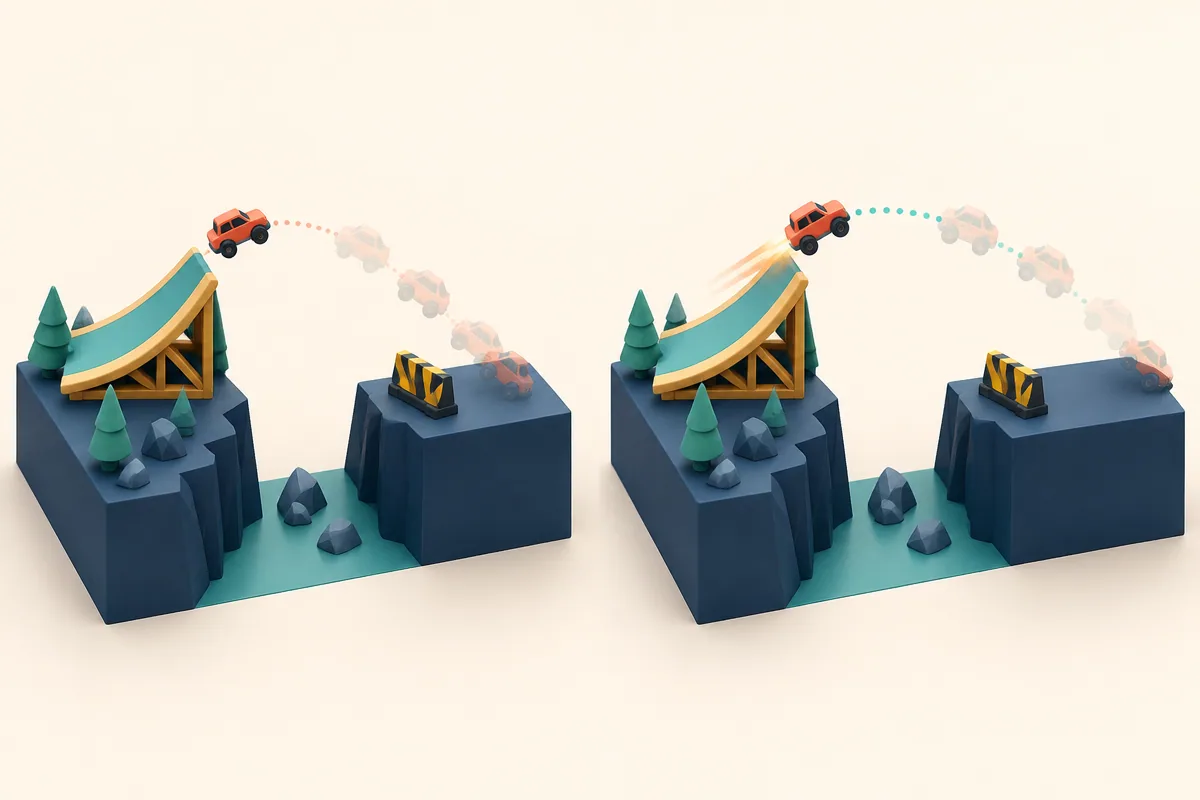
Illustration: Twin ramps differ only by a boost trail, so any change in the landing has one likely cause.
Use a small question: does a different approach line keep the car upright after the ramp, or does one handling mode make the same corner easier to complete? Avoid starting with a vague goal such as make the biggest crash, because there is no clear comparison when every run changes.
An illustrative test can use a familiar slope, one vehicle and one obstacle. Mark the starting position by nearby scenery, choose a camera and make an initial run without nitro. Repeat once with the same setup. If the approaches are inconsistent, practise the baseline before treating the next change as meaningful.
Know the reset and repair controls
| Game | Recovery controls in the guide | Observation tool |
|---|---|---|
| Car Smash Simulator | R flips, K repairs, N changes car | B slow motion, C camera |
| Drive & Crash Sandbox | R repairs, N changes vehicle | V slow motion, C camera |
| Car Crash Sandbox | R repairs, N changes vehicle | V slow motion, C camera |
Car Smash Simulator: Crash & Tune offers an open world with ramps, crushers and hammers, plus vehicle discovery and tuning. Drive & Crash Sandbox emphasises slopes and destructible obstacles without a strict checklist. Car Crash Sandbox adds maps, weather, tasks and distinct handling modes. Choose the environment whose controls let you repeat the question clearly.
Run a one-variable comparison
Suppose the baseline is a straight approach to one ramp. For the next run, keep the car, start point, camera and repair state unchanged, then change only whether you use nitro on the approach. Compare the landing and recovery, not just the visible damage. The game may not provide a speed log, so describe observations honestly instead of inventing precise measurements.
If you want to compare vehicles, return to the baseline approach first and then change the vehicle. Do not simultaneously select another ramp or a new weather effect. In Car Crash Sandbox, Drift, Arcade and Sport handling are distinct settings; changing one already changes the experiment even if the body shape stays the same.
Use slow motion to observe the sequence
Slow motion can help identify whether a wheel, the front body or a side contacts first. That may explain why two approaches leave the vehicle in different positions.
Choose a camera that shows the relationship you are testing. An external view can reveal approach alignment, while a closer view may reveal contact. Keep the view consistent for the comparison and use a second view afterward if you need to inspect something else.
Write down the result in ordinary language
A useful note might say the second approach landed farther left and needed a reset, while the baseline continued upright. That is stronger than claiming the new setup is universally better from one attempt. If the result varies across repeated runs, note the inconsistency rather than hiding it.
After answering one question, choose the next: line, boost, handling mode or vehicle. The sandboxes offer freedom, and a small test gives that freedom a direction. You can still enjoy a spectacular wreck, but each change now has a reason and each reset starts a clearer comparison.
Related tags
Frequently asked questions
Why change only one thing in a sandbox test?
If several settings change together, you cannot tell which one produced the difference. Keep a baseline and vary one input, vehicle or mode at a time.
Is R always the repair key?
No. Car Smash Simulator lists R for flipping and K for repair. Drive & Crash Sandbox and Car Crash Sandbox list R for repair.
Which games use V for slow motion?
Drive & Crash Sandbox and Car Crash Sandbox list V. Car Smash Simulator instead lists B.
What should I compare without a speed readout?
Describe visible outcomes such as landing direction, whether the vehicle stays upright and whether it continues afterward. Do not invent exact speeds or forces.
Does Car Crash Sandbox have different handling modes?
Its guide describes Drift, Arcade and Sport settings. Treat switching a mode as a meaningful variable in the test.
When should I change the sandbox weather?
After learning a repeatable baseline. Car Crash Sandbox offers weather options, but changing weather together with the car or route hides which variable caused the result.
Try the game that fits your next challenge
Play Car Smash Simulator: Crash & TuneMore racing guides
 Racing
Traffic Timing Games: Junctions, Laps and Safe Gaps
Compare roundabout launch timing with stop-and-go traffic driving. Learn to inspect entry, occupied space and the exit before committing.
 Racing
Parking Puzzle Games: Plan Routes, Fuel and Car Order
Compare six parking games on Zigzigo by route drawing, traffic removal, fuel rules, move order and careful steering. Find the right planning challenge.
 Racing
Browser Racing Games: Stunts, Chases and Steady Driving
Compare six browser driving games on Zigzigo, from police chases and motorcycle stunts to bus routes and timed drag-racing shifts.
 Racing
Motorcycle Upgrade Games: Pick Progression That Fits
Compare motorcycle progression through circuit upgrades, traffic earnings and stunt-stage unlocks. Connect each purchase to a clear riding objective.