Pixel Platform Games: Keys, Rescues and Classic Routes
On this page
A pixel-art thumbnail tells you how a platformer looks, but not what you will be doing between the first jump and the exit. Some adventures send you toward a rescue. Others ask you to clear enemies, obtain a key, or inspect blocks for useful items. Picking among pixel platform games by that structure gives you a clearer starting point than treating every retro-looking world as interchangeable.
The four games here offer different reasons to move through a level. Compare the main goal first, then the actions and optional discoveries around it. A rescue story can still contain coins; a key-based exit can still contain enemies. The distinction is which action actually moves the adventure forward.
| Game | Main attraction | Opening consideration |
|---|---|---|
| Super Onion Boy | Rescue across separate levels | Movement, jump and available powers |
| Super Oliver World | Blocks and hidden power-ups | Inspect the route as you advance |
| Super Cute Cat | Enemies followed by a key exit | Clear the task before leaving |
| Dotto Botto | A retro adventure opening | Keyboard-led title and menu |
A rescue route: Super Onion Boy
Super Onion Boy gives its platform action a rescue goal across 15 levels. You walk left or right, jump onto enemies, gather items, and use a power when one is available. The documented desktop choices include A/D or the arrow keys for movement, Z/K/Space for jumping, and X/J for powers.
Choose it when you want a familiar journey with a destination beyond the next screen. On a first pass, separate reaching safe ground from collecting every visible star. A star beside an enemy asks for an additional decision; it is not automatically part of the safest path through that section.
A discovery route: Super Oliver World
Super Oliver World emphasizes trap-filled routes, breakable blocks, coins and hidden power-ups. That makes the surroundings part of the attraction. Instead of only looking for the next gap, notice which blocks you can inspect and whether approaching one exposes you to a nearby hazard.
The documented desktop guide uses arrow keys for movement and Space for breaking blocks or attacking nearby foes. Treat a newly found ability as a reason to reassess the route, not a reason to ignore obstacles. If experimenting with the scenery appeals more than following a direct rescue line, this is the more relevant comparison.
A task-and-key route: Super Cute Cat
Super Cute Cat asks you to hunt mutated cats, obtain the key and use the exit, with candies along the way. The key creates a concrete completion check. Arriving at a door is insufficient if the action that makes departure possible has not happened yet.
Use a simple mental list: locate the required enemies, clear the immediate movement hazard, collect the key, then return toward the exit. Candy can become a secondary detour once the required route is understood. WASD movement is documented; confirm any other action on the opening screen instead of borrowing Onion Boy's keys.
A keyboard-led beginning: Dotto Botto
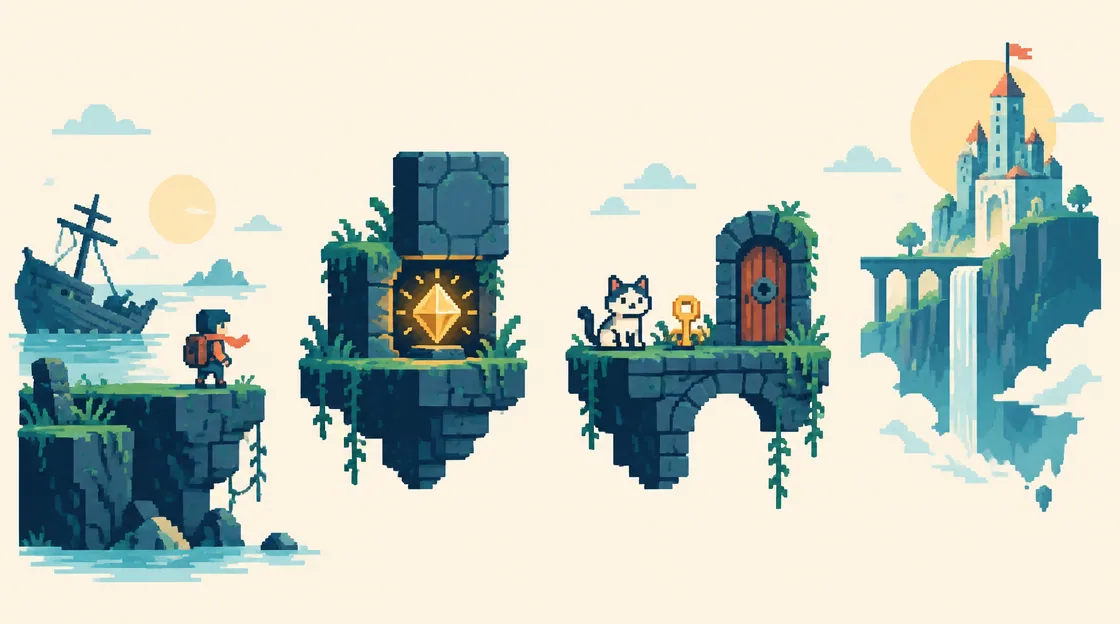
Dotto Botto begins with a crashed ship before its title and menu appear. Its opening asks for keyboard input: Space enters the menu and W moves the highlighted option upward, wrapping between choices. Audio and Music sit beside New Game as menu options.
This matters when choosing how to start an adventure. A title screen that reacts to keys can feel unresponsive if you keep tapping it. Reach New Game with the documented menu method before judging the platform action. Exact in-level movement should come from its current tutorial; the opening controls alone do not define the whole game.
Work through a hypothetical first junction
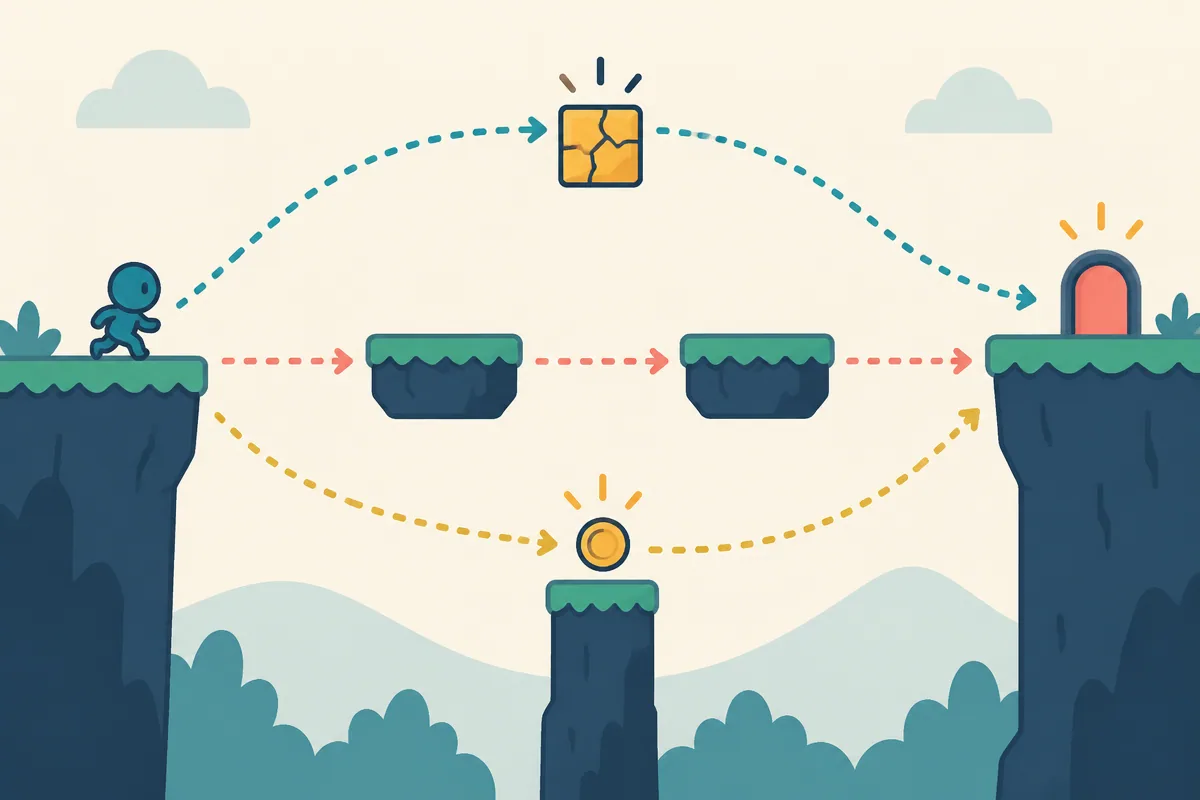
Conceptual route illustration; not a solved level from a listed game.
Imagine a platform section with an exit to the right, a block overhead and a collectible across a narrow gap. In a direct rescue run, reaching the right safely may be your immediate goal. In a discovery-focused run, inspecting the block could reveal a useful option. In a key-exit game, neither move substitutes for finding the key.
The same picture therefore creates different priorities. State the required task before making the detour. If the detour fails, you can then decide whether it was necessary, a worthwhile discovery, or an optional score attempt. That distinction makes replaying purposeful instead of repeating every jump without a clear reason.
Pixel platform games: choose the journey you want to repeat
Start with Super Onion Boy for a rescue-led structure, Super Oliver World for blocks and discoveries, or Super Cute Cat for a visible enemy-and-key task. Dotto Botto is an additional retro option with a keyboard-led opening. These choices describe different attractions rather than establish a universal winner.
After a first level, decide whether you want to advance, inspect overlooked areas or improve collection. Those are separate goals. Keeping one of them in mind helps you choose a platformer and gives the next attempt a practical purpose.
Related tags
Frequently asked questions
Which game has an explicit rescue objective?
Super Onion Boy describes rescuing a girlfriend across 15 levels. That story provides an overall destination alongside its jumping, items and enemy interactions.
Which pick emphasizes hidden power-ups?
Super Oliver World explicitly describes hidden power-ups and blocks to inspect. Approach them while accounting for traps and enemies along the route.
Does reaching the door finish Super Cute Cat?
The described sequence includes clearing mutated cats and obtaining a key before leaving. The exit is part of a task, rather than simply the far side of the level.
Why might Dotto Botto ignore taps at the title?
Its documented opening uses a keyboard for title and menu navigation. Space opens the menu and W moves its highlight; use the current game instructions for subsequent controls.
Should I collect every star before advancing?
That depends on your goal and the game rules. Separate required items from optional score detours, then choose whether the next attempt is for completion or collection.
Are identical pixel styles evidence of identical controls?
No. These games document different keys and tasks. Read each opening screen rather than assume movement, attacks and jumping share one layout.
Try a classic route with stomps and powers
Play Super Onion BoyMore arcade guides
 Arcade
Side-Scrolling Shooters: Ground Fire or Aerial Routes
Compare side-scrolling shooters by ground movement, free flight, enemy approaches and mission structure in Alpha Guns, Crazy Plane Shooter and Super Pork.
 Arcade
Vertical Climbing Games: Platforms, Dashes and Stacks
Compare vertical climbing games by alternating jumps, stacking blocks, timed jelly leaps and checkpoint routes. Choose the upward challenge you want.
 Arcade
Top-Down Shooter Games: Movement, Aim and Open Space
Compare top-down shooters by movement, aiming and the space you must protect in Geometry Gunner, The Room and In Space.
 Arcade
Flight Runner Games: Glide, Climb and Follow the Light
Compare flight runners by steering, upward taps, boosts and light management in Paperly, Horizon, Going Up and Shadobirds.