
Rooftop Runner Games: Compare Gaps, Slides and Chases

On this page
Rooftops make gaps easy to see, but rooftop runner games may ask for much more than pressing jump at an edge. Some games continue indefinitely, some combine slides and sidesteps, and some turn the course into a time-attack route with wall-running. Choose the movement pattern before deciding which skyline looks most appealing.
Santabalt, Parkour Runner 3D and Parkour Run - 3D Runner represent those differences. Compare what ends a run, which actions are separate and how the route rewards forward movement. The names are similar enough that checking the controls is particularly useful: their slide and special-action inputs are not interchangeable.
| Game | Route structure | Distinctive action |
|---|---|---|
| Santabalt | Endless rooftop run | Click to jump |
| Parkour Runner 3D | Rooftop obstacle course | Separate jump, slide and sidestep actions |
| Parkour Run - 3D Runner | Time-attack course with a finish | Wall-run and push off |
Santabalt: keep the next roof in view
Santabalt sends Santa across rooftops in an endless run. A desktop click makes him jump over gaps and barriers. The run has no finish line, so the immediate aim is to maintain the sequence rather than save effort for a final section you expect to arrive soon.
Look at the landing roof before committing to a jump. A gap and a barrier on the next surface create a sequence of decisions, not two unrelated obstacles. Choose Santabalt if one continuing jump action and a festive skyline sound right, without needing a separate wall-run or slide command.
Parkour Runner 3D: classify the obstacle before acting
Parkour Runner 3D gives jumping, sliding and lateral movement separate inputs. W or Up Arrow jumps; S or Down Arrow slides; A/D or left-right arrows move sideways. That action vocabulary changes how you read a barrier.
Before pressing, identify whether the useful path goes over, under or beside the obstruction. Repeatedly using jump because it worked on the previous roof may be the wrong response to a different obstacle. Learn those ordinary actions before adding its special abilities, so you can recognize which part of the route caused a miss.
Separate a single Space press from a double press
Parkour Runner 3D also documents Space as a Head Booster on a single tap and a Hover Board on a double tap. The difference is important because it is not a second jump key in this control scheme. A habitual double press can select a different action from the one you intended.
Choose a section with a clear route to understand the available special action before using it to solve an uncertain obstacle. The ability is part of the movement set, not evidence that every approaching gap can be ignored. Read the current game feedback to see what the selected action actually changes.
Parkour Run - 3D Runner: the wall becomes part of the route
Parkour Run - 3D Runner is built around finishing as quickly as possible. Holding left or right against a wall performs a wall-run; Space jumps or pushes off the wall; Shift slides. Its first level includes a tutorial, with further mechanics introduced as you progress.
The description says maximum speed comes from moving straight forward. That makes unnecessary steering a relevant replay issue, but not a reason to skip learning the route. A wall-run has an approach, contact and departure. Understand those stages before trying to connect them into a faster line.
Work through an invented rooftop sequence
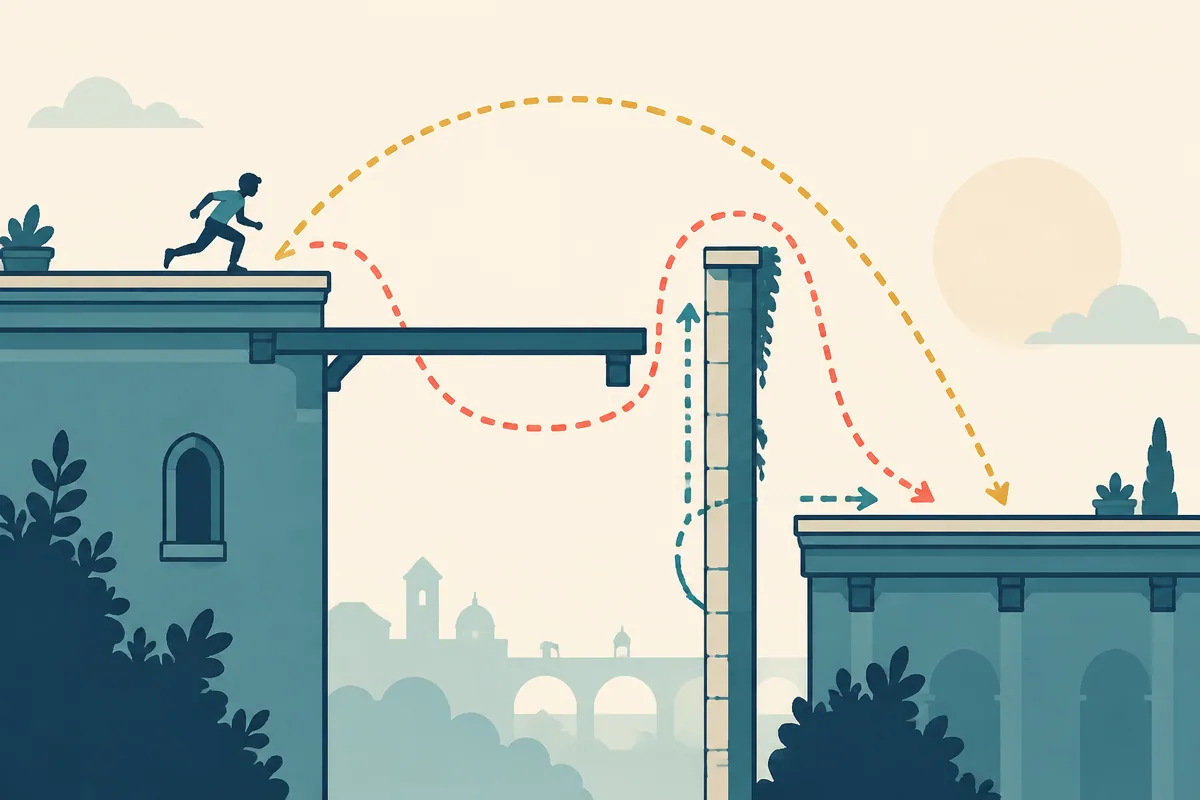
Hypothetical obstacle-sequence diagram; not a game level solution.
Imagine a wide roof, a low overhead obstruction, a wall beside a gap and a final platform. A jump-only runner would need a route designed around that single action. A multi-action course might ask for a slide before a sidestep. A wall-running course could make contact with the wall the intended continuation.
The same skyline does not imply the same solution. Read the action the game actually supports, then identify the next landing or safe passage. This hypothetical sequence illustrates why choosing by movement matters; it is not a claimed route through any of the three listed games.
Rooftop runner games: choose an ongoing run or a course to finish
Start with Santabalt for an endless jump loop, Parkour Runner 3D for distinct over-under-side actions, or Parkour Run - 3D Runner for a finish-line course with wall-running. Each gives you a different reason to replay.
After the opening attempt, name the missing skill in concrete terms: spotting the next roof, choosing the right obstacle response, or connecting a wall departure to a landing. That is more actionable than assuming every fall means you need to press faster.
Related tags
Frequently asked questions
Which rooftop pick has no finish line?
Santabalt explicitly describes an endless rooftop run. Its goal is extending the journey rather than completing a final course section.
What are the ordinary controls in Parkour Runner 3D?
W or Up jumps, S or Down slides, and A/D or left-right arrows move sideways. Space controls its special abilities.
What does a double Space press do in Parkour Runner 3D?
The documented mapping activates the Hover Board. A single Space tap uses the Head Booster, so the two presses have different meanings.
Which game documents wall-running?
Parkour Run - 3D Runner uses left or right held against a wall, with Space to jump or push off. Shift slides.
Should I hold forward without learning a time-attack route?
A direct line can matter for speed, but the course still contains mechanics and obstacles to learn. Use the tutorial and understand the next transition first.
Are these two Parkour Runner titles the same control scheme?
No. Despite similar names, the documented slide and special-action mappings differ. Read the selected game’s opening instructions.
Try rooftop movement with separate jumps and slides
Play Parkour Runner 3DMore casual guides
 Casual
Vertical Climbing Games: Platforms, Dashes and Stacks
Compare vertical climbing games by alternating jumps, stacking blocks, timed jelly leaps and checkpoint routes. Choose the upward challenge you want.
 Casual
Flight Runner Games: Glide, Climb and Follow the Light
Compare flight runners by steering, upward taps, boosts and light management in Paperly, Horizon, Going Up and Shadobirds.
 Casual
Music Games and Toys: Play Instruments or Follow Beats
Compare music games and sound toys by instrument notes, robot-band controls and beat-timed movement. Choose open sound play or a rhythm challenge.
 Casual
Easter Face Paint: Plan Bunnies, Flowers and Rainbows
Plan an Easter face-paint look with a focal motif, flowers and a balanced palette in Easter Funny Makeup. Includes creative ideas and PNG export.