
Horror Adventure Games: Story, Searching and Pursuit

On this page
Horror adventure games can place you in very different roles. You might select dialogue and clues, explore first-person corridors, stay quiet while something hunts or follow a guided story toward an ending. Choosing the structure helps you find the activity you want without assuming every dark house is a shooting arena or an identical escape puzzle.
The Man from the Window, The malevolent mansion of evil, Siren Head Nightmare Scary Survival and LAST NIGHT! illustrate those differences. This comparison focuses on interaction and progression. It avoids revealing puzzle answers or claiming which experience is objectively the scariest.
| Game | Primary structure | What guides attention |
|---|---|---|
| The Man from the Window | Family-centered mystery choices | Dialogue and clues |
| The malevolent mansion of evil | First-person manor exploration | Rooms, corridors and environmental details |
| Siren Head Nightmare Scary Survival | A creature hunts through sound | Movement noise, hiding and tools |
| LAST NIGHT! | Short linear story with three endings | In-game guidance and interactions |
The Man from the Window: choices carry the scene
The Man from the Window follows Mama Rabbit trying to protect her family through a dark mystery. Mouse selections or touch interact with dialogue choices and clues. The described action centers decisions and details rather than a broad list of combat inputs.
Choose it if reading a situation and selecting a response is part of the appeal. Pay attention to what a scene establishes before choosing the next option. A clue matters through its relationship to the current problem, not merely because it is another object on the screen.
The mansion: exploration is the stated attraction
The malevolent mansion of evil places the player in first-person gothic corridors, uncovering the manor's secrets through its environment and story. Its opening control screen should establish the actual interaction and movement actions.
Choose it if inspecting spaces from within the scene is what you want. Note how rooms connect and which environmental details change your understanding. The suggested control list is not enough to promise a particular combat system, so read the current screen instead of assuming that every first-person horror setting works like a shooter.
Siren Head: sound changes the movement decision
Siren Head Nightmare Scary Survival asks for surviving five nights in an abandoned mansion while a creature hunts by sound. The guide emphasizes quiet movement, hiding places and tools collected while the creature is elsewhere. WASD moves and C crouches on desktop.
Choose this if pursuit and avoidance are the central attraction. A route is useful not only because it reaches an item, but because of what happens while moving there and where you can hide afterward. The stated structure is not an invitation to assume a weapon is available whenever a threat approaches.
LAST NIGHT!: a guided story supplies direction
LAST NIGHT! follows a video creator whose computer becomes strange while pursuing a Gold Play Button. It is described as a short linear horror story with three endings. WASD moves, E interacts and an in-game tutorial tells you what to do.
Choose it if a guided narrative is more appealing than wandering through a large unknown map. Follow the current prompt and inspect the interaction it identifies. Multiple endings are a reason to revisit the story, but their existence does not establish which choice causes each outcome without actually checking the game.
Compare uncertainty about the task with uncertainty about the threat
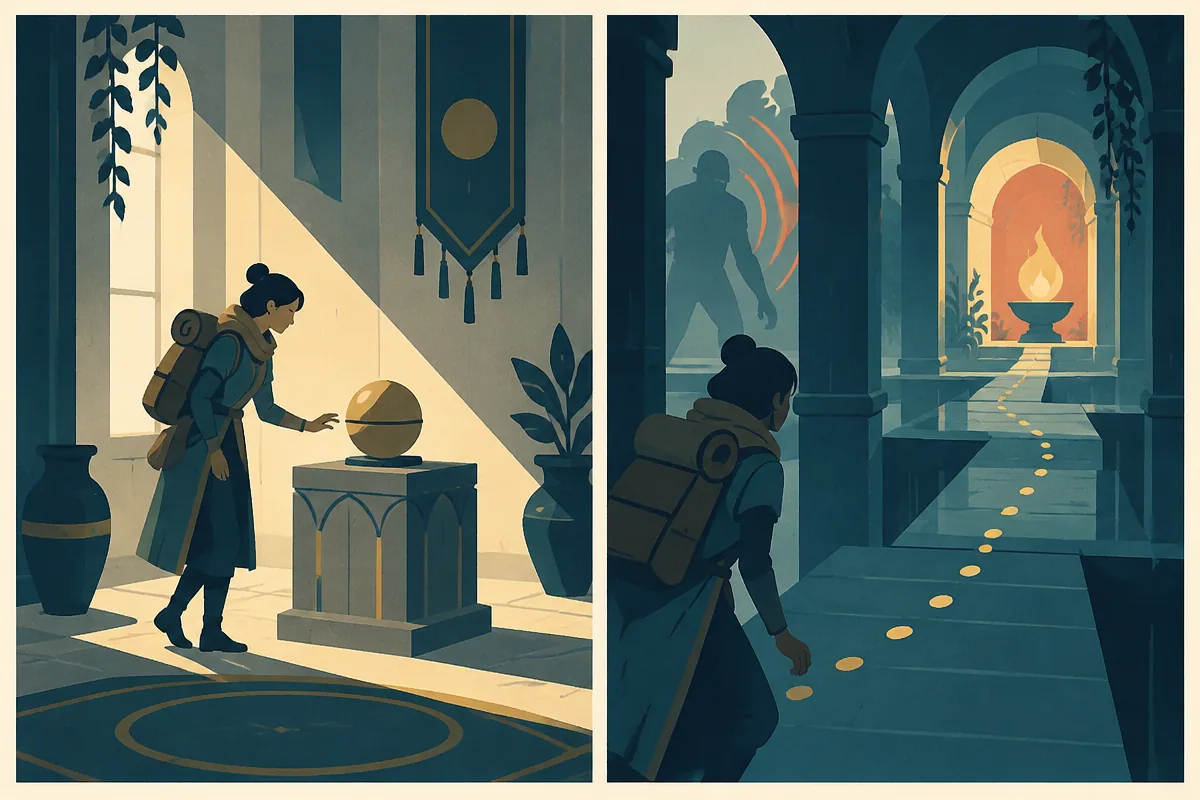
Hypothetical story-and-pursuit comparison; not an escape solution.
Imagine a room in which you understand the next required interaction but do not know where the pursuer is. The immediate uncertainty concerns the threat and route. In another story, the room may be quiet while you decide what a clue means. The uncertainty concerns the next decision instead.
A guided linear scene adds another structure by supplying the next action through a tutorial or prompt. These hypothetical contrasts explain why “horror adventure” is a useful umbrella but not a complete play description. Choose the kind of uncertainty you want to manage rather than assume every dark setting offers the same task.
Horror adventure games: choose the interaction, then judge the mood
Start with The Man from the Window for choices and clues, the mansion for first-person exploration, Siren Head for sound-led pursuit, or LAST NIGHT! for a directed story with ending variations. Their presentation and interaction work together, but the repeated actions differ.
At the beginning, confirm how to move, interact and read the current objective. After a scene, identify whether you missed information, chose a route poorly or misunderstood a prompt. Those are concrete reasons to adjust the next attempt without revealing a solution or inventing a shared horror formula.
Related tags
Frequently asked questions
Which pick uses dialogue selections and clues?
The Man from the Window documents mouse or touch interaction with those elements while following Mama Rabbit’s family-centered mystery.
What is the mansion game’s stated focus?
First-person exploration of gothic corridors and the manor’s secrets. Use its opening control screen for the actual interactions.
How does sound matter in Siren Head Nightmare Scary Survival?
Its guide says the creature detects movement noise, making quiet routes and hiding places part of the survival decisions.
How many endings does LAST NIGHT! describe?
Three endings within a short linear horror story. The description alone does not reveal the exact cause of each outcome.
Are all these games primarily shooters?
No. Their described structures include choices, exploration, pursuit and guided narrative. A first-person view does not by itself prove a combat system.
Does this guide reveal puzzle solutions?
No. It compares interaction formats and practical starting considerations without giving scene-specific answers or ending triggers.
Try a guided horror story with several endings
Play LAST NIGHT!More action guides
 Action
Side-Scrolling Shooters: Ground Fire or Aerial Routes
Compare side-scrolling shooters by ground movement, free flight, enemy approaches and mission structure in Alpha Guns, Crazy Plane Shooter and Super Pork.
 Action
Top-Down Shooter Games: Movement, Aim and Open Space
Compare top-down shooters by movement, aiming and the space you must protect in Geometry Gunner, The Room and In Space.
 Action
Flight Runner Games: Glide, Climb and Follow the Light
Compare flight runners by steering, upward taps, boosts and light management in Paperly, Horizon, Going Up and Shadobirds.
 Action
Melee Action Games: Compare Reach, Movement and Pace
Compare melee action games by movement, weapon interaction, aimed leaps and spinning attacks in four Zigzigo brawlers.