
Rhythm Game Timing: Listen, Watch and Choose the Beat
On this page
In a rhythm game, an action can be mechanically correct and still arrive at the wrong time. Pressing jump more often does not solve a timing mismatch. For rhythm game timing, the useful question is which sound or visual event should trigger the next deliberate action.
Cat Disco and Skibidi Toilet Jump Challenge focus on beat-synchronized jumps. PLAYMUSIC connects music with several arcade formats, so reading the required action matters as much as hearing its moment.
Rhythm game timing: find the cue that should trigger the action
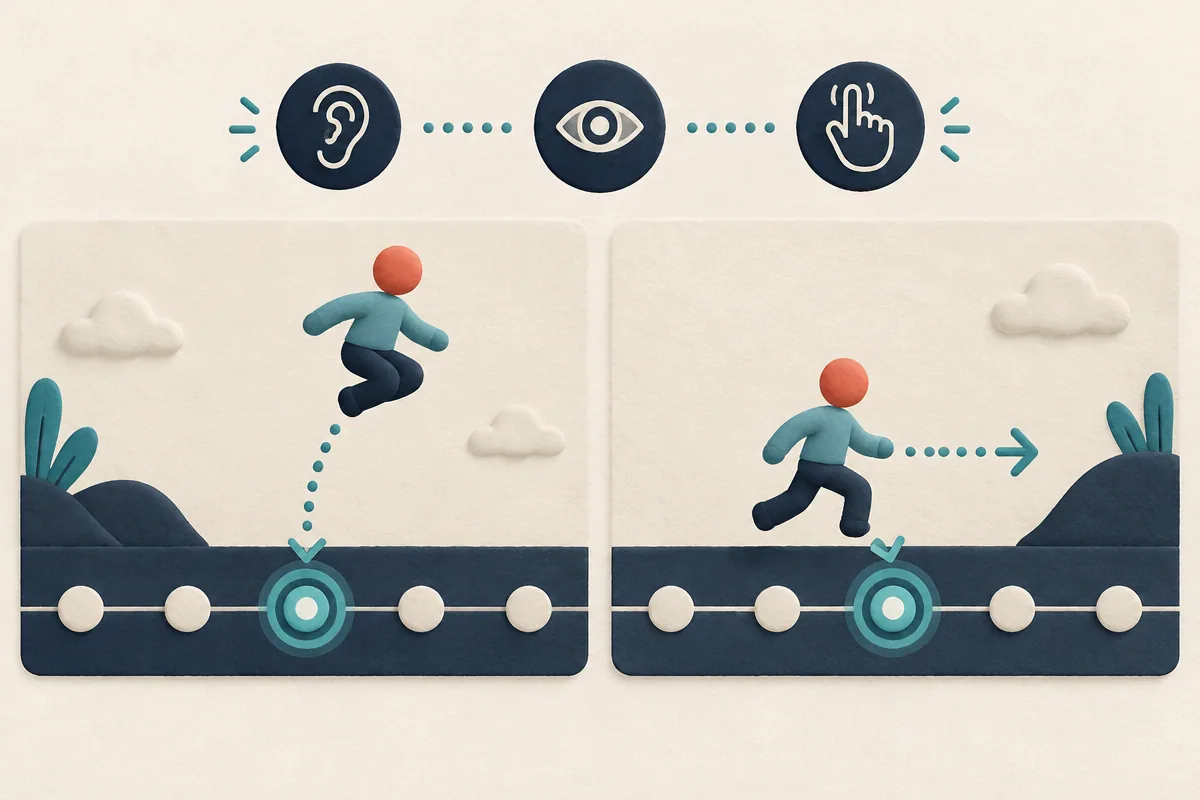
The same timing cue can call for a different action depending on the selected game format.
| Game | Decision to make | Watch for |
|---|---|---|
| Jump in Rhythm to the Hit! Cat Disco! | Tap to keep the cat moving with the tune | Precision matters more than extra taps |
| Skibidi Toilet Jump Challenge | Match a jump to the musical beat | An early jump can still miss the timing |
| PLAYMUSIC | Use each song-game’s movement rules | A musical cue can require a lane change, jump or another action |
Establish a pulse before adding extra reactions
Cat Disco asks you to keep a cat dancing through taps synchronized with the music. Meows are part of the rhythmic information, not simply decoration. Listen for a repeating pulse and compare your action with it before chasing a more complicated pattern.
A useful first attempt can focus on consistency: are your taps usually early, late or scattered? These are different diagnoses. Consistently early input suggests waiting slightly longer for the cue; scattered input suggests that you have not yet identified one stable cue.
The game includes cats with different abilities. Learn a familiar rhythm before changing characters, so a new ability and a new timing habit do not become two simultaneous unknowns.
Keep the jump count separate from the timing quality
Skibidi Toilet Jump Challenge also uses jumps matched to the beat. Its simple tap action can encourage nervous extra presses, but more input is not necessarily better synchronization.
Imagine a phrase with four evenly spaced opportunities. A burst of extra taps between the middle two does not restore a missed earlier moment. Try returning to the next clear beat rather than accelerating continuously after a mistake.
The example explains recovery of attention, not a fixed scoring window in the actual game. The source does not specify a universal millisecond tolerance, and no such value is needed to practise a consistent pulse.
PLAYMUSIC adds an action-selection problem
PLAYMUSIC supplies several song-game formats. Cyber Run uses lane and obstacle decisions, Neon Flyer can move in four directions, and Cloudscape includes single and double jumps. Music influences when hazards and opportunities arrive, but the same sound does not make every input a jump.
Before a track, identify the format's action vocabulary. In Neon Flyer, Down can move the character lower; in another mode it may correspond to a slide. Cloudscape allows a second Up input for a double jump. Read the selected mode rather than using a control solely because it worked on the previous song-game.
Choose one familiar format while learning the rhythm. Changing the song and the movement rule simultaneously makes it harder to diagnose whether a miss came from timing or choosing the wrong action.
A short practice method that produces useful feedback
First listen for the recurring cue during the opening phrase. Next identify the single action that the visible route requires. Then compare what happened with what you predicted: correct action late, correct action early, or wrong action at the expected moment.
Change the relevant variable on the next attempt. If the action was wrong, reread the mode controls. If the moment was wrong, use a clearer pulse instead of adding more buttons. If both were uncertain, simplify the task by returning to a familiar track or game format.
Visual feedback remains useful even when music supplies the timing. It tells you which obstacle or target is relevant. Treat listening and looking as complementary sources of information, rather than trying to ignore one entirely.
Choose repetition that keeps the comparison fair
Repeat a short section with the same character and movement format while changing one timing habit. That makes the result easier to interpret than switching every option after a miss.
Choose the jump-focused games if matching a simple action to a pulse appeals to you. Choose PLAYMUSIC if you enjoy combining musical anticipation with several types of arcade movement. No comparison requires assuming identical scoring rules across them.
Related tags
Frequently asked questions
Does tapping faster improve a rhythm-game score?
These games emphasize precise timing. Extra taps can fall between the relevant beats, so identify the next cue rather than increasing input frequency automatically.
Are Cat Disco’s meows part of the timing?
Its guide includes meows among the rhythmic cues. Listen to them alongside the tune when deciding when to tap.
Is every PLAYMUSIC mode controlled by jumping?
No. Its modes include lane movement, four-direction flight, drifting and shooting as well as jumping. Read the selected song-game controls first.
What does a consistent early miss suggest?
You may be acting before the relevant cue. Compare several attempts using the same format before changing to another character or control scheme.
Should I change songs after every missed section?
Repeating a familiar section can help isolate the cause. Change one timing habit while keeping the action rules consistent enough to compare the result.
Can these articles give a universal timing window?
The supplied guides do not establish a shared scoring tolerance. Use each game’s visible and audible feedback rather than assuming a fixed millisecond rule.
Try the mechanic that interests you
Play Jump in Rhythm to the Hit! Cat Disco!More arcade guides
 Arcade
Side-Scrolling Shooters: Ground Fire or Aerial Routes
Compare side-scrolling shooters by ground movement, free flight, enemy approaches and mission structure in Alpha Guns, Crazy Plane Shooter and Super Pork.
 Arcade
Vertical Climbing Games: Platforms, Dashes and Stacks
Compare vertical climbing games by alternating jumps, stacking blocks, timed jelly leaps and checkpoint routes. Choose the upward challenge you want.
 Arcade
Top-Down Shooter Games: Movement, Aim and Open Space
Compare top-down shooters by movement, aiming and the space you must protect in Geometry Gunner, The Room and In Space.
 Arcade
Flight Runner Games: Glide, Climb and Follow the Light
Compare flight runners by steering, upward taps, boosts and light management in Paperly, Horizon, Going Up and Shadobirds.