Football Path Puzzles: Plan Bounces and Goal Routes
On this page
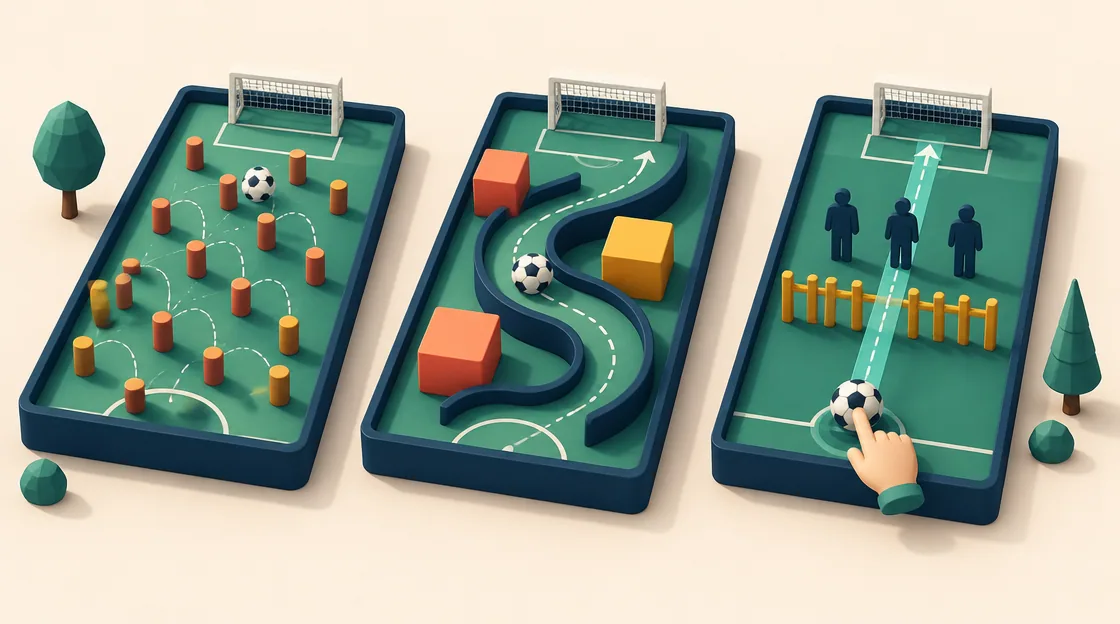
Football path puzzles make the ball the route-planning object. You may aim one ricochet, draw around defenders or slow the action to choose the next direction. The useful question is not which team is stronger, but which contact sends the ball into a playable next section.
Foot Chinko, Soccer Dash and Wonder Goal turn goals into different kinds of obstacle problem. Compare how much of the path you plan before launch and how much you can adjust while the ball is moving.
Compare launch planning with guided movement
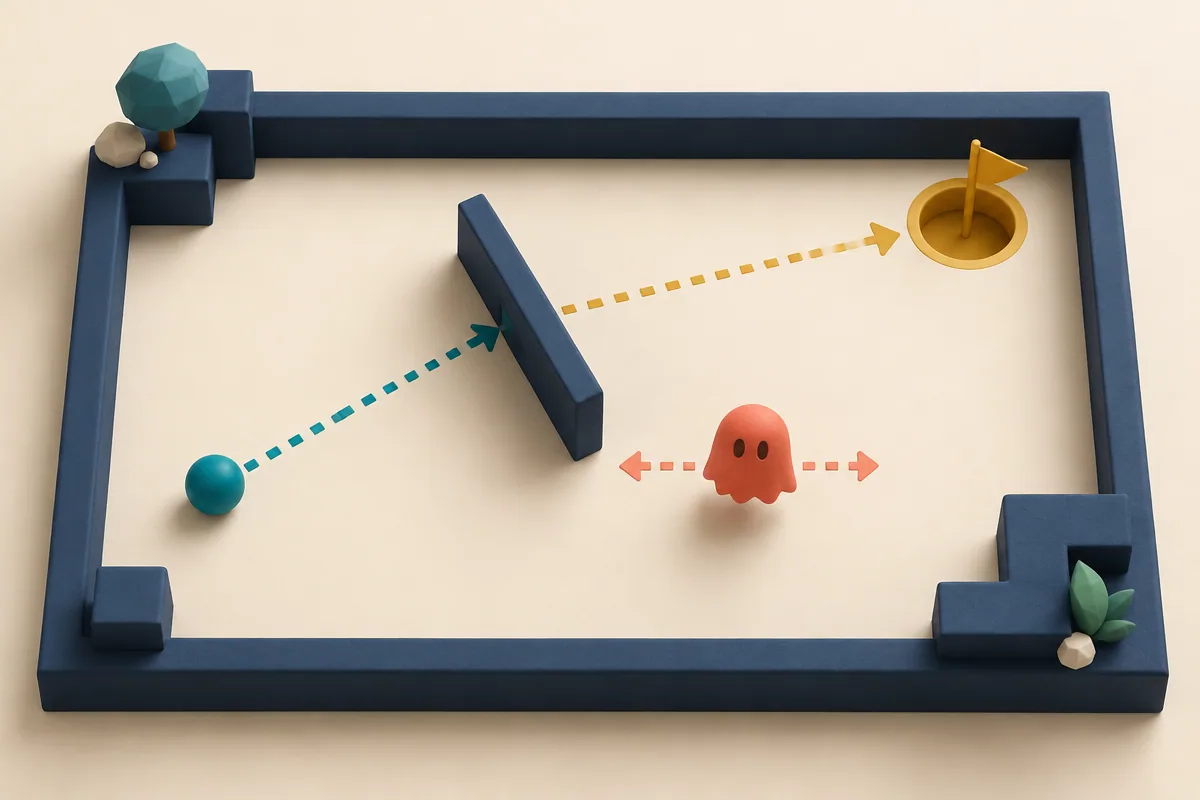
Illustration: Dotted lines carry the ball off one angled wall and into the gap a moving defender leaves.
| Game | Main route tool | What interrupts the path |
|---|---|---|
| Foot Chinko | Aimed launch and ricochets | Defenders and obstacle geometry |
| Soccer Dash | Direction changes and slow motion | A sequence of course obstacles |
| Wonder Goal | Drag direction and release | Moving or fixed defenders, fences and cones |
A straight line to the goal may be blocked while a planned rebound remains useful. Conversely, an available wall does not mean every bank shot helps. Inspect where the ball goes after contact.
Foot Chinko: plan the first useful bounce
Foot Chinko asks you to aim and click to launch the ball through a two-dimensional field. Obstacles and defenders create ricochets, and winning matches advances through a large level set and earns trophies. The arrangement changes, so a previous launch angle is only useful when the geometry still supports it.
Start with the first contact you can control. If it sends the ball toward another obstacle with no route to the net, the attractive opening angle may be a dead end. After a miss, find the earliest unexpected ricochet rather than changing aim based only on the final location. That lets one adjustment address the actual source of the failed path.
Soccer Dash: use slow motion to inspect the next gap
Soccer Dash lets you guide the ball rather than a footballer, using direction changes and a slow-time feature to pass obstacles. The guide does not establish a universal computer key for the slow-motion action, so learn its displayed control before the course becomes crowded.
Slow time is useful when it creates a clearer decision. Inspect the next gap, choose the intended outgoing direction and then continue. Repeatedly pausing without a route idea only postpones the same uncertainty. Because the ball itself is controlled, do not look for the player movement and kick buttons from a match-based football game.
Wonder Goal: distinguish a bounce from a defender hit
Wonder Goal: Fun Football Kick uses click-drag direction and release to launch. Some defenders patrol while others stay still, and fences or cones can help redirect the ball. Consecutive goals build coin multipliers; a miss or defender contact resets the combo. Ball skins are explicitly cosmetic.
Before release, inspect both the obstacle you intend to use and any moving defender near the resulting line. A helpful fence rebound can still fail if the defender crosses the exit. If preserving a combo is the current goal, compare a repeatable route with a narrower spectacular one. A cosmetic ball purchase does not change the physics and should not be treated as a solution to a path mistake.
Football path puzzles: review the route one contact at a time
Trace the intended path in short segments: launch, first contact, next gap and goal approach. After the attempt, locate where the actual path first differed. Adjust that segment rather than redesigning everything from the final missed goal.
Choose Foot Chinko for ricochet-led launches, Soccer Dash for guided direction and time control, or Wonder Goal for short defender puzzles with combo pressure. The comparison supplies a planning method, not an exact winning angle for a level you have not inspected.
Related tags
Frequently asked questions
Which game lets me guide the ball instead of a player?
Soccer Dash explicitly centres on steering the ball and using slow motion to plan around obstacles.
How do I launch in Foot Chinko?
Its computer instructions say aim and click. The planned ricochets through obstacles are the main route decision.
Does a Wonder Goal defender hit affect the combo?
The guide describes a miss or hit on a defender resetting the multiplier. Consecutive goals build it.
Do Wonder Goal ball skins change physics?
Its catalog explicitly describes them as cosmetic, changing appearance rather than ball physics.
Should I aim only at the goal?
Inspect the contacts between the ball and goal. A useful first bounce and the exit after it can matter more than the initial direct line.
What should I change after an unexpected rebound?
Find the earliest contact that diverged from the planned path, then adjust that segment while keeping the rest of the idea as consistent as possible.
Try the game that fits your next challenge
Play Foot ChinkoMore sports guides
 Sports
Landing Timing Games: Skates, Flips and Body Control
Compare flip landings, endless skating and ragdoll dunk routes. Learn to inspect the approach and first contact before a late correction.
 Sports
Browser Golf Games: Long Drives or Planned Hole Shots
Choose between Golf Orbit distance upgrades and Just Golf obstacle holes. Compare swing timing, payouts, guided aim and optional star routes.
 Sports
Flight Landing Games: Routes, Tasks and Smooth Arrivals
Compare browser flight games by landing focus, cockpit interaction and varied missions. Choose a task and learn the control layout before flying.
 Sports
Fishing Game Styles: Bait Choices or Arcade Reactions
Choose fishing games by bait selection, slow-boat positioning or timed arcade catches. Compare three Zigzigo options and their documented controls.